
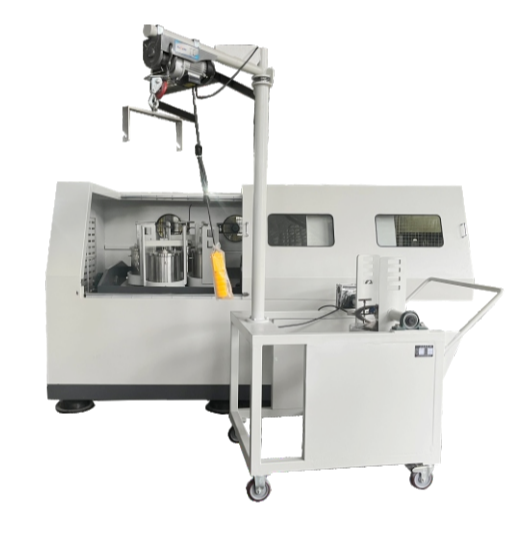
What is a Heavy-duty Full-directional Planetary Ball Mill? A High-Energy Milling Machine for Multi-Directional Ultra-Fine Grinding in Industrial Production

Introduction: What is a Heavy-duty Full-directional Planetary Ball Mill?
At its core, a Heavy-duty Full-directional Planetary Ball Mill is a specialized high-energy milling system used in powder metallurgy, advanced ceramics, battery materials, and chemical engineering to achieve ultra-fine and nano-scale particle sizes. Unlike conventional ball mills that only rotate in one plane, this equipment adds a full 360° directional rotation to the grinding jars, creating a complex three-dimensional motion that delivers exceptional crushing, impact, and shear forces. This design dramatically improves grinding efficiency and uniformity, making it an indispensable tool for laboratories and small-scale production facilities that require both high throughput and extreme fineness.
Core Function and Working Principle
The primary function of this mill is to transform coarse particles (typically ≤10 mm) into micron or sub-micron powders through intense mechanical energy. The mill operates on a planetary motion principle: a main sun wheel rotates while several grinding jars (planetary jars) mounted on it spin simultaneously around their own axes. In the heavy-duty full-directional version, an additional mechanism allows the entire grinding platform to tilt or rotate in a full 360° direction, enabling the grinding media balls to impact the material from every angle. This eliminates dead zones and ensures uniform stress distribution on every particle.
Inside each jar, the combination of centrifugal and Coriolis forces drives the grinding balls (e.g., zirconia, agate, or tungsten carbide) to collide, shear, and rub against the material. Key parameters such as rotation speed (typically 0–600 rpm for the sun wheel), jar speed ratio (commonly 1:–2 to 1:–2.5), and grinding time directly influence final particle size. Under optimal conditions, this mill can reduce particles down to <100 nm, making it suitable for nanomaterial synthesis and mechanical alloying.
Key Technologies and Components
Unlike standard planetary mills, the heavy-duty full-directional model incorporates several advanced features:
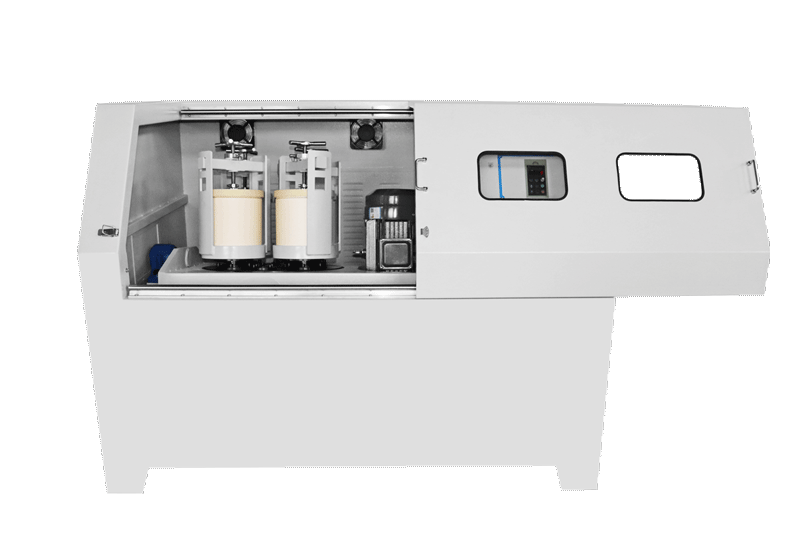
- Full-directional rotation: The grinding platform can rotate 360° in multiple axes, allowing material in bottom corners and side walls to be continuously lifted and impacted. This is especially beneficial for high-density materials like tungsten alloys or for long-duration grinding where sedimentation would normally occur.
- Heavy-duty construction: Reinforced gear transmission, high-power motors, and robust bearings allow continuous operation with large jar capacities (up to 20 L per jar) and high-load materials without overheating or vibration.
- Programmable control system: Touch-screen interfaces (as seen in the Micro-computerized Touch Screen Planetary Ball Mill) enable setting rotation direction, speed cycles, pause intervals, and total grinding time, ensuring reproducibility.
- Multi-jar design: Typically 2–4 jar stations, each capable of holding different jar materials (stainless steel, ZrO₂, agate, PTFE, etc.) to avoid cross-contamination and meet specific chemical compatibility requirements.
Key Performance Indicators and Selection Criteria
When choosing a heavy-duty full-directional planetary ball mill, users should evaluate the following metrics:
Processing Capacity and Throughput
These mills are available in capacities ranging from 2 L to 100 L total jar volume. For pilot-scale production, 20–40 L combinations are common. The actual throughput depends on feed material, target fineness, and cycle time. A typical batch of 5 kg ceramic powder can be milled to 1–5 µm in about 2–4 hours.
Fineness and Particle Size Distribution
The mill can achieve d50 < 0.1 µm under wet-grinding conditions. The use of smaller grinding media (0.1–3 mm) and high energy input yields narrower size distributions compared to conventional ball mills. Always verify the mill’s maximum centrifugal acceleration (often expressed in g-force) – higher values mean stronger impacts.
Automation and Reproducibility
Look for models with programmable logic controllers (PLC) or touch-screen systems that allow storing up to 10 grinding protocols. Features like auto-reverse, interval operation, and password protection enhance user convenience and research repeatability.
Maintenance and Durability
Heavy-duty mills should have sealed bearings, easy-access jar clamps (like the safety slider design used in planetary ball mills), and oil-lubrication systems. The full-directional mechanism adds complexity, so check the manufacturer’s support for replacement parts and service intervals.
Application Fields and Selection Advice
This type of mill excels in research and small-batch production where material variety and purity are critical. Typical applications include:
- Advanced ceramics – milling of alumina, zirconia, silicon nitride to submicron powders.
- Battery materials – uniform mixing of cathode/anode active materials with binders and conductive additives.
- Mechanical alloying – synthesis of oxide dispersion-strengthened alloys (e.g., W-Ni-Fe heavy alloys as described in scientific studies).
- Pharmaceuticals and pigments – deagglomeration and particle size reduction.
For users who require ultra-fine grinding of hard, brittle materials with high throughput and minimal contamination, the heavy-duty full-directional model is an excellent upgrade from standard laboratory planetary mills. If your work involves only soft materials or small sample volumes, a Laboratory Full-Directional Planetary Ball Mill may be more cost-effective. However, for continuous production-scale tasks, consider the Continuous Planetary Ball Mill series.
References
Related Products
Get In Touch
Our professional team will reply to you within one business day. Please feel free to contact us!