
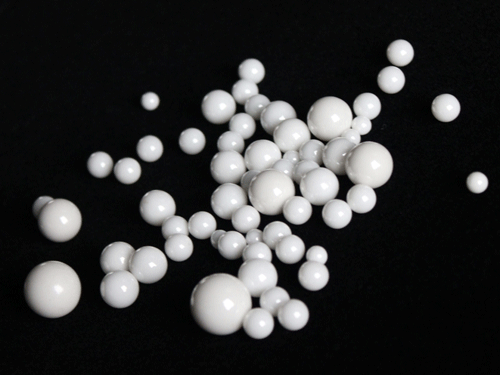
What is a Zirconia Grinding Ball? A High-Performance Ceramic Grinding Media for Ultra-Fine Milling and Contamination-Free Processing

What is a Zirconia Grinding Ball?
At its core, a zirconia grinding ball is a high-performance ceramic grinding media made from zirconium dioxide (ZrO₂). It is widely used in planetary ball mills, sand mills, stirred mills, and other grinding equipment to achieve ultra-fine particle size reduction while minimizing contamination. Unlike steel or agate media, zirconia balls offer exceptional hardness, fracture toughness, and chemical inertness, making them the preferred choice for high-purity and high-efficiency grinding applications.
Core Function and Working Principle
Zirconia grinding balls serve as the active grinding medium inside a mill. When the mill rotates or vibrates, the balls collide with each other and with the material, generating impact and shear forces that break down particles. The high density of zirconia (typically 5.9–6.1 g/cm³) provides greater kinetic energy per ball compared to lower-density media, leading to more efficient grinding. Additionally, the smooth surface and high sphericity of premium zirconia balls reduce wear on both the balls and the mill lining, extending service life.
The key to zirconia's performance lies in its phase transformation toughening mechanism. When stress is applied, the metastable tetragonal phase transforms to monoclinic, accompanied by a volume expansion that absorbs energy and prevents crack propagation. This gives zirconia balls a fracture toughness (KIC) of 8–11 MPa·m¹⸍², far higher than that of alumina or glass media. As a result, zirconia balls resist chipping and breakage even under high-energy milling conditions.
Main Types of Zirconia Grinding Balls
1. Yttria-Stabilized Zirconia (Y-TZP)
Y-TZP balls contain 3–5 mol% yttria (Y₂O₃) as a stabilizer, offering the best combination of hardness (≥1300 HV5), density, and toughness. They are white or ivory in color and are ideal for grinding battery materials, ceramics, pigments, and pharmaceuticals where contamination must be strictly avoided. Y-TZP is the most common type used in planetary ball mills and sand mills.
2. Ceria-Stabilized Zirconia (Ce-TZP)
Ce-TZP balls use ceria (CeO₂) as a stabilizer, providing even higher fracture toughness and thermal stability. They often appear black or dark brown due to the ceria content. Ce-TZP is preferred for high-impact applications such as grinding hard minerals, zirconia powders, and for use in high-energy stirred mills.
3. Zirconia Silicate (Zircon) Balls
These are composite balls containing ZrO₂ and SiO₂, with a lower zirconia content (typically 50–65%). They offer good wear resistance at a lower cost, making them suitable for large-scale industrial grinding in paints, coatings, and calcium carbonate processing. However, they have lower density and hardness compared to Y-TZP and Ce-TZP.
4. Colored Zirconia Balls (Black, Green, etc.)
Some manufacturers add coloring oxides (e.g., cobalt, chromium) to produce black or green zirconia balls for specific applications, such as grinding magnetic materials where color identification is needed. The mechanical properties are similar to Y-TZP.
Key Performance Indicators and Selection Criteria
When selecting zirconia grinding balls, consider the following parameters:
- Hardness: Typically ≥1300 HV5 for Y-TZP. Higher hardness ensures slower wear and longer life.
- Density: 5.9–6.1 g/cm³ for Y-TZP. Higher density gives more impact energy and faster grinding.
- Fracture Toughness (KIC): 8–11 MPa·m¹⸍². High toughness prevents breakage under high-energy milling.
- Wear Resistance: Measured by wear loss in g/kg·h. Premium Y-TZP balls have wear loss <0.1 g/kg·h in sand mills.
- Sphericity & Size Tolerance: High sphericity (>95%) and narrow size distribution ensure uniform grinding and prevent jamming.
- Purity: For contamination-sensitive applications, choose high-purity (>99.9% ZrO₂) balls with minimal leaching of trace elements.
- Size Range: Available from 0.1 mm to 50 mm. For planetary ball mills, typical sizes are 3–20 mm; for sand mills, 0.3–2 mm beads are common.
It is also important to match the ball size to the initial feed particle size and target fineness. As a rule, the ball diameter should be 10–20 times the feed particle size for efficient grinding.
Application Areas and Selection Advice
Zirconia grinding balls are used across a wide range of industries:
- Electronic Ceramics & Battery Materials: Grinding lithium cobalt oxide, lithium iron phosphate, and solid electrolytes require ultra-high purity to avoid metal contamination. Y-TZP balls are the standard choice.
- Pigments & Inks: For dispersing TiO₂, carbon black, and organic pigments, zirconia beads provide excellent color strength and dispersion stability.
- Pharmaceuticals & Cosmetics: Grinding active pharmaceutical ingredients and pigments for lipsticks/creams demands non-reactive media. Zirconia balls are chemically inert.
- Minerals & Ceramics: For wet grinding of kaolin, alumina, zircon, and feldspar, zirconia silicate balls offer a cost-effective balance of performance and price.
- Nanomaterials: Producing nano-sized particles (e.g., barium titanate, quantum dots) often requires high-energy mills with 0.1–0.5 mm Y-TZP beads.
For general laboratory R&D, Y-TZP balls in sizes 5–15 mm are recommended for most planetary ball mill applications. For industrial production, consult with the manufacturer on the optimal media type and size based on mill type, material hardness, and throughput requirements.
References
For more details, visit the product page on Zirconia grinding ball and related grinding media such as 304 stainless steel grinding ball, agate ball, and corundum grinding ball.
Related Products
Get In Touch
Our professional team will reply to you within one business day. Please feel free to contact us!