

What Is a Zirconia Grinding Ball? A Durable Ceramic Media for Ultrafine Milling
What Is a Zirconia Grinding Ball?
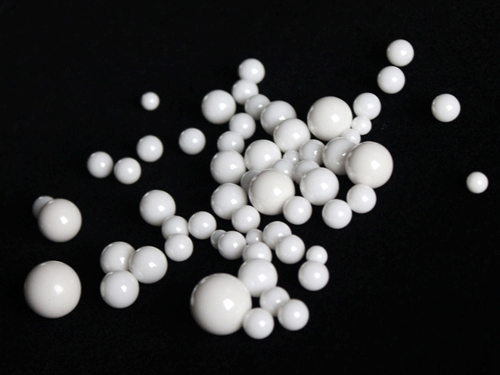
From a practical standpoint, a zirconia grinding ball is a small ceramic grinding medium used inside a ball mill, planetary mill, stirred mill, or similar size-reduction equipment. Its job is to transfer mechanical energy from the mill into the material being processed, breaking down agglomerates and reducing coarse particles into finer particles. In powder processing, the ball is not the machine itself; it is a consumable tool that works together with the mill jar, the feed material, and the chosen process liquid. The TENCAN product page for the zirconia grinding ball presents this ceramic media as an option for milling and dispersion work where a zirconia-based material is preferred.
Zirconia, in this context, refers to a zirconium dioxide-based ceramic. The useful idea for a buyer is simple: the ball is made from a ceramic material chosen for its combination of density, hardness, wear resistance, and chemical stability. Those properties matter because the media must survive repeated collisions, resist abrasion, and avoid introducing unwanted contamination into the batch. Exact values such as density, hardness, and wear rate are grade-dependent and should be checked against the supplier's current product data rather than assumed from the name alone. A buyer should also confirm the available sizes, packaging, and recommended use conditions before planning a full production batch.
How Zirconia Grinding Balls Work in a Mill
In a typical milling cycle, the operator loads the mill jar or chamber with grinding media, the material to be milled, and often a liquid to form a slurry. When the mill runs, the jar rotates, vibrates, or drives an agitator, causing the media to move. The balls collide with one another, roll against the jar wall, and pass through the material. Each collision applies compressive and impact forces, while the sliding and rolling motion adds shear and attrition. The result is a gradual reduction in particle size and, in many formulations, better dispersion of solids in the liquid.
The transformation is not instantaneous. Coarse particles are first broken at weak points; then agglomerates are separated; then the particle-size distribution becomes narrower as milling continues. At the same time, the total surface area of the powder increases, which can change viscosity, flow behavior, and reactivity. This is why milling is both a size-reduction step and a formulation step. Over-milling can be just as undesirable as under-milling, because it may alter particle shape, generate excessive heat, or change the rheology of the slurry.
Impact, Attrition, and Shear
Impact is the dominant mechanism when relatively large media fall or collide with force. Attrition is the slower wear and polishing action that occurs as media rub against each other and the jar. Shear becomes especially important in stirred media mills and in slurries where agglomerates must be separated rather than simply fractured. A zirconia ball can contribute to all three mechanisms, but the balance depends on mill type, ball size, media loading, rotational speed, and slurry properties. For example, a heavy media charge in a fast mill may improve breakage but also raise the temperature and increase wear on the jar and media.
Process Parameters That Change the Result
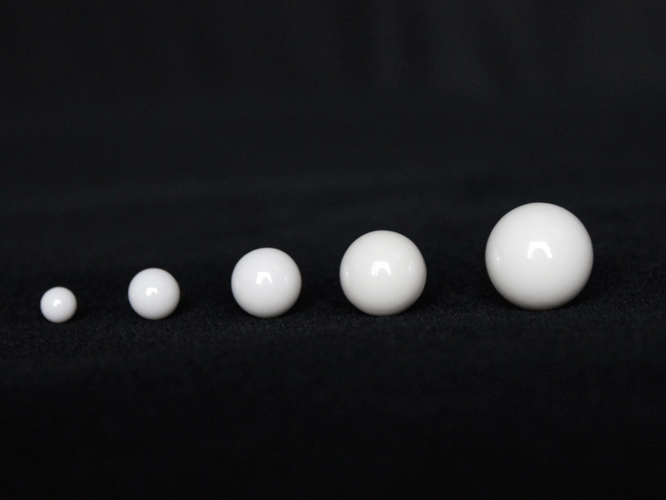
Ball size is one of the most important choices. Smaller media create more contact points and are often useful for fine grinding, but they carry less impact energy and may not break large feed particles efficiently. Larger media deliver stronger impacts but can leave a coarser product and may increase wear. Media fill ratio, mill speed, milling time, solids loading, and slurry viscosity all interact. A fast mill with a high media load can shorten processing time, but it can also raise temperature and wear. A viscous slurry may cushion impacts and slow size reduction, while a very thin slurry may reduce suspension stability. Because these variables interact, the best starting point is usually a small trial matrix rather than a single guessed setting.
It is also important to separate machine variables from media variables. The mill sets the available energy and motion; the media determines how that energy is delivered to the particles. If a process is limited by contamination, media wear, or poor dispersion, changing only the mill speed may not solve the problem. A media review, including grade, size, and condition, is often just as important as a machine adjustment.
Core Components and Key Technology
Because the referenced product is a single zirconia grinding ball rather than a family of machines, it is more useful to look at the ball as an engineered component. Its performance comes from the ceramic composition, the forming and sintering process, the ball geometry, and the final inspection. These are the areas a buyer should understand when comparing suppliers and planning a process.
The Zirconia Ceramic Body
The ceramic body is based on zirconium dioxide. In commercial ceramics, zirconia is often stabilized to keep the desired crystal phase stable through manufacturing and use. The stabilization system and the exact formulation influence toughness, hardness, and resistance to wear. This article does not assume a specific grade for the referenced product; instead, it highlights what to ask about. A supplier should be able to state the material family, the stabilization approach where relevant, and the typical property range for the grade being offered. Buyers should also ask whether the grade is intended for general milling, high-purity work, or a particular chemical environment.
Forming, Sintering, and Surface Condition
Grinding balls are formed into a rounded shape and then fired at high temperature so that the ceramic particles bond into a dense body. Density matters because a denser ball carries more mass for its size, which can improve energy transfer in impact milling. Surface condition matters too: smooth, well-finished media are easier to clean and may reduce unnecessary abrasion, while rough or damaged media can trap material and create contamination risks. The user should inspect a sample for chips, cracks, color variation, and obvious dimensional scatter before accepting a lot. A simple visual check is not a substitute for analytical testing, but it is a useful first screen.
Size Sorting and Consistency
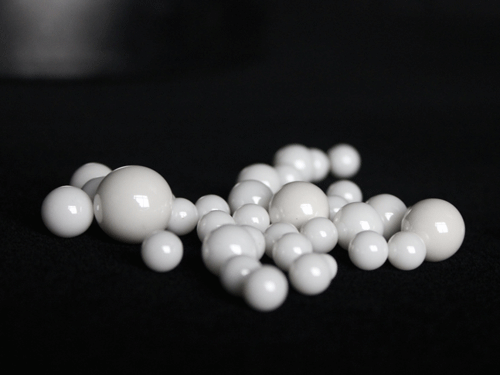
Ball size distribution affects milling reproducibility. A narrow size range makes it easier to repeat a process; a wide range may improve packing in some mills but makes the energy spectrum less predictable. Consistent ball-to-ball quality also matters in planetary mills and small jar mills, where a few atypical balls can have a noticeable effect on a small batch. For production, lot traceability and a stable supply of the same grade are often more valuable than a single impressive specification number. If a process is validated with one size and grade, changing suppliers without re-testing can introduce unexpected variation.
Key Performance Indicators and Selection Criteria
When selecting a zirconia grinding ball, buyers should look beyond the product name. The right media is the one that matches the mill, the feed material, the target fineness, and the contamination limits of the application. The following indicators are a practical starting point.
- Media size: Match the ball diameter to the feed particle size, the target fineness, and the mill geometry. Smaller balls are generally better for fine grinding and dispersion; larger balls are better for breaking coarser material.
- Density and energy transfer: Higher-density media can deliver more impact energy per collision, but the benefit depends on mill speed and slurry viscosity. Dense media are not automatically better if the mill cannot keep them moving effectively.
- Wear resistance and contamination: The wear rate determines how much media material enters the batch over time. For electronics, optical materials, advanced ceramics, and other contamination-sensitive products, ask for wear data and consider a trial with analytical checks.
- Chemical compatibility: The media must be compatible with the solvent, pH, additives, and solids in the slurry. Zirconia is generally chosen for chemical stability, but no material is universal; check the specific grade against the process chemistry.
- Mill compatibility: Confirm that the ball size and loading fit the jar or chamber, the screen or discharge arrangement, and the manufacturer operating limits. A media that is too large for a small jar can damage the jar or produce poor milling.
- Reproducibility and supply: Consistent size, surface quality, and lot-to-lot properties reduce process drift. For production, ask about packaging, traceability, and repeat order availability.
Cost should be evaluated as cost per useful batch, not simply price per kilogram. A lower-cost media that wears quickly, contaminates the product, or lengthens milling time may be more expensive in practice. Conversely, a high-performance media is only justified if the process actually needs its density, wear resistance, or cleanliness. A short trial that measures particle size, viscosity, temperature rise, and wear can reveal more than a specification sheet alone.
Selection also depends on scale. In a laboratory planetary mill, small batches and narrow size ranges dominate the decision. In a pilot or production stirred mill, media life, loading and unloading time, and repeatability become more important. The same zirconia ball grade may not be the best choice for every scale, even when the chemistry is similar.
How to Evaluate a Media Trial
A useful media trial begins with a clear baseline. Record the current media grade, size, loading, mill speed, milling time, solids loading, and starting particle size. Then run the zirconia candidate under the same conditions and compare the results. Do not change several variables at once, because a good result will be difficult to explain and a poor result will be difficult to diagnose. For a laboratory test, keep the batch size large enough to reduce sampling error; for a pilot test, include a realistic loading and unloading procedure.
Measure the outcomes that matter to the product, not just the milling time. Particle-size distribution, median size, span, viscosity, temperature rise, and visual dispersion are common checks. If contamination is a concern, add an appropriate analytical method. Also inspect the media after the trial for chips, cracks, discoloration, and weight change. A trial that produces a fine powder but damages the jar or leaves visible wear debris is not a successful result.
- Use a control batch with the current media.
- Keep mill speed, fill ratio, and slurry formulation fixed where possible.
- Compare at least two media sizes if the target fineness is uncertain.
- Track wear and contamination, not only particle size.
- Repeat the best result before scaling up.
The best trial is one that can be repeated by another operator. Write the procedure in plain language, label the samples, and keep the raw data. That record becomes the basis for scale-up and for future supplier comparisons.
Applications and Selection Advice
Zirconia grinding balls are used in laboratory and production processes where fine particles, good dispersion, and controlled contamination are important. Typical settings include advanced ceramics, mineral and inorganic powders, pigments and coatings, battery and electronic materials, and other fine-chemical or research applications. In many of these processes, the media is selected not only for size reduction but also for its ability to maintain product purity and reduce batch-to-batch variation.
For a first selection, define the job in plain terms: what is the feed material, what is the target particle size or dispersion state, what mill will be used, and what contamination level is acceptable? Laboratory users should prioritize small, well-sorted media and a manageable trial quantity. Pilot and production users should ask for consistent lots, wear information, and a supply plan. If the application is sensitive to metal pickup or abrasive wear, a ceramic media trial with analytical verification is more meaningful than a visual check alone. The product page for the TENCAN zirconia grinding ball is the appropriate place to confirm the currently offered grade and options before specifying a full batch.
Frequently Asked Questions
Is a zirconia grinding ball a machine or a consumable?
It is a consumable grinding medium. The mill provides motion and energy; the ball transfers that energy to the material. Buyers should therefore evaluate the ball together with the mill, jar, and process conditions, not as a standalone device.
Can the same ball be used in planetary and stirred mills?
Sometimes, but not automatically. The allowed media size, loading, and wear conditions differ between mill types. Check the mill manufacturer limits and run a small trial before transferring a recipe from one mill to another.
How can I tell whether the media is wearing too quickly?
Track media weight or volume over time, monitor product contamination, and compare particle-size results under the same milling conditions. A sudden change in color, surface condition, or batch viscosity can also indicate a media problem.
What information should I request before ordering?
Ask for the material grade, available sizes, typical density and wear information, recommended cleaning and handling, packaging, and lot traceability. For critical applications, request a sample and test it in the actual process.
Practical Handling and Care
Keep zirconia media clean and separated by size. Store it in a dry, labeled container and avoid mixing lots unless the process has been qualified for that change. Before use, inspect for cracks, chips, and foreign matter. Clean according to the supplier guidance and the requirements of the product being milled; a cleaning method that is acceptable for a pigment may not be acceptable for a battery or electronic material. When loading a mill, measure the media charge rather than estimating it, and record the size, lot, and loading for traceability.
Finally, treat the media as part of the process recipe. If a batch performs well, record the media grade, size, loading, mill speed, and milling time. That record is the basis for scale-up and troubleshooting. If a batch underperforms, change one variable at a time. In powder processing, small differences in media condition can produce large differences in the final particle-size distribution, so routine inspection and consistent handling are worthwhile habits.
Related Products
Get In Touch
Our professional team will reply to you within one business day. Please feel free to contact us!