

What is a Vacuum Kneading Machine? A Professional Mixing and Kneading Equipment for High-Viscosity Material Processing
What is a Vacuum Kneading Machine? A Professional Mixing and Kneading Equipment for High-Viscosity Material Processing
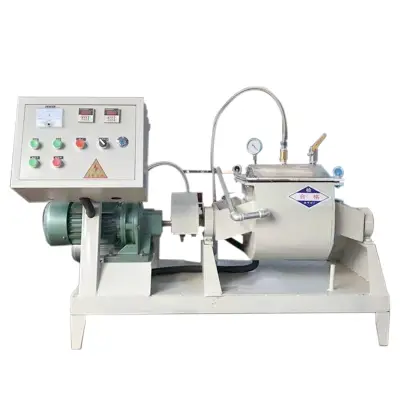
At its core, a vacuum kneading machine is a specialized industrial mixer designed to thoroughly blend, knead, and deaerate high-viscosity materials. Industries such as electronics, chemical engineering, new energy, and pharmaceuticals use it to process pastes, gels, sealants, and adhesives with viscosities ranging from 10,000 to 1,500,000 centipoise (cps) or even higher. By combining powerful mechanical kneading with a controlled vacuum environment, this equipment eliminates air bubbles and ensures uniform dispersion, making it indispensable for high-quality product manufacturing.
Core Function and Working Principle
The primary function of a vacuum kneading machine is to transform inhomogeneous, sticky raw materials into a consistent, air-free mixture. The core working principle relies on two synchronized Σ-shaped (sigma) blades that rotate in opposite directions inside a sealed trough. These blades create intense shear, compression, and folding actions, effectively breaking down agglomerates and dispersing solid particles into the liquid matrix. The material is continuously turned over and kneaded, ensuring no dead zones remain.
Simultaneously, a high-vacuum system evacuates the chamber to a pressure as low as -0.098 MPa, removing air and volatile components from the material. This vacuum deaeration process is critical for preventing bubbles, oxidation, and defects in the final product. The combination of mechanical kneading and vacuum extraction allows the machine to achieve superior homogeneity and density in a single operation, greatly reducing processing time compared to traditional methods.
Key process parameters include blade speed, mixing duration, and vacuum level. These parameters can be precisely adjusted to suit different material characteristics, such as viscosity, thixotropy, and temperature sensitivity. For example, higher speed increases shear force for breaking down tough agglomerates, while longer mixing time ensures complete dispersion of fillers or additives.
Core Components and Key Technologies
While vacuum kneading machines share a common operating principle, they incorporate several critical components that determine performance and reliability:
Kneading Blades
The blades are typically made of stainless steel or specially coated materials to resist wear and corrosion. The Σ-shaped design is optimized for high-viscosity kneading, with a precise gap between the blades and the trough wall to avoid contact while maximizing shear. Some models feature interchangeable blades for different material types.
Vacuum System
A robust vacuum pump and sealed chamber are essential. The vacuum level can reach -0.098 MPa or higher, effectively removing micro-bubbles and dissolved gases. The system is designed to maintain vacuum during the entire kneading cycle, preventing air ingress and ensuring consistent product quality.
Heating/Cooling Jacket
Many materials require temperature control during kneading to maintain optimal viscosity or to promote chemical reactions. A double-walled trough allows circulation of heating or cooling media, enabling precise temperature regulation from ambient up to 200°C or more.
Discharge Mechanism
For easy material removal, the machine can be equipped with a tilting trough or a bottom discharge valve. Tilting is common for batch operations, while bottom discharge suits continuous or semi-continuous processes.
Key Performance Indicators and Selection Points
When selecting a vacuum kneading machine, consider the following critical parameters:
- Working Capacity: Available from laboratory-scale (1-5 liters) to production-scale (100-2000 liters) to match batch size requirements.
- Viscosity Range: Ensure the machine can handle your material's viscosity, typically from 10,000 to 5,000,000 cps or more.
- Vacuum Level: Higher vacuum (e.g., -0.098 MPa) is essential for materials requiring complete bubble removal.
- Temperature Control: Check if heating/cooling capability is needed for your process.
- Material of Construction: Stainless steel is standard for cleanliness and corrosion resistance; special coatings may be required for abrasive or reactive materials.
- Automation: Many machines offer PLC control with touchscreen interfaces, allowing programmable recipes and data logging for consistent production.
- Ease of Cleaning: Look for designs with smooth surfaces, easy blade removal, and CIP (Clean-in-Place) options for quick changeover between batches.
Application Fields and Selection Advice
Vacuum kneading machines are widely used in:
- Electronics & Semiconductors: For mixing silicone encapsulants, underfill adhesives, and thermal pastes.
- Chemical Industry: For producing sealants, adhesives, and coatings.
- New Energy: For battery electrode slurries and electrolyte pastes.
- Pharmaceuticals & Cosmetics: For ointments, gels, and creams.
- Ceramics & Powder Metallurgy: For binder mixing and granulation.
For laboratory R&D, a compact model with 1-5 liters capacity and full parameter control is ideal. For pilot production, choose a 10-50 liter machine with a tilting discharge. For mass production, a 100-2000 liter unit with bottom discharge and automation is recommended. Always consult with the manufacturer to test your specific material before purchase.
References
For more detailed information, please visit the product page: Vacuum Kneading Machine.
Related Products
Get In Touch
Our professional team will reply to you within one business day. Please feel free to contact us!