

What is a Vacuum Freeze-Drying Oven? A Lab Device for Gentle Low-Temp Drying
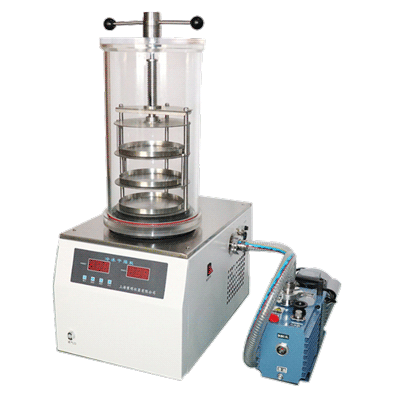
From a core perspective, a vacuum freeze-drying oven is a laboratory dehydration device that removes water from a frozen material under reduced pressure, leaving a dry structure that keeps much of its original shape. It is used when ordinary heat drying would be too rough on a sample. Instead of evaporating water from a warm slurry, the process freezes the water first and then causes it to pass directly from ice to vapor. That change is called sublimation. The equipment creates the low-pressure environment and the controlled warming needed for that transition, while a cold trap captures the vapor so it does not return to the product. For the specific listing referenced here, see the Vacuum freeze-drying oven product page.
What the Equipment Does in Practical Terms
The word oven can be misleading. In a freeze-dryer, the chamber is not meant to cook or roast the product. It is a controlled vessel in which a previously frozen sample can be dried at low temperature. The oven part of the name refers to the chamber and its temperature-controlled surfaces, not to a hot-air process. The practical goal is to remove water while limiting the damage that can occur when liquid water moves through a delicate solid structure.
At a functional level, the equipment performs three connected tasks. It maintains a cold environment or accepts material that has already been frozen; it lowers the pressure in the chamber so that ice can change to vapor without first becoming liquid; and it supplies a small, controlled amount of heat to the frozen material so that sublimation can continue. A separate cold surface, usually called a condenser or cold trap, captures the water vapor. Without that trap, the vapor would raise the pressure and could migrate back toward the sample.
The result is a dry product that is often porous and lightweight. Because the material is dried while frozen, the solid skeleton left behind can retain the shape of the original frozen mass. This is why freeze-drying is associated with gentle dehydration rather than with simple evaporation. The exact appearance and behavior of the finished product depend on the material, the freezing step, the amount of heat supplied, the pressure maintained, and the point at which the cycle is stopped.
How the Freeze-Drying Cycle Works
A freeze-drying cycle is normally described in three stages: freezing, primary drying, and secondary drying. The stages are connected. A poor freezing step can create an ice structure that is difficult to dry. Too much heat during primary drying can cause the frozen matrix to soften or collapse. Ending the cycle too early can leave bound water in the product. For that reason, freeze-drying is best understood as a recipe that must match the material, not as a single switch that can be applied to every sample.
Freezing: setting the structure of the sample
Freezing is the first step because the process depends on water being present as ice. The way the sample freezes affects the size and distribution of ice crystals. Those crystals leave pores as they sublimate. A freezing step that is too slow, too fast, or uneven can produce a different pore structure and a different drying behavior. In a laboratory setting, the sample may be frozen in a freezer, in a cold bath, or on a temperature-controlled shelf before the chamber is evacuated. The important point is that the material should be solid enough to hold its structure when the pressure is reduced.
The material itself also matters. Some samples freeze into a rigid crystalline solid. Others form a glass-like or partially amorphous structure. Some formulations contain dissolved solids that can concentrate as ice forms. These differences influence how much heat the sample can accept before it softens or loses its shape. This is why selection advice for freeze-drying often begins with sample characterization rather than with chamber size.
Primary drying: ice changes directly to vapor
During primary drying, the vacuum system lowers the pressure in the chamber, and the shelf or sample holder supplies heat to the frozen material. At the right combination of pressure and temperature, ice sublimes. The vapor moves away from the sample and is captured on the cold condenser. The sample does not become wet during this stage; the water leaves as vapor from the ice front. As the ice front moves inward, the dry layer becomes thicker, and vapor must travel through that layer to escape.
Primary drying is usually the longest part of the cycle. It is also the stage where poor control is most visible. If heat is applied too aggressively, the frozen material may melt back, puff, shrink, or collapse. If heat is too low, the cycle may take far longer than necessary. The best setting is not simply the coldest or the fastest; it is the setting that keeps the product below its critical temperature while still allowing the ice front to advance. Because the critical temperature is material-specific, the product page should be used to confirm the available control range, while the actual cycle should be developed for the sample.
Secondary drying: removing water that remains bound
After the visible ice has sublimated, some water can remain bound to the solid matrix. Secondary drying raises the sample temperature, within the limits of the material, to encourage that residual water to desorb. This step is important when the target is a very dry product or a stable long-term form. It is not simply an extension of primary drying, because the physical situation has changed. The sample is no longer an ice-filled solid; it is a porous dry solid that may be sensitive to heat, moisture, or oxidation.
The end point of secondary drying should be based on the product requirement and, where possible, on measurement rather than on a fixed time alone. A cycle that stops too early can leave a product that is not stable or that cakes during storage. A cycle that continues too long can waste energy or expose a sensitive material to unnecessary heat. The right balance depends on the sample, the container, and the intended use.
Why the parameters are linked
Chamber pressure, shelf temperature, condenser temperature, sample load, container type, and cycle time all interact. A change in one can shift the behavior of the others. For example, a larger sample load can slow the escape of vapor and require a longer primary drying step. A container with a narrow opening can restrict vapor flow. A colder condenser can capture vapor more effectively, but it also affects the pressure balance in the system. A higher shelf temperature can speed drying, but only if the product remains below its collapse or melt point.
This is why freeze-drying equipment is often judged by control and repeatability as much as by chamber volume. The operator needs to be able to set, hold, and record a cycle. The system needs to maintain vacuum reliably. The condenser needs enough capacity for the amount of water being removed. The shelves need to deliver heat evenly enough that one part of the batch does not dry while another part remains icy. These are general principles, but they are the right questions to bring to any specific product listing.
Core Components and Configuration Choices
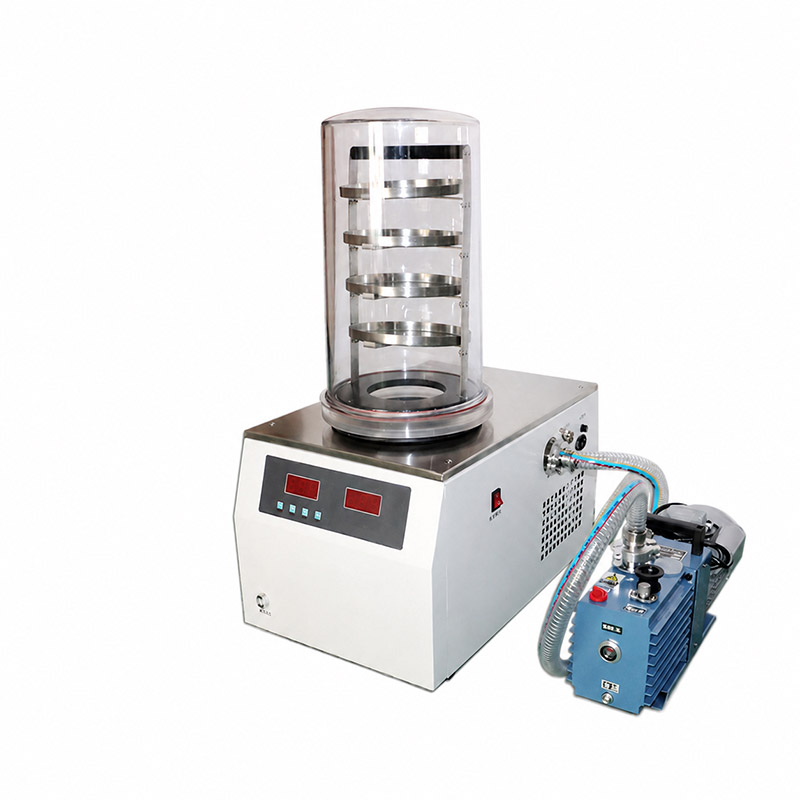
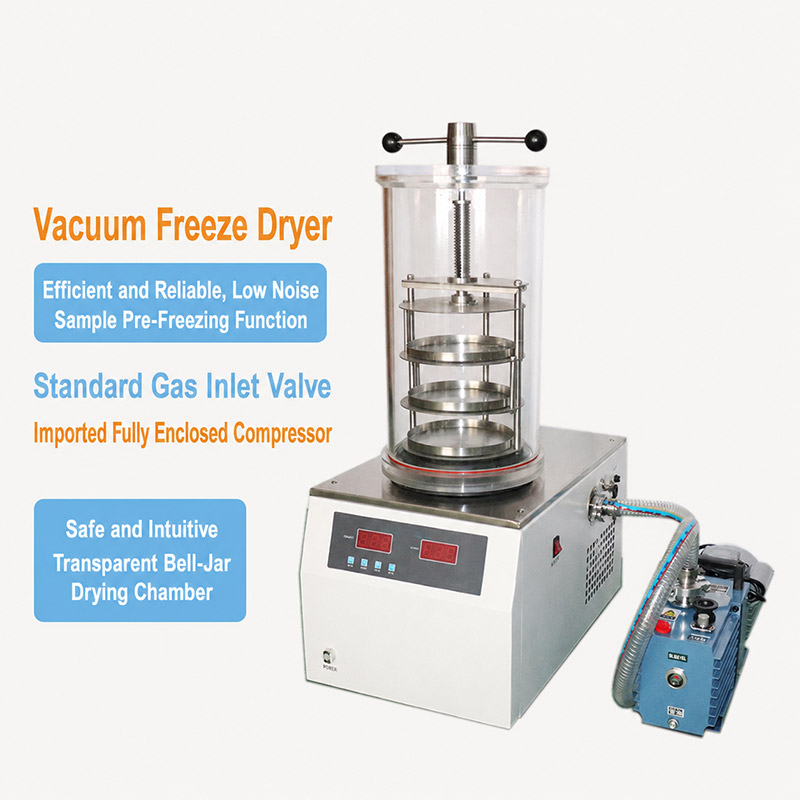
Although a freeze-dryer can look like a simple cabinet, it is a system of interacting parts. The vacuum chamber is the main vessel. It must hold the sample, withstand external pressure, and provide a sealed environment. The shelves or sample holders provide thermal contact. In some designs, the shelves are temperature-controlled and can be used for freezing, primary drying, and secondary drying. In other designs, samples are pre-frozen and placed on a manifold or in a smaller holder. The exact arrangement offered for the referenced product should be checked on the product page, because configuration has a large effect on how the unit is used.
The condenser is the cold trap that captures water vapor. Its job is to remove vapor from the chamber before it reaches the vacuum pump. A condenser that is too small or too warm can become overloaded, especially when a large amount of water is being removed. The vacuum pump creates and maintains the low-pressure environment. It must be matched to the chamber volume, the leak rate, and the vapor load. The control system ties the cycle together by managing temperature, pressure, and time, and by recording the run so that it can be repeated.
Seals, valves, windows, and ports are small parts with a large effect on performance. A vacuum system is only as good as its weakest seal. A door gasket that is worn, a valve that does not close fully, or a port that is not capped can prevent the chamber from reaching the intended pressure. For that reason, maintenance access and spare-part availability belong in the selection conversation. A freeze-dryer is not a passive box; it is a vacuum instrument that needs clean surfaces, intact seals, and a clear operating routine.
Key Performance Indicators and Selection Points
When comparing vacuum freeze-drying ovens, the first question should be what the user needs to dry, not how large the chamber looks. Capacity is more than internal volume. It includes usable shelf area, shelf spacing, the size and shape of the containers, and the amount of water that must be removed in one run. A chamber that is large but poorly arranged may hold less usable sample than a smaller, better-organized unit. The product page is the place to confirm the available dimensions and accessories, while the user should calculate the real load from sample volume, container size, and batch pattern.
Vacuum performance and leak integrity are equally important. The system must reach and hold the pressure needed for the material. That depends on the pump, the condenser, the seals, and the plumbing. A user does not need to be a vacuum engineer, but a buyer should ask how the system is tested, how pressure is displayed, and what maintenance is required to keep it stable. Temperature control is another central point. The shelves or sample holders should provide even conditions across the usable area, and the control system should make it clear whether the displayed temperature reflects the shelf, the chamber, or the product.
Cycle control and data records matter for repeatability. A good control system lets the operator create a cycle, monitor the key values, and review what happened. For laboratory work, the ability to save and export a run can be as useful as a very wide temperature range. For quality-focused work, traceability and user access control may matter. Automation should simplify the routine, not hide the process. The best interface is one that makes the stage of the cycle, the pressure, the temperature, and any alarm condition easy to read.
Maintenance and material compatibility should be checked before purchase. The interior surfaces should be easy to clean and suitable for the samples being handled. If solvents, acids, salts, or biological materials are used, the user should confirm compatibility with the chamber, seals, and condenser. Access to the condenser, drain, and door seal should be practical. Spare parts and service support should be available for the life of the equipment. These points may not appear in a short specification table, but they determine how often the oven can be used and how long it remains reliable.
Applications and Selection Advice
Vacuum freeze-drying is used where water must be removed while limiting thermal damage and preserving structure. In pharmaceutical and biological work, it is associated with the stabilization of formulations, samples, and materials that are sensitive to heat or to ordinary drying. In food science, it is used to study and produce lightweight, porous products with altered rehydration behavior. In materials research, it can help prepare dry powders, porous solids, and composite structures without the shrinkage that may occur in evaporative drying. In conservation and archival work, it can be considered for waterlogged or moisture-sensitive materials, but only with careful material-specific testing.
Selection advice should follow the use case. A teaching or general research laboratory may prioritize a compact chamber, clear controls, and simple maintenance. A project that handles many small vials may care more about shelf uniformity and repeatable recipes than about maximum chamber volume. A user working with larger or denser samples should look closely at condenser capacity, shelf loading, and cycle time. A user working with sensitive biological materials should ask about temperature control, data records, and cleaning procedures. In every case, the sample should be tested in a small trial before a full batch is committed.
The product page for the Vacuum freeze-drying oven should be used to confirm the actual configuration, dimensions, control features, and accessories. A general article can explain the process, but only the product documentation can say what a specific unit includes. Buyers should compare the listed information with their sample requirements and ask for missing details rather than assuming a value from a similar machine.
Limits, Safety, and Operating Discipline
Freeze-drying is gentle, but it is not risk-free. The chamber operates under vacuum, so the door, seals, and ports must be in good condition. Cold surfaces and condensers can cause cold burns or frost buildup. Solvents and volatile materials require special attention because they can affect the vacuum system, the condenser, and the safety of the workspace. Samples that are infectious, toxic, or chemically reactive need procedures that go beyond the basic drying cycle. The equipment should be installed and operated according to the manufacturer's instructions and the laboratory's safety rules.
Product quality also depends on discipline. Samples should be prepared consistently. Containers should be loaded in a repeatable pattern. The freezing step should not be left to chance. The cycle should be recorded, and deviations should be investigated. After a run, the chamber and condenser should be cleaned and dried according to the operating procedure. A freeze-dryer that is kept clean and properly sealed is more likely to reproduce a successful cycle than one that is judged only by its maximum vacuum reading.
It is also important to recognize when freeze-drying is not the right answer. A material that cannot tolerate freezing, or one that forms a structure that collapses during drying, may need a different method. A sample with a very high water load may require a larger condenser or a longer cycle. A product that must meet a formal specification may need method development and validation rather than a single trial. These limits are not defects in the equipment; they are reasons to match the process to the material.
Quick FAQ
Is a vacuum freeze-drying oven the same as a vacuum drying oven?
No. A vacuum drying oven usually removes water by evaporation at reduced pressure and often uses heat. A freeze-drying oven freezes the water first and then removes it by sublimation. The two processes can both use vacuum, but they differ in the state of the water and in the damage they may cause to a delicate structure.
Can it dry heat-sensitive materials?
It is chosen for materials that may be damaged by ordinary heat drying, but sensitivity is not the only issue. The material must also freeze in a way that forms a suitable structure and must tolerate the pressures and temperatures of the cycle. A small trial is the best way to judge suitability.
What should a buyer prepare before asking for a price?
The buyer should prepare the sample type, the amount per batch, the container format, the required final moisture condition, the available space, and the level of cycle control or record keeping needed. With those details, a supplier can discuss the right chamber, shelf arrangement, condenser capacity, and accessories. The referenced product page is a useful starting point for the specific listing.
Where to Verify Product Details
The Vacuum freeze-drying oven listing is the authoritative source for the product name, images, and the details of the offered configuration. Use that page to check the actual chamber, shelf, control, and accessory information before making a selection. A freeze-drying cycle should then be developed for the material and confirmed with a trial, because the best equipment choice is the one that matches the sample, the batch size, and the required level of control.
Related Products
Get In Touch
Our professional team will reply to you within one business day. Please feel free to contact us!