
What is a Vacuum Feeder? A Dust-Free Pneumatic Conveying Equipment for Powder and Granule Materials

What is a Vacuum Feeder? A Dust-Free Pneumatic Conveying Equipment for Powder and Granule Materials
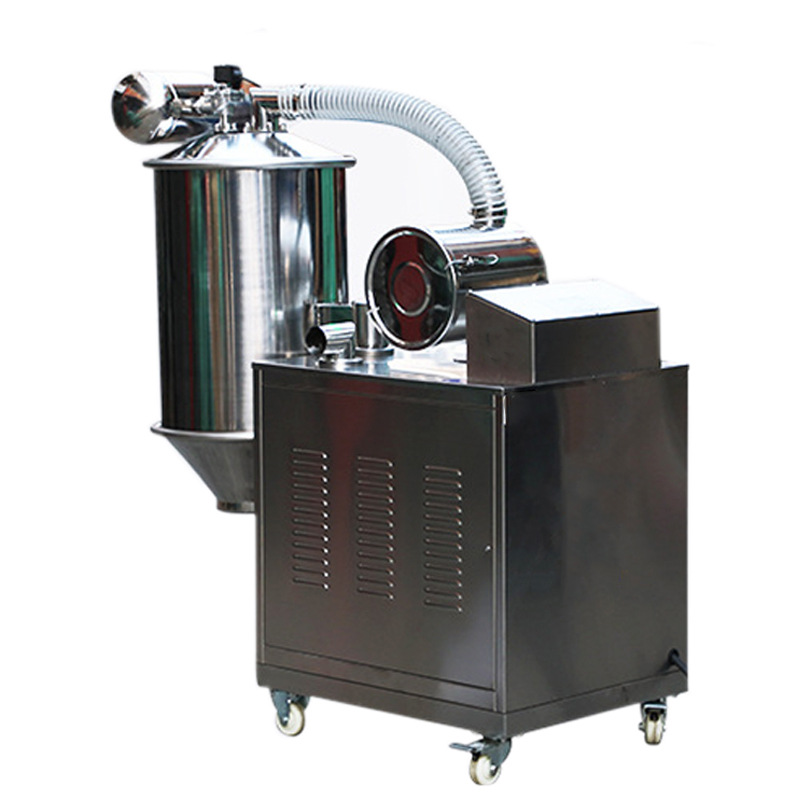
At its core, a vacuum feeder (also called a vacuum conveyor or vacuum loader) is a fully enclosed pneumatic conveying system that uses negative pressure (vacuum) to transport powders, granules, and small bulk solids from one location to another without dust leakage or environmental contamination. It is widely used in the pharmaceutical, chemical, food, plastics, and battery industries to automate the feeding of materials into mixers, reactors, packaging machines, tablet presses, and other processing equipment.
How Does a Vacuum Feeder Work?
The vacuum feeder operates on a simple but effective principle: a vacuum source (such as a regenerative blower, compressed air venturi, or vacuum pump) creates a pressure difference between the inside of the conveying line and the surrounding atmosphere. This pressure difference induces airflow, which carries the material from the pickup point through a hose or pipe into a separation hopper. Inside the hopper, the material settles, while the air passes through a filter system and is exhausted. Once the hopper is full, the vacuum is automatically shut off, a discharge valve opens, and the material is released into the target equipment. The filter is then cleaned by a pulse of compressed air to prepare for the next cycle.
Key working parameters that affect performance include vacuum level, air flow rate, material density, particle size, and conveying distance. By adjusting these parameters, the system can be tailored to handle a wide range of materials—from fine powders like titanium dioxide to coarse granules like plastic pellets.
Core Components and Key Technologies
A typical vacuum feeder consists of the following main parts:
- Vacuum Source: Can be a regenerative blower (electric), a pneumatic venturi (compressed air), or a central vacuum pump. The choice depends on the application, required capacity, and available utilities.
- Separation Hopper: A stainless steel or plastic vessel where the material is separated from the conveying air. It is usually equipped with a level sensor to control the fill cycle.
- Filter System: High-efficiency filters (e.g., polyester or PTFE) prevent fine particles from entering the vacuum source. Automatic pulse-jet cleaning ensures long filter life.
- Discharge Valve: Typically a flap valve or rotary valve that opens when the hopper is full and closes during the conveying cycle.
- Controls: PLC-based or simple timer boards that manage the sequence of vacuum on/off, filter cleaning, and discharge. Advanced models offer touch-screen interfaces and remote monitoring.
Modern vacuum feeders also incorporate features like anti-static design, stainless steel construction for GMP compliance, and explosion-proof options for hazardous environments.
Key Performance Indicators and Selection Guide
When selecting a vacuum feeder, consider the following critical parameters:
- Conveying Capacity: Typically measured in kg/h (or lb/h). Capacity depends on conveying distance, pipe diameter, material properties, and vacuum level. For example, a small unit may handle 300 kg/h, while a large industrial unit can exceed 5000 kg/h.
- Material Compatibility: The feeder must be matched to the material's bulk density, particle size, flowability, and hygroscopicity. Abrasive or sticky materials may require special liners or filter materials.
- Vacuum Source Type: Electric blowers are suitable for high-capacity, continuous operation; pneumatic venturi systems are simpler, quieter, and ideal for explosion-proof zones but consume more energy per unit of material.
- Filtration Efficiency: For pharmaceutical or food applications, HEPA filters may be required to prevent cross-contamination.
- Automation: Look for systems with programmable logic controllers (PLC) that can integrate with existing plant automation, such as central control systems or SCADA.
- Maintenance: Easy access to filters, valves, and seals reduces downtime. Many units offer quick-release clamps for tool-free disassembly.
Application Areas and Selection Advice
Vacuum feeders are used across a broad spectrum of industries:
- Pharmaceutical: Transfer of API powders, excipients, and granules into tablet presses, capsule fillers, blenders, and dryers, under strict GMP conditions.
- Chemical: Handling of pigments, catalysts, additives, and hazardous materials in a dust-free, safe manner.
- Food & Beverage: Conveying of sugar, salt, coffee powder, milk powder, and flavorings while maintaining hygiene.
- Plastics & Rubber: Feeding of pellets, regrind, and powder into injection molding machines, extruders, and mixers.
- Battery Manufacturing: Transfer of electrode materials (e.g., NMC, LFP, graphite) in a dry, oxygen-free environment.
For laboratories or small-scale production, a compact vacuum feeder with a pneumatic venturi source is often sufficient. For large-scale industrial lines, a central blower system with multiple pickup points and advanced controls delivers higher efficiency. Always consult with the manufacturer to match the feeder design to your specific material characteristics and installation requirements.
References
Related Products
Get In Touch
Our professional team will reply to you within one business day. Please feel free to contact us!