
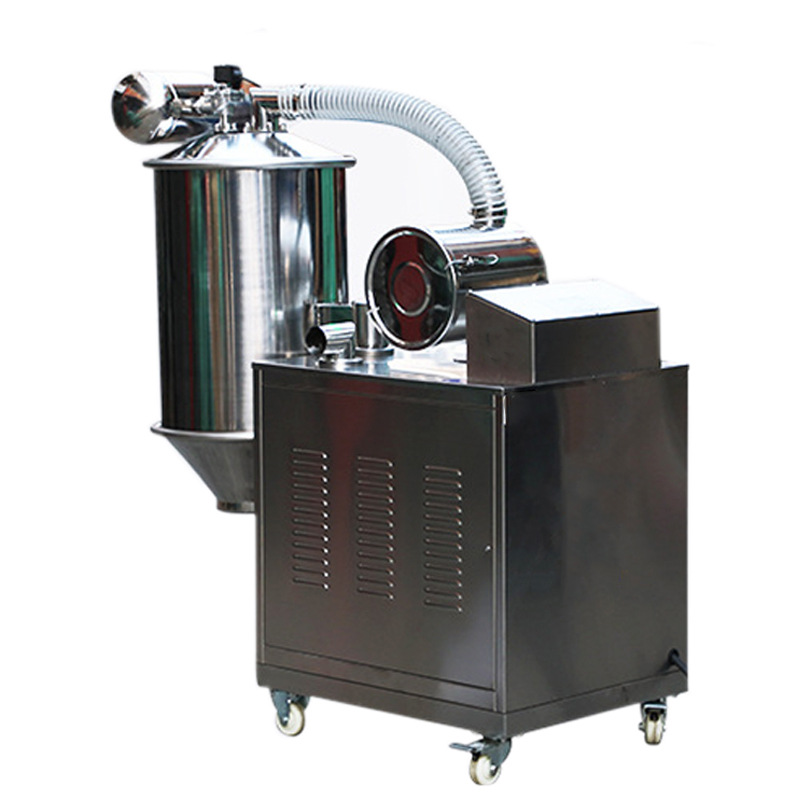
What is a Vacuum Feeder? A Dust-Free Conveying Equipment for Powder and Granular Materials

What is a Vacuum Feeder?
At its core, a vacuum feeder is a specialized enclosed pneumatic conveying device that industries such as chemicals, pharmaceuticals, foods, and metallurgy use to transport powders, granules, and mixed particles from one point to another without dust escape. By creating a pressure difference between the system and the ambient atmosphere, it generates airflow inside the pipeline that carries the material forward, achieving clean, efficient, and automated material transfer.
Core Function and Working Principle
The vacuum feeder's basic function is to convert a bulk supply of powder or granular material from a storage container (e.g., drum, bag, or hopper) into a controlled, continuous flow delivered to a downstream process machine such as a mixer, mill, packaging machine, or injection molding machine. The entire process occurs in a sealed pipeline, eliminating cross-contamination and environmental pollution.
The working principle relies on a vacuum source (usually a regenerative blower or a vacuum pump) that draws air from the receiving hopper, creating negative pressure. The suction nozzle or pickup wand is inserted into the material source; atmospheric pressure forces the material into the airstream. The material-laden air travels through the conveying hose into the separator hopper, where the velocity drops, causing the material to settle. The air passes through a filter (often with a reverse-pulse cleaning system) and exits to the vacuum source. Once the hopper is full, a discharge valve opens, releasing the material into the downstream equipment while the vacuum source pauses or continues depending on the system design. The cycle repeats automatically.
Key parameters affecting performance include conveying distance, material density, particle size, pipeline diameter, and vacuum level. Proper selection of these parameters ensures efficient, non-damaging transport.
Main Types / Key Components and Technologies
Types by Power Source
- Electric Vacuum Feeders: Driven by an electric regenerative blower, they are common for most applications. They offer consistent vacuum, easy control, and are suitable for clean environments. Typical models like the FZ series are widely used in pharmaceutical and food industries.
- Pneumatic Vacuum Feeders: Powered by compressed air via Venturi nozzles, they are intrinsically safe for explosive environments (ATEX zones) and require no electrical connections at the feeding point. They are often used in chemical and solvent-laden processes.
Key Components
- Vacuum Source: The heart of the system, generating the required negative pressure.
- Separator Hopper: Where material and air separate; includes a filter to retain fine particles.
- Self-Cleaning Filter : Typically equipped with reverse-pulse jet cleaning to maintain airflow and prevent clogging.
- Discharge Valve : A pneumatic or mechanical flap valve that releases material while maintaining vacuum integrity.
- Suction Wand & Hose: Flexible components that reach into the material source.
Key Performance Indicators and Selection Criteria
When selecting a vacuum feeder, several critical parameters must be evaluated:
- Conveying Capacity: Measured in kg/h, typical ranges from 300 kg/h for small models to over 9000 kg/h for industrial units. The actual throughput depends on material bulk density, distance, and pipe layout.
- Conveying Distance: Horizontal and vertical distances affect system design. Longer distances require stronger vacuum sources and larger pipelines.
- Power Consumption: Electric models range from 1.5 kW to 11 kW or more. Pneumatic models consume compressed air (e.g., 400–8440 NL/min).
- Filtration Efficiency: High-efficiency filters (e.g., HEPA) are essential for fine powders to prevent emissions.
- Automation Level: Modern vacuum feeders feature PLC control, touch-screen interfaces, and integration with upstream/downstream equipment.
- Material Compatibility: Must consider temperature, moisture, abrasiveness, toxicity, and explosion risk.
- Maintenance: Easy access to filters, quick-release clamps, and modular design reduce downtime.
Application Areas and Selection Advice
Vacuum feeders are used in virtually every industry handling dry bulk solids:
- Pharmaceutical: Transfer of APIs, excipients, and granules to tablet presses, blenders, and capsule fillers under GMP conditions.
- Chemical: Conveying pigments, powders, carbon black, and hazardous materials with minimal operator exposure.
- Food: Transport of sugar, spices, flour, coffee, and additives while maintaining hygiene.
- Plastics & Rubber: Feeding pellets and powders to injection molders, extruders, and mixers.
- Metallurgy & Minerals: Handling fine metal powders, ceramics, and abrasives.
For small-scale or research applications, a compact electric vacuum feeder with low capacity and simple controls is suitable. For large production lines, consider a high-capacity model with automated filter cleaning and integrated controls. For explosive environments, a pneumatic vacuum feeder is mandatory. Always consult the manufacturer's specifications and test with the actual material when possible.
For more detailed specifications and model options, visit the Vacuum Feeder product page.
Related Products
Get In Touch
Our professional team will reply to you within one business day. Please feel free to contact us!