

What is a V-type Mixer? A High-Efficiency Blending Machine for Dry Powder and Granular Materials
What is a V-type Mixer?
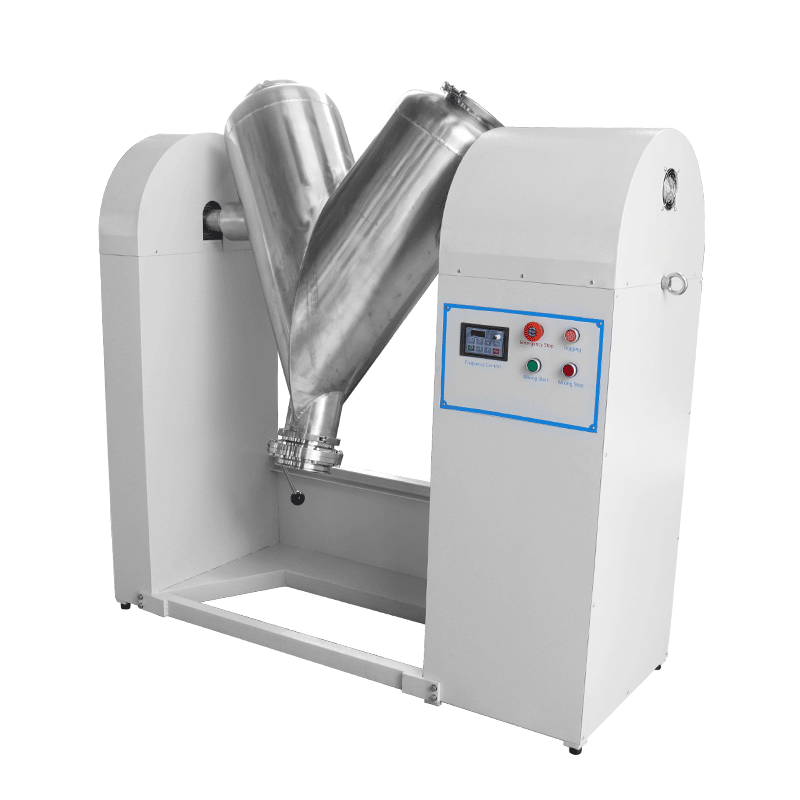
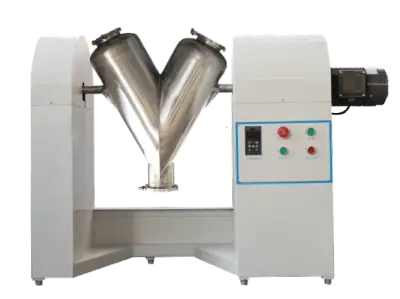
At its core, a V-type mixer is a specialized blending machine that industries such as chemical, pharmaceutical, food, ceramic, and metallurgy use to uniformly mix two or more dry powders or granular materials. The equipment features a distinctive V-shaped rotating drum that relies on gravity and mechanical motion to achieve a homogeneous blend without mechanical agitators inside the mixing chamber. It is particularly effective for free-flowing powders and granules, offering high efficiency, low energy consumption, and minimal material residue.
Core Function and Working Principle
The primary function of a V-type mixer is to transform initially separated bulk materials into a uniform mixture. The key working component is a stainless steel drum shaped like the letter “V,” which rotates around a horizontal axis. As the drum turns, the material inside is continuously lifted and allowed to fall under gravity. The asymmetric design of the two arms (one longer than the other) creates a time difference in material flow, causing the powder to be repeatedly split, converged, and diffused.
This process combines two mixing mechanisms: gravity diffusion and convective mixing. When the drum’s bottom (the junction of the two arms) moves upward, material collects at the bottom; when it moves downward, the material is split into two streams that flow into the opposite arms. The repeated cycle ensures that particles from different regions are constantly exchanged, resulting in a statistically random distribution. The mixing uniformity can reach over 99% under optimal conditions. Key process parameters include drum rotation speed (typically 8–25 rpm depending on volume), filling ratio (30%–50% of total volume), and mixing time (usually 4–12 minutes).
Main Types and Classifications
While the basic V-type mixer design is standard, several variants cater to different production needs:
Standard V-type Mixer
The most common model, consisting of a simple V-drum driven by a motor and reducer. It is suitable for general-purpose blending of free-flowing powders and granules. The drum is made of 304 stainless steel, polished inside and out for easy cleaning and corrosion resistance. This model is available in capacities from 0.18 m³ (laboratory scale) to 6 m³ (industrial production).
Forced (Intensive) V-type Mixer
Equipped with an internal rotating shaft or stirring device inside the drum to provide additional shear and mixing force. This type is ideal for materials with large density differences, sticky tendencies, or those requiring shorter mixing times. It is also suitable for adding small amounts of liquid to powder.
Vacuum Feeding V-type Mixer
Integrated with a vacuum feeder system for automatic material loading. The drum can be sealed, and the mixing process can be performed under vacuum to avoid dust generation and contamination. This is particularly useful in pharmaceutical and food applications where hygiene and containment are critical.
Laboratory and Pilot Scale Models
Small-volume V-type mixers (0.018 m³ to 0.1 m³) are designed for R&D and small batch production. They often feature variable speed control and quick-release clamps for easy cleaning between batches.
Key Performance Indicators and Selection Criteria
When selecting a V-type mixer, consider the following technical parameters:
- Total Volume and Working Capacity: The mixer’s total volume should be chosen based on the batch size. The recommended filling rate is 30%–50% of total volume. For example, a 1 m³ unit can process 400–500 kg of typical powder per batch.
- Mixing Uniformity: Most V-type mixers achieve a coefficient of variation (CV) of less than 3% for well-flowing materials. This is a critical metric for quality assurance.
- Drum Rotation Speed: Optimal speed is usually 60%–80% of the critical speed (the speed at which material centrifuges to the drum wall). Higher speeds can cause segregation, while lower speeds reduce mixing efficiency.
- Material of Construction: The contact parts should be made of stainless steel (304 or 316L) for corrosion resistance and easy cleaning. Surface polishing reduces material adhesion and cross-contamination risk.
- Discharge and Cleaning: A butterfly valve or vacuum discharge system enables dust-free operation. The drum design should have no dead corners to allow complete emptying and easy washing.
- Energy Efficiency: V-type mixers have low power consumption compared to other mixer types due to the absence of internal agitators. For a 1 m³ unit, motor power is typically 1.5–3 kW.
Application Fields and Selection Recommendations
V-type mixers are widely used in:
- Chemical Industry: Blending resins, pigments, plastic powders, and additives.
- Pharmaceutical Industry: Homogenizing drug powders, excipients, and granules.
- Food Industry: Mixing sugar, salt, spices, milk powder, and instant drink granules.
- Ceramic and Metallurgy: Blending ceramic powders, refractory materials, and metal powders.
- Feed and Agriculture: Uniform mixing of feed additives and premixes.
For selection guidance: If your materials are free-flowing, dry, and not prone to segregation, a standard V-type mixer is sufficient. For materials with large density differences or that tend to agglomerate, choose a forced mixing model. For high-value or toxic products, opt for a vacuum feeding and sealed design to ensure safety and cleanliness. Always test your material with a laboratory-scale mixer to confirm the blending time and achievable uniformity before scaling up.
References
Related Products
Get In Touch
Our professional team will reply to you within one business day. Please feel free to contact us!