

What is Stainless Steel Roll Mill Jar? A Durable Grinding Container for High-Purity and Corrosion-Resistant Ball Milling
What is Stainless Steel Roll Mill Jar? A Durable Grinding Container for High-Purity and Corrosion-Resistant Ball Milling
At its core, a stainless steel roll mill jar is a specialized grinding container used in roll ball mills (also known as jar rolling mills) to perform fine grinding, mixing, and homogenization of solid materials. Laboratories and small-scale production facilities use it to process materials that require high purity, corrosion resistance, and contamination-free environments. Made from high-grade SUS 304 stainless steel, this jar combines mechanical strength with excellent chemical resistance, making it an ideal choice for grinding abrasive, acidic, or alkaline substances.
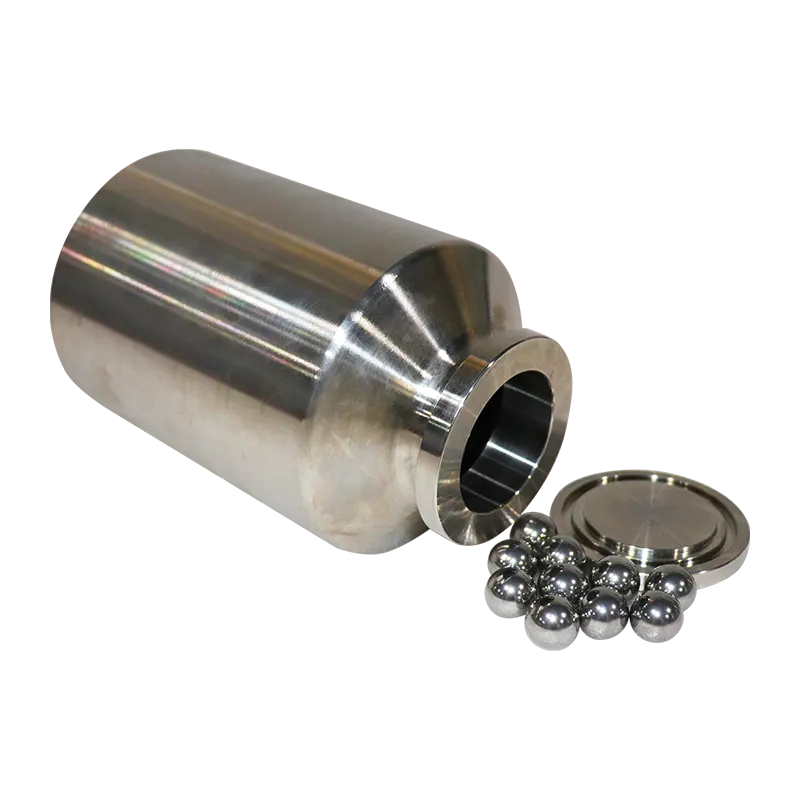
Core Function and Working Principle
The stainless steel roll mill jar is designed to work with a roll ball mill system. The jar is placed on rotating rollers, and the rotational motion causes the grinding media (typically stainless steel or other balls) inside the jar to cascade and impact the material, gradually reducing particle size. The cylindrical jar's smooth inner surface facilitates uniform grinding action, while the stainless steel construction withstands the mechanical stress of continuous operation.
The grinding process can be performed either dry or wet. In wet grinding, a liquid medium (such as water, ethanol, or oil) is added to the jar to reduce heat generation, prevent agglomeration, and achieve finer particle sizes. Key parameters affecting the final product include rotation speed (typically 50-410 rpm for roll mills), grinding time, ball-to-material ratio, and the size of grinding media. Selecting the appropriate stainless steel jar ensures consistent results and long service life even under demanding conditions.
Main Types: Material Selection for Roll Mill Jars
While stainless steel is a popular choice, roll mill jars are available in various materials to suit different applications. Understanding the differences helps users select the right jar for their specific needs.
Stainless Steel Roll Mill Jar
As the focus of this article, the stainless steel jar offers excellent durability and corrosion resistance. It is suitable for grinding materials that are not overly abrasive, such as pharmaceuticals, food ingredients, chemicals, and metal powders. The SUS 304 grade provides good resistance to most organic and inorganic acids, making it safe for routine laboratory use. It also withstands vacuum conditions if equipped with a vacuum seal, allowing for controlled atmosphere grinding.
Nylon Roll Mill Jar
Nylon jars are lightweight and provide excellent wear resistance. They are ideal for grinding materials that are sensitive to metal contamination, such as electronic ceramics or magnetic materials. Nylon is also non-reactive and can be used for dry grinding of organic compounds.
Ceramic Roll Mill Jar
Ceramic (alumina) jars offer high hardness and abrasion resistance, making them suitable for grinding hard materials like minerals, glass, and ceramics. They also prevent metallic contamination, which is critical for high-purity applications.
PTFE Roll Mill Jar
PTFE (Teflon) jars are chemically inert and can withstand extreme temperatures and corrosive chemicals. They are the best choice for grinding highly reactive or acidic materials, such as certain catalysts or battery materials.
Polyurethane (PU) Roll Mill Jar
PU jars combine flexibility with wear resistance. They are often used for grinding materials that require gentle handling to avoid excessive heat or particle breakage, such as in the production of pigments or coatings.
Corundum Roll Mill Jar
Corundum (aluminum oxide) jars provide extreme hardness and are nearly wear-free. They are ideal for grinding very hard samples like rocks, minerals, and cemented carbides, and they also offer excellent chemical resistance.
Key Performance Indicators and Selection Criteria
When selecting a stainless steel roll mill jar, consider the following factors to ensure optimal performance:
- Volume Capacity: Jars are available in capacities from 0.05L to 20L, matching the scale of your operation. Choose a size that accommodates your batch volume without exceeding the mill's maximum load.
- Grinding Efficiency: The inner surface finish and geometry affect grinding efficiency. High-quality stainless steel jars have smooth, polished interiors to minimize material sticking and facilitate cleaning.
- Sealing Mechanism: For processes requiring vacuum or inert gas atmosphere, a stainless steel jar with a vacuum seal (e.g., threaded ports with O-ring) is essential. This prevents oxidation and contamination.
- Temperature Resistance: Stainless steel can withstand moderate heat generated during grinding, but avoid excessive temperatures that may degrade material properties. For high-temperature applications, consider ceramic or PTFE jars.
- Maintenance and Durability: Stainless steel jars are easy to clean with common solvents and are resistant to dents and cracks. However, they are heavier than nylon or PTFE jars, which may affect the mill's total load capacity.
- Compatibility with Mill: Ensure the jar's diameter and length match the roller spacing of your roll ball mill. Most standard jars fit mills with adjustable roller positions.
Application Fields and Selection Suggestions
The stainless steel roll mill jar is widely used in research laboratories, universities, and small-scale production in industries such as:
- Chemical and Pharmaceutical: For grinding active pharmaceutical ingredients, catalysts, and fine chemicals requiring purity and traceability.
- Food and Agriculture: For processing spices, grains, and food additives where stainless steel is food-grade approved.
- Materials Science: For preparing powders for sintering, coating, or composite material synthesis.
- Environmental Testing: For grinding soil, sediments, and waste samples for analysis.
For users who prioritize corrosion resistance and mechanical strength, stainless steel is the best all-around choice. If contamination from metal ions is a concern (e.g., for electronic materials), opt for ceramic or nylon jars. For highly corrosive chemicals, PTFE is superior. Always match the jar material to the chemical nature and target particle size of your material.
References
Related Products
Get In Touch
Our professional team will reply to you within one business day. Please feel free to contact us!