
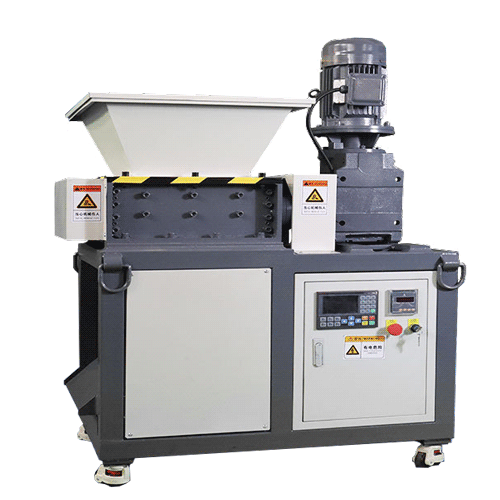
What is a Small Shredder? A Compact Industrial Shredder for Daily Solid Waste Shredding

What is a Small Shredder?
At its core, a small shredder is a compact industrial shredding machine designed for daily solid waste management. It is used by recycling facilities, manufacturing plants, and laboratories to reduce the size of various materials such as metal scraps, plastic containers, wood, paper, and electronic waste. The machine employs a dual-shaft cutting mechanism to tear, shear, and crush materials into smaller, uniform pieces, facilitating downstream processing like sorting, granulation, or disposal.
Core Function and Working Principle
The small shredder transforms bulky, heterogeneous waste into manageable fragments (typically 1–10 cm). Its core working principle relies on two counter-rotating shafts equipped with interlocking blades. As the shafts rotate slowly but with high torque, the blades grab, cut, and tear the feed material. The resulting shearing and tensile forces break down even tough materials like metals, plastics, and wood.
Key process parameters include shaft speed, blade configuration, and gap between blades. Lower speeds with higher torque are ideal for hard materials, while higher speeds suit softer waste. The final particle size can be adjusted by changing the screen size or blade spacing. The machine's automatic operation and overload protection ensure reliable performance in continuous duty cycles.
Main Types and Configurations
Small shredders are primarily categorized by their shaft design:
- Double Shaft Shredder: The most common type for general industrial waste. Two shafts with interlocking blades provide high throughput and versatility. Suitable for metals, plastics, tires, and e-waste.
- Single Shaft Shredder: Often used for finer shredding of plastics, wood, and paper. One rotating shaft works against a stationary counter-knife, producing more uniform output.
- Mini Shredder (Portable): Compact units for small workshops or laboratories. They handle low volumes and are easy to move.
When selecting a type, consider the material's hardness, moisture content, and desired output size. Double shaft shredders are preferred for heavy-duty applications, while single shaft models excel in achieving finer granules.
Key Performance Indicators and Selection Criteria
When choosing a small shredder, evaluate these factors:
- Throughput Capacity: Measured in kg/h or tons/day. Typical mini shredders handle 100–500 kg/h, while larger models reach several tons.
- Output Size: Adjustable from 1 cm to 10 cm. Finer output requires more energy and specific blade designs.
- Energy Efficiency: Look for low power consumption relative to throughput. Variable frequency drives can optimize energy use.
- Automation: Automatic start/stop, reverse function, and overload protection enhance safety and reduce downtime.
- Maintenance: Easy access to blades, bearings, and screens. Durable materials like 9CrSi or D2 steel prolong blade life.
Reputable manufacturers offer CE, ISO, and other certifications. For example, the small shredder from TENCAN features a 12-month warranty, 7×24 online support, and customizable blade materials.
Applications and Buying Advice
Small shredders are used across industries:
- Recycling: Shredding scrap metal, plastic containers, cans, and bottles for volume reduction and material recovery.
- Waste Management: Processing municipal solid waste, industrial waste, and electronic waste before landfill or incineration.
- Manufacturing: Reducing off-spec products, wood pallets, and packaging materials.
For a laboratory or small workshop, a mini double shaft shredder (e.g., 200×100×200 cm, 1–10 cm output) is ideal. For larger operations, consider a heavy-duty single shaft shredder. Always verify the machine's compatibility with your specific waste stream and consult the manufacturer for a tailored solution.
References
Related Products
Get In Touch
Our professional team will reply to you within one business day. Please feel free to contact us!