
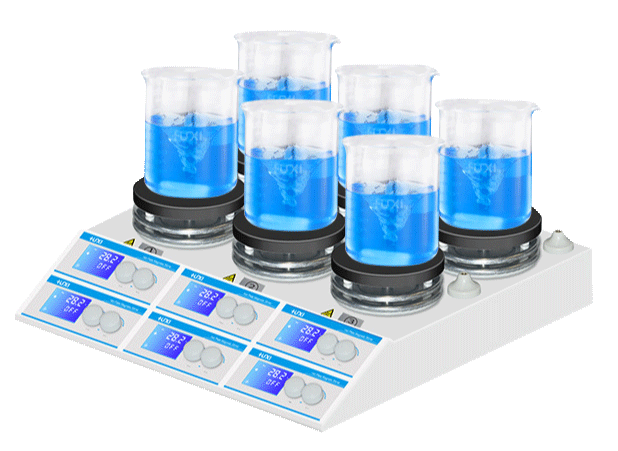
What is a Multi Station Magnetic Stirrer? A Versatile Lab Mixing Device for Simultaneous Stirring

Introduction
At its core, a Multi Station Magnetic Stirrer is a professional laboratory device used to simultaneously stir multiple liquid samples in separate containers. Researchers in chemistry, biology, pharmaceuticals, and materials science rely on it to achieve consistent mixing, dissolution, or reaction conditions across multiple vessels without manual intervention. Each station typically features an independent magnetic drive that rotates a small stir bar placed inside the container, ensuring uniform agitation.
Core Function and Working Principle
The Multi Station Magnetic Stirrer transforms a stationary liquid sample into a well-mixed or reacted solution by generating a rotating magnetic field beneath each stirring position. The device consists of a flat work surface with multiple embedded electromagnets or permanent magnets that rotate at controlled speeds. A small magnetic stir bar (often PTFE-coated) is placed inside each beaker, flask, or vial. When the magnetic field rotates, the stir bar spins accordingly, creating a vortex that mixes the liquid.
Key parameters include stirring speed (typically 0–2000 rpm), the number of stations (from 2 to 20 or more), and the maximum volume per station (usually 50 mL to 5 L). The stirring speed can be adjusted individually or globally, and some advanced models offer programmable speed ramps, timer functions, and even heating capabilities for each station. The uniformity of stirring directly affects reaction kinetics, dissolution rates, and experimental reproducibility.
Core Components and Key Technologies
Magnetic Drive System
Each station uses a dedicated motor and magnet assembly to provide precise and stable rotation. High-quality models use brushless DC motors for low noise, long life, and accurate speed control.
Control Interface
Modern multi-station stirrers feature digital displays and intuitive controls. Some models allow independent speed setting per station, while others offer group control. Touchscreen or membrane keypad interfaces are common.
Heating Option (if applicable)
Certain models include integrated heating plates under each station, enabling simultaneous stirring and heating. Temperature control typically ranges from ambient to 300°C, with accuracy of ±1°C.
Construction Materials
The work surface is often made of chemically resistant materials such as stainless steel or ceramic-coated aluminum. The housing is designed to withstand spills and corrosive chemicals.
Key Performance Indicators and Selection Criteria
When choosing a Multi Station Magnetic Stirrer, consider the following factors:
- Number of Stations: Determine how many samples you need to process simultaneously. Common configurations include 4, 6, 8, 10, or 15 stations.
- Stirring Speed Range: Typical range is 0–1500 rpm for general use, but high-speed models up to 2000 rpm are available for demanding applications.
- Volume Capacity per Station: Ensure the stirrer can accommodate the container sizes you use (e.g., 100 mL, 1000 mL, 2000 mL).
- Heating Capability: If your experiments require temperature control, select a model with integrated heating and temperature sensors.
- Programmability: Advanced models offer programmable sequences, timers, and data logging via USB or RS232.
- Maintenance: Look for easy-to-clean surfaces and replaceable stir bars. Magnetic stirrers generally require minimal maintenance.
Energy efficiency is usually high, as motors consume only 10–50 W per station. The device's footprint on the lab bench is also an important consideration for crowded workspaces.
Applications and Selection Advice
The Multi Station Magnetic Stirrer is widely used in:
- Chemical Synthesis: Parallel reactions, titrations, and dissolution studies.
- Biological Research: Cell culture media preparation, buffer mixing, and ELISA assays.
- Pharmaceutical Quality Control: Dissolution testing, sample preparation.
- Environmental Analysis: Water sample homogenization, extraction procedures.
- Educational Labs: Teaching demonstrations, student experiments requiring multiple replicates.
For routine mixing tasks without heating, a basic model with 6–8 stations is sufficient. For parallel synthesis or process development, consider a programmable model with heating and individual speed control. For high-throughput screening, choose a 10–15 station model with large volume capacity.
References
For more detailed specifications, please visit the product page: Multi Station Magnetic Stirrer.
Related Products
Get In Touch
Our professional team will reply to you within one business day. Please feel free to contact us!