

What Is a Manual Tablet Press? A Lab Press Forming Device for Powder Compaction
What Is a Manual Tablet Press?
From its core, a manual tablet press is a professional press forming device that laboratories, universities, quality-control departments and small-batch workshops use to compact loose powder into a solid, uniform pellet or tablet. Unlike the automatic rotary presses found on pharmaceutical production lines, a manual press does not depend on motors, servos or programmable controllers to generate its working force. The operator supplies the energy — through a lever, a handwheel or a screw — and the machine converts that human effort into a controlled compressive load that is transferred to a powder sample held inside a die cavity.
The purpose of the operation is straightforward: to turn a free-flowing or slightly cohesive powder into a self-supporting disc, cylinder or shaped tablet with a defined diameter, thickness and density. The finished pellet can be handled, weighed, labelled and measured like any other solid specimen. It no longer behaves as a pile of loose grains but as a single engineering body with measurable mechanical strength. For an analytical chemist the pellet becomes a sample suitable for spectroscopy; for a materials researcher it becomes a green compact ready for sintering; for a ceramic engineer it becomes the first shaping step of a component.
A manual tablet press is therefore best understood as an enabling instrument rather than a mass-production machine. It exists so that small quantities of expensive, hazardous or experimental powders can be formed into reliable test specimens without the cost, complexity and material waste of a fully automated line. Because the operator controls the pressing stroke directly, the device also gives an intuitive feel for how a given powder behaves under load — knowledge that is genuinely useful when a formulation is being developed or a process is being scaled up.
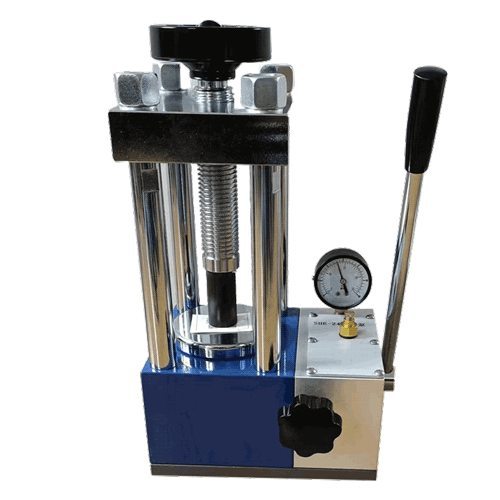
Core Function and Working Principle
From Loose Powder to a Densified Pellet
Every press forming operation follows the same basic sequence. A measured quantity of powder is poured into the cavity of a die, the cavity is closed by a punch, and a compressive load is applied from above and, in some designs, from below as well. As the load rises, the powder bed is first rearranged: particles slide past one another and the voids between them shrink. This densification stage accounts for most of the volume reduction. Once the particles are packed closely together, further pressure causes them to deform elastically, then plastically, and finally to bond at their contact points through cold welding, mechanical interlocking and, for some materials, localised melting or diffusion.
When the load is released, the compact springs back slightly. If the applied pressure was high enough and the bonding sufficiently developed, the pellet retains its shape. If not, it crumbles — a familiar outcome when a powder is pressed too lightly, when the particles are too coarse, or when no binder or lubricant has been added to the formulation. The whole process is a balance between pressure, powder characteristics and tooling geometry.
The Mechanics of Hand-Powered Compaction
In a manual press, the force originates from the operator. A lever-based design uses a handle and a linkage or cam to multiply the hand force; a screw-based design uses a threaded spindle so that a modest torque on a handwheel produces a large axial thrust; a manual hydraulic design uses a hand pump to raise oil pressure in a cylinder, which then drives the ram. In each case the machine acts as a force multiplier and a force director, converting a comfortable human input into a concentrated load on a small punch face.
Because the punch face is usually much smaller than the area over which the hand force is applied, the pressure experienced by the powder is far higher than the pressure the operator feels. This is why a compact bench instrument can press powders at pressures comparable to those used in industrial tooling, even though the total force involved is modest. The mechanical advantage of the lever, screw or hydraulic circuit is what makes the operation feasible.
Key Process Parameters That Shape the Result
Several parameters decide whether the pellet comes out intact and reproducible. The first is the compaction pressure — the force divided by the cross-sectional area of the punch. Too little pressure leaves a fragile, chalky compact; excessive pressure can cause lamination, capping or cracking, especially when air trapped in the powder cannot escape quickly enough. The second is dwell time, the short period during which the load is held before release. A brief dwell allows plastic flow and particle bonding to develop, which often improves strength noticeably.
Powder-related variables matter just as much. Particle size distribution, moisture content, the presence of a lubricant such as stearic acid, and the intrinsic hardness of the material all influence how a powder compacts. Fine, soft, ductile powders press easily; hard, coarse, brittle powders resist densification and tend to form weak compacts. Finally, tooling geometry plays a role: a tall, narrow die transmits pressure less evenly than a short, wide one, because friction between the powder and the die wall absorbs part of the load.
Core Components and Key Technologies
Although manual presses come in many shapes, most share a common set of functional parts. Understanding them helps a buyer judge build quality and match a machine to a specific application.
Frame and Load Path
The frame is the structural backbone. It must resist the reaction force of the punch without flexing, because any deflection wastes part of the operator's effort and reduces the pressure actually delivered to the sample. Robust frames are usually made from cast iron or welded steel plate, with a geometry that keeps the load path short and direct. A stiff frame also improves repeatability, since the same handle movement produces a similar result every time.
Die, Punch and Base Plate
The die is the cylindrical cavity that holds the powder; the punch is the piston that compresses it; the base plate or lower punch closes the bottom of the cavity. Together they define the pellet's diameter, thickness and surface finish. Dies are commonly made from hardened tool steel, stainless steel or, for contamination-sensitive work, ceramic or tungsten carbide. Interchangeable die sets are a practical advantage, because a single press can then produce pellets of different diameters simply by swapping tooling.
Force-Applying Mechanism
This is the part the operator interacts with: a lever arm, a handwheel driving a screw, or a hand pump feeding a hydraulic cylinder. The mechanism determines the maximum force available, the resolution with which that force can be adjusted, and how physically demanding the work feels. Screw and hydraulic designs generally allow finer, more gradual loading, which reduces the risk of cracking a fragile compact.
Ejection and Release
After pressing, the pellet must be removed without damage. Many designs use a push-out arrangement in which the lower punch or the die itself is raised or lowered so that the compact can be pushed clear. Gentle, axial ejection is important: side-loading or twisting during removal is a common cause of chipped edges and broken pellets.
Safety and Operating Discipline
Hand-powered equipment is inherently calm and controllable, but basic discipline still matters. Powders should be weighed and loaded in a clean, ventilated area; fine or toxic dusts call for a fume hood or glove-box arrangement; and the press should never be operated with a missing or mismatched die. Keeping the working surfaces clean and storing tooling in a dry place protects both the operator and the accuracy of the next measurement.
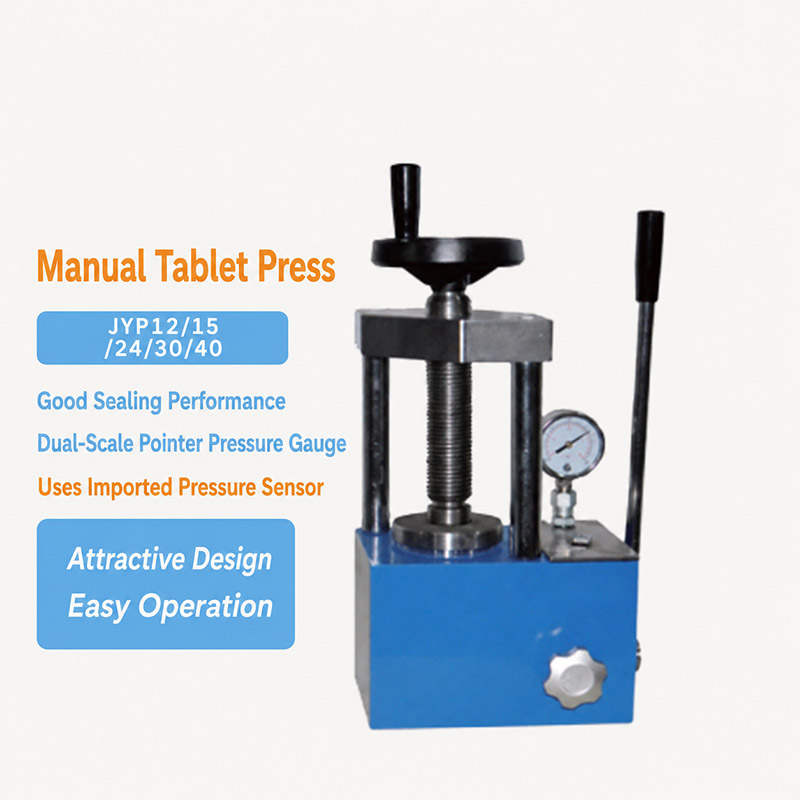
Main Types of Manual Tablet Presses
Lever-Operated Single-Punch Presses
The simplest category. A handle drives a punch directly or through a short linkage. These presses are compact, inexpensive and quick to operate, which makes them popular for routine tasks such as preparing pellets for infrared spectroscopy or compressing small samples for X-ray fluorescence analysis. Their limitation is that the achievable force depends on the operator's strength and technique, so reproducibility between different users can vary.
Handwheel and Screw-Type Presses
Here a threaded spindle converts rotating motion into linear thrust. The gearing of the screw gives a high mechanical advantage and allows the load to be increased in small, controlled increments. This makes screw presses well suited to fragile or brittle powders that would crack under a sudden blow, and to situations where the operator wants to hold a load gently for a period of time.
Manual Hydraulic Presses
In these machines a hand pump pressurises oil that drives a ram. The advantage is a higher and more uniform force, plus a pressure gauge that lets the user monitor and repeat a target load. Hydraulic manual presses are often chosen when a defined compaction pressure is part of a documented procedure, for example in battery electrode research, ceramic powder studies or powder metallurgy trials.
Heated and Special-Purpose Variants
Some manual presses incorporate heated platens or heated dies so that pressing and mild thermal treatment occur together — a useful capability for polymer powders and for preparing transparent pellets from alkali halide powders for infrared transmission analysis. Other variants add vacuum or inert-gas enclosures for air-sensitive materials such as lithium compounds or metal hydrides. Dies with non-cylindrical profiles allow rectangular, ring-shaped or custom specimens to be produced.
How to Choose Between These Types
The deciding factors are usually the required pressure, the fragility of the powder and the need for documentation. Simple lever presses suit occasional qualitative work; screw presses suit delicate materials and slow loading; hydraulic presses suit procedures that specify a pressure value. If the sample must be protected from air or moisture, enclosure capability outweighs every other convenience.
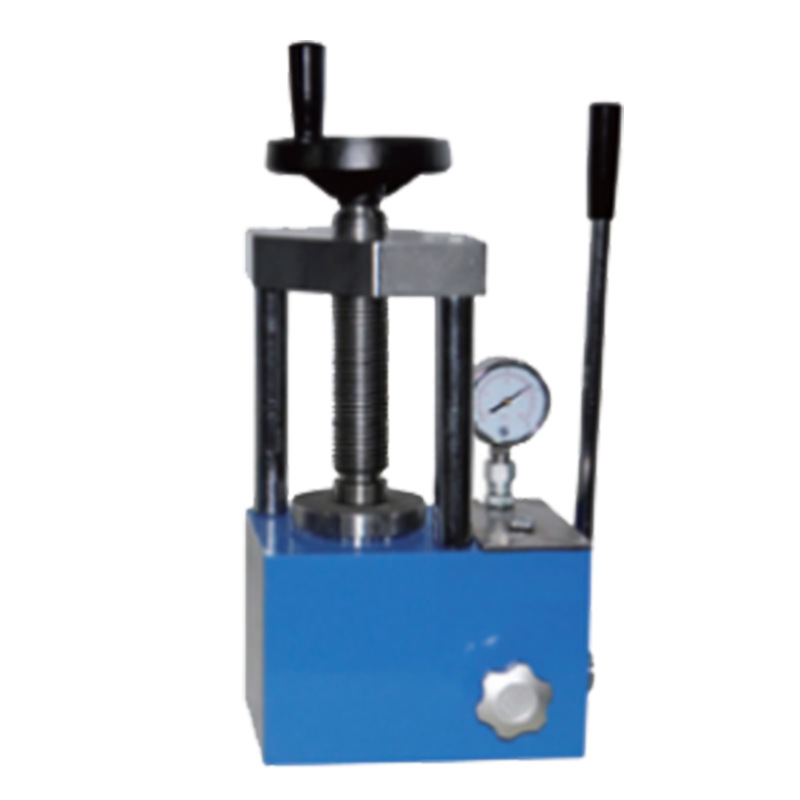
Key Performance Indicators and Selection Points
Compaction Force and Achievable Pressure
The most basic selection criterion is how much force the press can deliver and how that force translates into pressure on the sample. A larger maximum force gives more headroom for hard powders and large-diameter dies, but it is only useful if the frame and tooling are stiff enough to transmit it. Buyers should look at the relationship between force, die diameter and the pressure actually needed by their material, rather than at a headline force figure alone.
Pellet Size, Shape and Surface Quality
Die diameter and punch geometry determine the size and shape of the finished part. Laboratories frequently need several diameters, from small discs used in spectroscopy to larger cylindrical compacts for mechanical testing. Interchangeable tooling, polished punch faces and precisely machined die bores all contribute to clean edges, flat surfaces and consistent thickness — qualities that matter when the pellet must be measured optically or weighed precisely.
Reproducibility and Operator Influence
Manual operation introduces human variability. Machines that offer a pressure gauge, a mechanical stop, a screw with fine pitch or a lever with a defined stroke help standardise results between operators. Where a procedure demands that every pellet be pressed at the same load, a manual hydraulic press with a gauge, or a press with a hard stop, is usually the better choice than a bare lever device.
Throughput and Ergonomics
Manual presses are not built for high output, but the number of pellets per hour still matters in a busy laboratory. Filling, pressing and ejecting should each require a small number of simple movements. Handle height, stroke length, clamping arrangements and the weight of the machine all affect how tiring the work becomes over a long session, so ergonomics deserves attention alongside technical specifications.
Maintenance, Cleanliness and Consumables
A manual press has few moving parts, which keeps maintenance simple. The main tasks are keeping the load-bearing surfaces lightly lubricated, protecting the die and punch from corrosion, and cleaning powder residue from the tooling between different samples to avoid cross-contamination. Because dies, punches and base plates wear or become damaged, the availability of spare and replacement tooling is an important practical consideration — a press is only as useful as the die sets available for it.
Applications and Selection Advice
Where Manual Tablet Presses Are Used
These instruments appear in a remarkably wide range of fields. In analytical laboratories they prepare potassium bromide discs for infrared spectroscopy and pressed pellets for X-ray fluorescence and other spectroscopic techniques, where a flat, uniform surface is essential for accurate measurement. In battery and energy research they compact electrode powders and solid electrolyte samples. In ceramics and powder metallurgy they produce green compacts that are subsequently sintered. In pharmaceutical and nutraceutical development they make small trial tablets for dissolution and hardness studies. In geology, environmental science and agriculture they press powdered rock, soil and feed samples into discs for elemental analysis.
Universities and teaching laboratories value them because they demonstrate the fundamentals of powder compaction — densification, particle bonding, spring-back and ejection — using equipment that is safe, quiet and easy to explain. Pilot plants use them to bridge the gap between laboratory trials and full production, generating enough material for realistic testing before a large capital investment is made.
Choosing the Right Configuration
For routine spectroscopic pellet preparation, a compact lever or screw press with a small set of dies is usually sufficient. Where documented pressures are required — battery electrodes, ceramic powders, metallurgical specimens — a manual hydraulic press with a readable gauge and sturdy tooling is the safer investment. For air-sensitive, hygroscopic or reactive powders, an enclosed or glove-box-compatible design should be selected from the start. For fragile materials, a screw press that allows slow, gradual loading will give better yields than a fast lever action. And for laboratories that expect to change sample sizes often, a machine with a well-supported range of interchangeable dies is more economical than buying several dedicated presses.
Because the total investment is modest compared with automated equipment, the practical question is seldom whether a manual press is affordable but whether its tooling, force range and repeatability match the work the laboratory actually does. Reviewing the tooling catalogue alongside the press specification is the most reliable way to make that decision, and the product page for a press forming tablet press is a good place to start.
Frequently Asked Questions
Do I need a binder or lubricant to press a pellet?
Not always. Ductile metal powders and many soft inorganic powders bond well under pressure alone. Brittle, hard or very fine powders often benefit from a small amount of binder to increase green strength, or a lubricant to reduce friction between the powder and the die wall. Adding a lubricant also makes ejection easier and lowers the risk of cracking, but it dilutes the sample, which may be unacceptable in analytical work.
Why do my pellets crack or cap?
Cracking usually comes from trapped air, excessive pressure, too rapid loading or too little dwell time. Air trapped in the powder bed is compressed during pressing and expands when the load is released, splitting the compact. Pressing more slowly, using a coarser or better-lubricated powder, or lowering the maximum pressure often solves the problem.
Can a manual press produce the same pressure as an automatic one?
In short, yes, for small pellets. Pressure is force divided by area, and a modest force concentrated on a small punch can generate high pressure. What a manual press cannot match is the throughput and the machine-to-machine consistency of an automated press, since the operator is part of the control loop.
How do I keep results reproducible?
Standardise everything you can: the mass of powder in each pellet, the die diameter, the loading rate, the dwell time and the final load. Use a press with a gauge or a mechanical stop, record the settings, and clean the tooling between samples. With consistent technique, manual pressing can be surprisingly repeatable.
The Bottom Line
A manual tablet press is a compact, hand-powered press forming device that turns loose powder into a solid, uniform pellet. Its appeal lies in simplicity: no motors, no complex control system, a small footprint, and a price that makes it accessible to almost any laboratory. Used with an appropriate die set and a disciplined procedure, it is a dependable tool for spectroscopy sample preparation, materials research, ceramics, battery development and teaching — a small machine that performs an essential step in the wider powder processing chain. For readers who want to see how these presses are configured in practice, the manufacturer's manual tablet press page provides the relevant specifications and optional tooling.
Related Products
Get In Touch
Our professional team will reply to you within one business day. Please feel free to contact us!