

What is a Laboratory Full-Directional Planetary Ball Mill? A High-Efficiency Milling Device for Multi-Dimensional Sample Preparation
Introduction
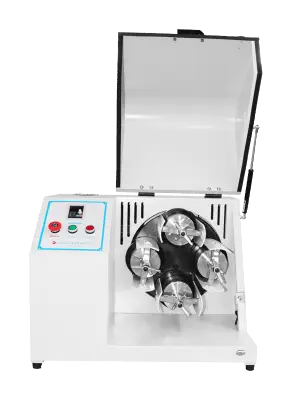
At its core, a Laboratory Full-Directional Planetary Ball Mill is a specialized milling device that research laboratories and material science departments use to grind, mix, and homogenize solid samples down to sub-micron or even nano-scale particle sizes. Unlike conventional planetary ball mills where the grinding jars rotate only in a fixed plane, this full-directional model adds a unique 360° rotational axis that continuously changes the orientation of the jars relative to gravity. This innovative design prevents material from settling at the bottom of the jar, ensuring more uniform grinding and significantly reducing the time required to achieve target fineness.
Core Function and Working Principle
The fundamental task of the Laboratory Full-Directional Planetary Ball Mill is to transform coarse particles (typically 0.5–3 mm) into fine powders (down to < 0.1 µm) through a combination of impact, friction, and shear forces. The working principle is based on the planetary motion: the grinding jars are mounted on a rotating sun wheel (the main platform), and each jar also rotates around its own axis in the opposite direction. This creates a high-energy environment where the grinding balls inside the jars collide vigorously with the sample.
The key differentiator of the full-directional version is an additional tilting or wobbling motion that continuously reorients the jars. In standard planetary mills, gravity causes coarse particles and grinding media to collect at the lowest point of the jar, leading to uneven energy distribution and longer grinding times. The full-directional mechanism periodically lifts and rotates the entire jar assembly, effectively redistributing the material and balls. This results in more consistent particle size distribution and enhanced efficiency, especially for sticky, fibrous, or high-density materials.
Critical process parameters include rotation speed (both sun wheel and jar), grinding time, ball-to-powder ratio, and the choice of grinding media materials (e.g., stainless steel, zirconia, agate, tungsten carbide). The final particle size and uniformity are directly influenced by these settings. Many models offer programmable control, allowing users to set forward/reverse cycles and pause intervals to optimize results.

Core Components and Key Technologies
While the product line does not have multiple subtypes, the Laboratory Full-Directional Planetary Ball Mill integrates several sophisticated components that define its performance:
- Planetary Drive System: A high-torque motor drives the sun wheel and the jar holders through a belt or gear mechanism. The full-directional functionality adds an extra motor and a cam mechanism to achieve the 360° tilting motion.
- Grinding Jars and Media: The machine accommodates standard planetary jars made from stainless steel, zirconia, alumina, agate, nylon, PTFE, and other materials. Each jar can hold up to two-thirds of its volume of sample and balls. The full-directional motion minimizes dead zones, so even with less material, grinding remains efficient.
- Control System: Advanced microprocessor or touch-screen controllers allow setting rotation speed (typically 50–600 rpm for the sun wheel), grinding time, pause intervals, and direction changes. Some models feature data logging and recipe storage for reproducible results.
- Safety and Noise Reduction: Enclosed design with noise-dampening materials and automatic shut-off when the lid is opened. The rolling friction transmission (metal wheel against polymer) common in high-end models reduces wear and noise compared to gear-driven systems.
Key Performance Indicators and Selection Criteria
When evaluating a Laboratory Full-Directional Planetary Ball Mill, users should focus on the following specifications:
- Processing Capacity: Typically ranging from 0.2 L (micro models) to 10 L per jar, with 2 or 4 jars per machine. For research labs, 1–4 L total capacity is common; for pilot production, larger volumes are available.
- Fineness and Particle Size Control: The ability to reach < 0.1 µm (100 nm) for most materials. Full-directional models often achieve finer results in less time due to reduced sedimentation.
- Speed Range and Relative Acceleration: Maximum centrifugal acceleration (G-force) can reach 100 G or more. Higher G generally means faster grinding but may generate more heat and wear.
- Versatility in Milling Conditions: Support for dry milling, wet milling, vacuum or inert gas milling (with optional vacuum jars), and cryogenic milling (with optional liquid nitrogen accessories). This flexibility is crucial for air-sensitive or heat-sensitive materials.
- Automation and Programmability: Look for models with programmable cycles (forward/reverse/pause) and data recording. Touch-screen interfaces simplify operation and improve reproducibility.
- Maintenance and Durability: Rolling friction drives (rather than gears) reduce noise and extend service life. Easy-access clamps for jar installation and replacement save time.
Application Fields and Selection Advice
The Laboratory Full-Directional Planetary Ball Mill is widely used in geology, mining, metallurgy, electronics, ceramics, chemicals, pharmaceuticals, cosmetics, food (e.g., matcha), and environmental analysis. It is ideal for preparing samples for XRF, XRD, SEM, and other analytical techniques, as well as for mechanical alloying, nanomaterials synthesis, and color pigment dispersion.
Selection Tip: For academic labs that process a variety of materials with limited quantity (5–50 g per batch), a micro model (0.2–1 L jars) with full-directional function is sufficient. For industrial R&D centers working with larger samples (100–500 g), a 2–4 L jar model is recommended. If you frequently handle air-sensitive materials, choose a model compatible with vacuum jars (See the product page for available options).
References
Related Products
Get In Touch
Our professional team will reply to you within one business day. Please feel free to contact us!