

What Is a Lab Disperser? A Lab Mixing Device for Homogeneous Fine Suspensions
What Is a Lab Disperser?
From a practical standpoint, a lab disperser is a laboratory-scale mixing device for combining solid particles with a liquid medium. Coatings, inks, battery slurries, ceramics, cosmetics, pharmaceuticals, and food laboratories use it to prepare samples that are uniform enough for testing, analysis, or small-scale production trials. The goal is not merely to make the mixture look smooth; it is to control the state of dispersion, meaning how well particles are separated, wetted, and held in suspension. The TENCAN Lab disperser is one example of this equipment category, and its product page is the right place to confirm current model-specific details.
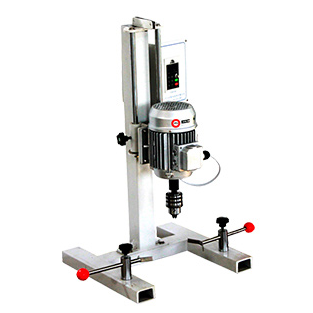
A disperser is often confused with a simple stirrer, but the duties are different. A stirrer may keep a mixture moving without breaking the clusters that form when fine powders are added to a liquid. A disperser is expected to provide enough localized shear, impact, and bulk flow to wet the powder, separate agglomerates, and distribute the solids evenly. That distinction matters in formulation work, because an apparently mixed sample can still contain invisible lumps that affect viscosity, color, conductivity, or test results.
How a Lab Disperser Works
A disperser works by applying mechanical energy to a liquid-solid mixture. A motor turns a shaft fitted with a dispersion tool, and that tool creates shear, impact, and circulation inside the vessel. The combined action draws material into the working zone, brings liquid into contact with dry particles, breaks clusters apart, and circulates the mixture until the solids are distributed through the liquid. The exact flow pattern depends on the tool shape, vessel geometry, immersion depth, speed, and formulation.
Wetting and Deagglomeration
Dry powders rarely arrive as individual particles. They usually contain agglomerates held together by van der Waals forces, moisture, or binder bridges. A disperser first brings liquid into contact with those clusters. Surfactants or wetting agents can reduce interfacial tension and help liquid penetrate the powder, but mechanical energy is still needed to separate the primary particles. High-shear zones near the dispersion tool create velocity gradients that pull agglomerates apart. Once broken, the particles must be distributed quickly enough to prevent them from recombining into larger clusters.
The addition sequence is part of the mechanism. If powder is dumped into the vessel too quickly, the liquid may not wet it fast enough, and large lumps can form. Those lumps may be difficult to remove later, even with a long mixing time. Many laboratories therefore add solids gradually while the impeller creates a steady vortex or circulation pattern, then continue mixing until the required dispersion state is reached.
Maintaining a Stable Suspension
Dispersion is only half the task; the mixed state must also remain stable long enough to be used. Stability depends on particle size, density difference, viscosity, and the formulation's colloidal chemistry. A disperser can help by reducing cluster size and distributing stabilizers, but it cannot correct a fundamentally unstable formulation. In practice, formulators adjust dispersant level, pH, solids loading, and mixing energy together, then observe whether the suspension remains uniform during storage or testing. Settling, syneresis, and viscosity drift are useful signals that the formulation or the mixing method may need refinement.
Key Process Parameters
Several variables determine whether a lab disperser produces a useful result. They should be recorded during method development so that a batch can be repeated.
- Tip speed: controls shear rate and the balance between dispersion and circulation.
- Mixing time: too short leaves agglomerates, while too long may overheat or damage shear-sensitive particles.
- Solids loading: higher solids content increases viscosity and the torque required.
- Tool and vessel geometry: the gap, diameter, and immersion depth affect flow and shear.
- Temperature: heat from the motor and shear can alter binders, surfactants, or particles.
- Addition sequence: adding powder too quickly can create lumps that are difficult to remove.
These parameters interact. Increasing speed may improve deagglomeration but also raise temperature and air entrainment. A slower, longer mix can be gentler but may not break tough agglomerates. The right balance is formulation-specific and is usually found through a small designed experiment rather than a single trial.
Core Components and Design Features
Although laboratory dispersers vary in size and detail, most share the same functional building blocks. Understanding them makes specification and troubleshooting easier.
Drive and Speed Control
The drive provides torque and speed. A useful laboratory disperser offers controlled, repeatable speed rather than only a few fixed settings, because dispersion depends strongly on tip speed. Digital readout and programmable profiles help different operators run the same method. The motor should have enough torque for the intended viscosity range; a high top speed is not useful if the shaft stalls as solids are added.
Shaft and Dispersion Tool
The shaft transmits power to the dispersion tool. Tool choice matters: a disc or blade produces strong circulation and shear for free-flowing liquids, while a rotor-stator head concentrates shear in a smaller zone and is often used for finer emulsions or tougher agglomerates. Tool diameter, tooth pattern, and clearance influence the shear field. Quick-change connections and clearly marked immersion depths make methods easier to reproduce and clean.
Vessel, Temperature, and Containment
The vessel is part of the mixing system, not a passive container. Its diameter, bottom shape, baffles, and working volume affect flow. A jacketed or temperature-controlled vessel allows heat to be removed during long or high-energy runs. For volatile solvents, dust-forming powders, or sensitive materials, containment and ventilation should be considered. A lid can reduce splashing and evaporation, but it must leave enough headspace for the vortex and for foam to break.
Controls and Safety
Laboratory dispersers should include basic safety features such as guarded rotating parts, emergency stop, and stable mounting. Interlocks or covers are valuable when operators handle hot, corrosive, or toxic materials. Data logging is not essential for every laboratory, but the ability to record speed, time, and temperature helps when methods must be transferred or audited.
Common Laboratory Disperser Configurations
The term lab disperser covers several mechanical arrangements. The best choice depends on the material, the target dispersion, and the amount of cleaning and changeover the laboratory can tolerate.
High-Speed Disc Disperser
A high-speed disc disperser uses a rotating disc or saw-tooth blade to create strong circulation and a high-shear region near the teeth. It is well suited to paints, pigments, fillers, and other formulations where a vortex draws powder into the liquid. It can handle moderate viscosities and is relatively easy to clean, but it may not break every tough agglomerate in a single pass.
Rotor-Stator Disperser
A rotor-stator disperser forces material through a narrow gap between a spinning rotor and a stationary stator. The concentrated shear is useful for emulsions, fine suspensions, and agglomerates that resist open-tank mixing. Because the working zone is small, the tool may process a limited volume at a time and can generate heat quickly. It is often chosen when dispersion quality matters more than rapid bulk turnover.
Overhead Stirrer-Based Disperser
Some laboratory dispersers use an overhead stirrer with a specialized dispersion impeller in a stirred tank. This arrangement is flexible: shafts and impellers can be changed, vessels can be scaled, and the same drive may handle several mixing tasks. It may be less aggressive than a dedicated high-speed disperser, so the impeller and speed range must match the duty.
How to Choose a Configuration
Start with the formulation and the output required. If the main problem is wetting a fine powder into a low-viscosity vehicle, a high-speed disc may be appropriate. If the target is a fine emulsion or a difficult cluster, a rotor-stator head may be more effective. If the laboratory needs one drive for many vessel sizes and impeller types, an overhead system may offer the most flexibility. In all cases, confirm the working volume, viscosity range, tool options, and cleaning method against the actual product information rather than assuming a generic specification.
Key Performance Indicators and Selection Criteria
Selecting a lab disperser is not a matter of choosing the highest speed or the largest motor. The useful question is whether the equipment can reproduce the required dispersion in the intended vessel, with a reasonable batch time and a manageable cleaning burden.
Dispersion Quality and Particle Size
The most important performance indicator is whether the equipment can reach the required dispersion state. This may be judged by fineness of grind, particle-size distribution, haze, conductivity, viscosity, or visual uniformity, depending on the product. A machine that mixes quickly but leaves persistent agglomerates is not suitable. During evaluation, compare the same formulation and mixing time across candidate tools, and check whether the result remains stable after standing.
Working Volume and Batch Size
Laboratory dispersers are often described by a working volume range, not a single capacity. The vessel must be large enough to allow circulation and small enough for the tool to create useful flow. Running a large vessel with a small batch can leave material outside the active zone; overfilling can cause splashing, poor vortex formation, and overheating. Plan for the smallest and largest batches the laboratory will actually run.
Viscosity and Solids Loading
As solids are added, viscosity rises and the motor must supply more torque. A disperser that handles a clear liquid may struggle with a filled slurry. Check the intended viscosity range and the maximum solids loading with the supplier, and test the addition sequence gradually. If the formulation becomes a paste, a different impeller or a stronger drive may be needed.
Speed, Torque, and Control
Speed alone does not describe mixing intensity. Tip speed, the rotational speed at the outer edge of the tool, is often a better basis for comparison, but it depends on tool diameter. Torque determines whether the machine can keep turning a viscous batch. Repeatable electronic control, soft start, and the ability to set a ramp are useful when shear-sensitive ingredients are added.
Temperature Control
Mechanical energy eventually becomes heat. Small laboratory batches have a high surface-to-volume ratio, but they can still warm quickly when a rotor-stator tool is run at high speed. Temperature-sensitive binders, biological materials, and volatile solvents may require a jacketed vessel, a cooling bath, or a programmed pause. Temperature data should be recorded alongside speed and time.
Materials, Cleaning, and Cross-Contamination
Wetted parts should be compatible with the formulation and the cleaning solvents. Stainless steel is common, but some applications require alternative surfaces or disposable components. Tool and vessel design affect cleaning time: blind holes, tight gaps, and rough surfaces retain residue. For multi-product laboratories, quick disassembly and smooth product-contact surfaces can matter as much as mixing performance.
Automation and Documentation
Programmable speed profiles, timers, and data export help laboratories standardize methods and investigate failures. Automation is most valuable when a formulation is sensitive to small changes in energy input. It does not replace good experimental design, but it makes repetition easier and reduces operator-to-operator variation.
Maintenance and Support
A disperser is a mechanical tool with bearings, seals, and a drive that need service. Check the availability of spare parts, tooling, and technical documentation. A simple design with accessible components may be more useful in a busy laboratory than a highly automated unit that is difficult to repair.
Applications and Selection Advice
Lab dispersers appear in many industries because the underlying job is similar: combine solids and liquids into a controlled, reproducible mixture. In coatings and inks, they disperse pigments and fillers; in battery research, they prepare electrode slurries; in ceramics, they mix powders into casting or coating slips; in cosmetics and personal care, they help form stable creams and suspensions; in pharmaceuticals and food science, they support formulation studies where small batches and clean equipment are essential. Environmental and materials laboratories also use them to prepare slurries, pastes, and composite samples.
For a laboratory that mostly handles low-viscosity samples at small volumes, a compact high-speed unit with straightforward speed control may be sufficient. A laboratory developing filled systems, pastes, or fine emulsions should prioritize torque, tool options, and temperature control. A multi-user laboratory that runs many formulations should look for quick cleaning, clear operating limits, and documented methods. When the process is expected to scale, the laboratory should record tip speed, mixing time, addition sequence, and temperature so that the dispersion can be translated to larger equipment later.
A Practical Trial Checklist
Before buying or adopting a lab disperser, run a structured trial with the actual formulation. A simple checklist prevents a trial from becoming a visual demonstration.
- Define the target: particle size, fineness, viscosity, stability, or appearance.
- Record the formulation, solids loading, and addition order.
- Measure the batch temperature before, during, and after mixing.
- Use the same vessel and tool geometry for every comparison.
- Inspect for lumps, settling, foam, and material trapped on the walls.
- Check cleaning time and residue after the run.
- Repeat the best condition at least twice to confirm reproducibility.
The trial should also establish a safe operating envelope. Note the speed at which the vortex becomes excessive, the point at which powder addition causes stalling, and the time needed to reach a stable dispersion. These observations are more useful than a single best speed, because they show how the equipment behaves as the formulation changes.
Frequently Asked Questions
Is a lab disperser the same as a mixer?
No. A mixer may blend components without necessarily breaking agglomerates or creating a fine suspension. A disperser is designed to deliver enough localized shear and flow to wet and separate particles. Some equipment can perform both tasks, but the dispersion capability depends on the tool and operating conditions.
Can a lab disperser grind particles?
Dispersion can reduce clusters and improve uniformity, but it is not a milling process. If the primary particles must be reduced in size, a mill or homogenizer designed for that duty may be required. A disperser is usually judged by how well it wets, separates, and distributes the particles already present.
How do I know when dispersion is complete?
Use a defined endpoint rather than a fixed feeling. Depending on the product, the endpoint may be a fineness-of-grind reading, a particle-size measurement, a viscosity target, or a specified mixing energy. Visual smoothness alone can be misleading, because fine agglomerates may remain invisible.
Can the same machine handle different batch sizes?
Often, but not without limits. The tool and vessel must suit the batch volume, and the speed may need to be adjusted to maintain a similar flow pattern. Very small batches in a large vessel may not be mixed efficiently, while overfilling can cause splashing and poor circulation.
What information should I request from the supplier?
Ask for the working volume range, recommended viscosity range, tool options, wetted materials, speed and torque data, cleaning guidance, and spare-parts information. For the TENCAN Lab disperser, the product page is the starting point for current configuration details; confirm any critical value for your application before purchase.
Conclusion
A lab disperser is a focused piece of laboratory equipment: it turns powders and liquids into a controlled suspension by combining wetting, shear, and circulation. Its value lies less in a single specification than in the match between tool, vessel, speed, formulation, and method. By defining the target dispersion, testing the actual formulation, and recording the parameters that matter, a laboratory can choose a disperser that produces repeatable results and supports later scale-up.
Related Products
Get In Touch
Our professional team will reply to you within one business day. Please feel free to contact us!