
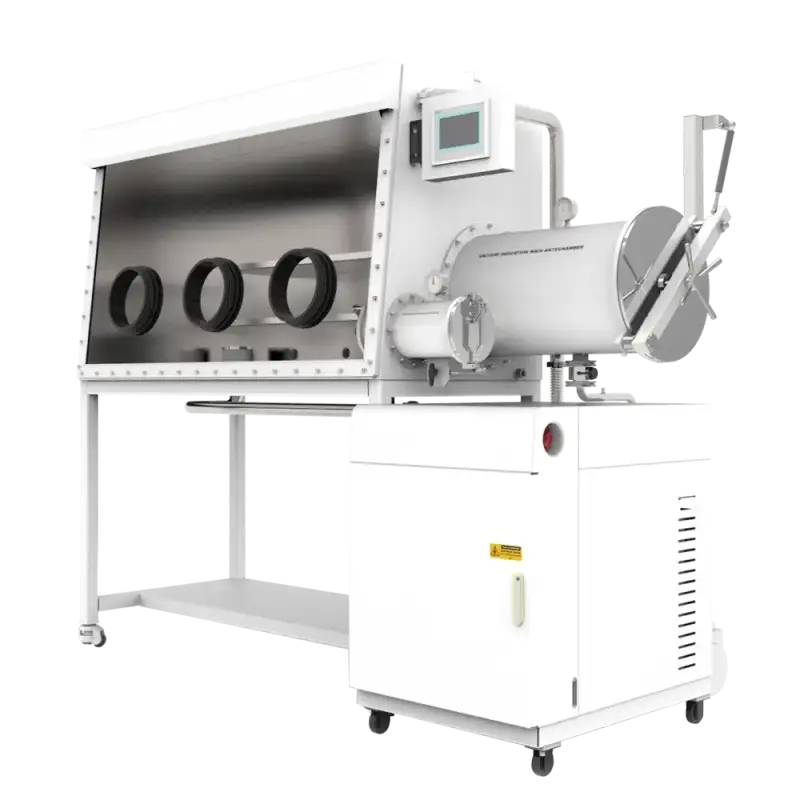
What is a Glove Box with Purification System? A Controlled Environment Enclosure for Air-Sensitive Material Processing

What is a Glove Box with Purification System? A Controlled Environment Enclosure for Air-Sensitive Material Processing
At its core, a glove box with purification system is a specialized sealed enclosure designed to maintain an ultra-low oxygen and moisture atmosphere (typically below 1 ppm) for handling and processing materials that are sensitive to air, humidity, or contaminants. Industries such as battery research and production, organic electronics (OLED/PLED), pharmaceutical synthesis, rare earth metal welding, and advanced materials science rely on this equipment to provide a stable, inert working environment – typically using argon or nitrogen as the protective gas.
Core Function and Working Principle
How It Transforms the Work Atmosphere
The primary function of a glove box with purification system is to take a standard ambient air environment (with ~21% oxygen and variable moisture) and convert it into a super-clean, inert atmosphere with oxygen and water concentrations below 1 part per million (ppm). This is achieved through a closed-loop gas purification cycle that continuously circulates the internal gas through a purification column containing specialized adsorbents.
Closed-Loop Purification Cycle
The system operates in a continuous loop: gas inside the glove box is drawn by a blower into the purification unit, where it passes through a column packed with high-capacity oxygen and moisture adsorbents (e.g., copper-based catalysts for oxygen removal and molecular sieves for water removal). The purified gas is then returned to the box. This method not only maintains ppm-level purity but also drastically reduces gas consumption compared to a simple purge method, making it cost-effective for long-term operations. The glove box with purification system also includes an automatic regeneration function: once the adsorbents are saturated, the system heats and purges the column with a small amount of regeneration gas to restore its capacity, typically controlled by a programmable logic controller (PLC).
Key Parameters Affecting Performance
Critical parameters include the leakage rate of the glove box itself (typically less than 0.001 vol/hr), the capacity of the purification column (e.g., oxygen capacity of 60 L and water capacity of 2 kg), and the regeneration cycle time. The purity of the incoming working gas also influences the ultimate achievable purity. A well-designed system can maintain O₂ < 1 ppm and H₂O < 1 ppm (equivalent to a dew point below -76°C) even with continuous operation.
Core Components and Key Technologies
1. Sealed Main Chamber
Typically constructed from 304 stainless steel (SUS304) with a wall thickness of 3 mm or more, the chamber ensures structural integrity and low permeability. Gloves made of special materials (e.g., butyl rubber or Hypalon) are fitted to the front ports; however, gloves contribute significantly to the overall leakage rate (approx. 60% of leaks). Therefore, minimizing the number of glove ports is beneficial for stricter purity requirements.
2. Gas Purification System
This is the heart of the equipment. It consists of one or two purification columns (for oxygen/water removal) and optionally a solvent adsorber to remove organic vapors. The columns are regenerable, often using a mixture of inert gas and small amount of hydrogen to reduce the catalyst. Advanced systems may also feature a reactive nitrogen removal unit (e.g., using heated titanium sponge) for applications demanding total inertness, such as some metal processing or nitrogen-sensitive chemistry.
3. PLC Control and Monitoring
A PLC (Programmable Logic Controller) manages all operations: pressure control (typically maintaining a slight negative or positive pressure inside the box), automatic regeneration cycles, and data logging. Touchscreen interfaces provide real-time readings of O₂, H₂O, and pressure. Many units also include optional add-ons like solvent adsorbers, integrated vacuum ovens, freezers, microscopes, or coating systems to expand functionality.
Key Performance Indicators and Selection Criteria
Purity and Leakage Rate
The most important specification is the achievable oxygen and water concentration. For most R&D applications, O₂ < 1 ppm, H₂O < 1 ppm is standard. The leakage rate (vol % per hour) indicates how well the box seals; a rate below 0.001 vol/hr is typical for a high-quality stainless steel glove box. If the application is extremely sensitive to nitrogen (e.g., lithium metal handling), look for a model with optional reactive nitrogen removal.
Gas Purification Capacity
Choose a purification column with adequate oxygen and water capacity based on your expected gas consumption and glove port numbers. Larger boxes or higher usage rates require greater capacity. Also consider the regeneration time and the amount of regenerant gas needed – some systems can regenerate automatically overnight, minimizing downtime.
Automation and Ease of Use
A PLC-controlled system with a touchscreen interface simplifies operation. Features like automatic pressure regulation, remote monitoring, and programmable regeneration cycles reduce manual intervention. For long-term continuous applications, look for robust blower systems and redundant safety features.
Customization and Options
Depending on your needs, you may require an integrated antechamber (to transfer samples without breaking atmosphere), a vacuum oven for drying, a refrigerator/freezer for temperature-sensitive materials, or a camera/microscope system for remote observation. Many manufacturers offer modular designs that allow you to add these features later.
Application Fields and Selection Advice
Primary Industries
- Lithium-ion battery research & production – handling electrolyte, cathode materials, and assembling cells under moisture-free conditions.
- OLED/PLED and photovoltaic devices – processing organic layers that degrade in air.
- Advanced materials synthesis – working with air-sensitive catalysts, metal-organic frameworks (MOFs), and nanomaterials.
- Rare earth metal welding & processing – achieving high-quality welds without contamination.
- Pharmaceutical & chemical industry – preparing and handling reactive intermediates.
Selection Guidance
For laboratory-scale R&D, a compact single-station glove box with a basic purification system is sufficient. For pilot or production lines, consider multi-station units with larger antechambers and optional solvent removal. If your work involves flammable solvents, ensure the glove box is certified for explosion-proof operation. Always verify that the glove box can integrate with your existing equipment (e.g., a stainless steel vacuum glove box for integration with vacuum processes).
Conclusion
A glove box with purification system is an indispensable tool for any research or production activity that demands a controlled, inert atmosphere. By understanding its core working principle, key components, and selection criteria, you can confidently choose the right system to protect your air-sensitive materials and ensure reproducible results.
References
Related Products
Get In Touch
Our professional team will reply to you within one business day. Please feel free to contact us!