

What Is a Double Cone Mixer? A Versatile Device for Uniform Powder Blending
What Is a Double Cone Mixer?
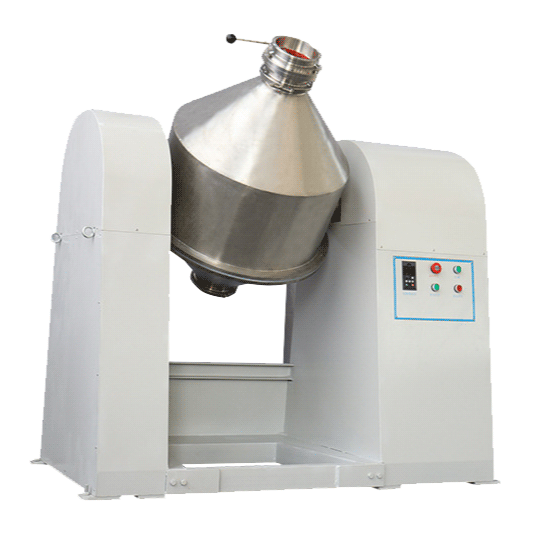
From a functional standpoint, the Double cone mixer is a gentle, gravity-driven blending machine used to combine dry powders, granules, and other free-flowing or semi-free-flowing solids into a more uniform bulk mixture. Its name comes from the shape of its rotating vessel: two conical sections joined at their widest point to form a double-cone drum. The vessel turns around a horizontal axis, causing material inside to tumble, fold, and exchange positions without the aggressive shear of a high-speed impeller. This makes the design relevant when the process goal is homogeneous blending rather than size reduction, wet granulation, or intense dispersion.
In a production or laboratory line, a double cone mixer usually sits between material preparation and downstream processing such as filling, tableting, packaging, or further reaction. It is used in food, chemical, pharmaceutical, ceramic, battery, and other powder-handling industries where an enclosed batch mixing step is needed. The product page describes the machine as part of a mixed-series equipment range; the exact model, working volume, contact material, and drive configuration should be confirmed with the supplier because those details vary by application.
Core Function and Working Principle
How the Double Cone Shape Supports Mixing
The core function of a double cone mixer is to convert a loaded batch of powders or granules from a settled, non-uniform state into a blended bulk state. The vessel is essentially a closed drum with two conical ends. When it rotates, friction between the powder bed and the inner wall lifts material along the rising side. Gravity then pulls the material back down, creating a continuous cascade. Because the vessel is widest at the middle and narrow at both ends, the powder does not simply slide as a single block; it is repeatedly divided, folded, and recombined.
This motion is often described as a combination of tumbling and folding. The conical ends guide material toward the center, while the cylindrical midsection provides space for the bed to expand and roll. Compared with a simple horizontal drum, the double cone geometry can improve axial exchange and reduce dead zones near the ends. Compared with high-shear or high-speed impeller mixers, it is gentler on fragile granules and less likely to cause excessive particle attrition, heat buildup, or over-blending.
The Mixing Cycle: From Loaded Powders to a Uniform Blend
A typical batch cycle begins with charging the vessel through a feed opening while the drum is positioned for convenient access. The opening is then sealed, and the drive rotates the vessel at a controlled speed. As the drum turns, the powder bed cascades from the upper wall, falls through the free space, and is reincorporated into the lower bed. Over successive revolutions, differences in position, velocity, and residence time within the bed cause the components to exchange places. The process continues until samples or validation checks indicate the required degree of uniformity.
Discharge usually takes place through a valve or opening at the low point of the vessel after rotation has stopped and the drum has been indexed to the correct position. The cycle can be batch-based and relatively simple, but the result depends on more than just rotation time. Fill level, rotational speed, particle size distribution, bulk density, flowability, and the tendency of ingredients to segregate or agglomerate all influence how quickly a uniform blend is reached.
Key Process Parameters and Their Influence
Rotational speed is one of the most visible parameters. If the vessel turns too slowly, the powder bed may slide rather than cascade, and mixing becomes inefficient. If it turns too fast, material may be carried too far up the wall or thrown against the shell, which can increase attrition or produce a less controlled folding pattern. The useful speed range depends on vessel diameter, material flow behavior, and the desired balance between gentle handling and mixing efficiency.
Fill level is equally important. A double cone mixer needs free space for the bed to expand and roll. Overfilling reduces the free surface and can suppress the cascading action, while underfilling may reduce contact between portions of the batch and lengthen the time needed to reach uniformity. Mixing time should be established experimentally for each formulation rather than copied from another product. Cohesive powders, ingredients with very different particle densities, and mixtures prone to segregation may need additional attention to charging order, feed preparation, or downstream handling.
Main Configurations and Key Components
Drive, Support, and Discharge Arrangements
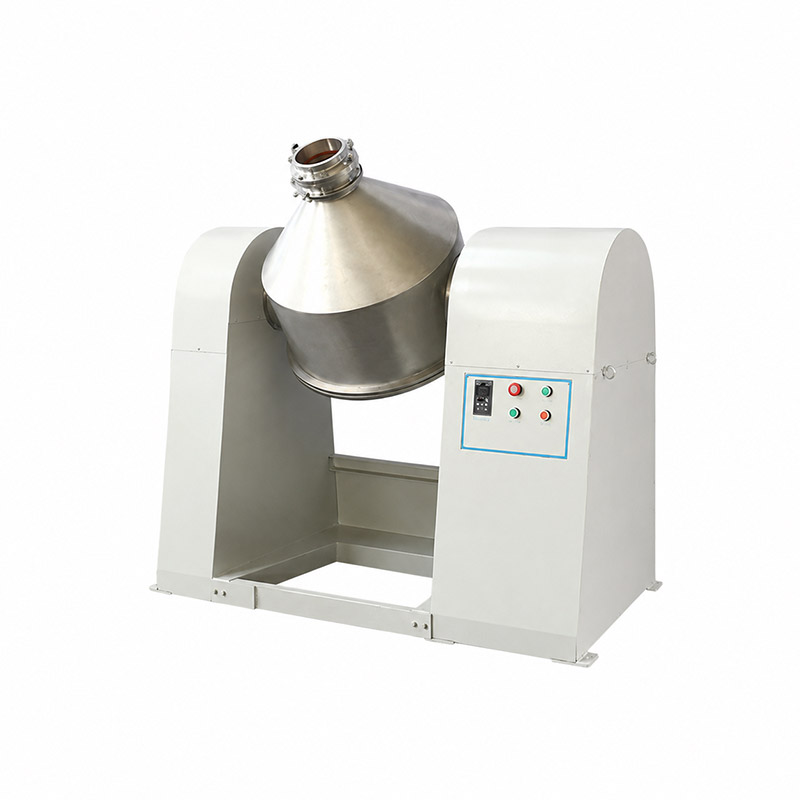
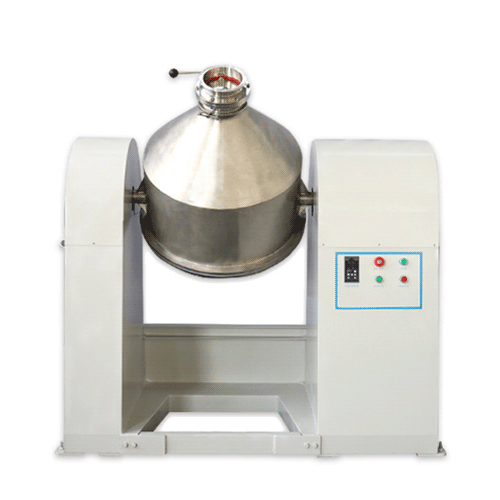
A double cone mixer is built around a rotating vessel, a support frame, and a drive system. The vessel is mounted on a horizontal shaft or trunnion arrangement that allows it to turn smoothly while carrying the batch load. A motor and gearbox provide the required torque at a controlled speed. The frame transfers the weight and dynamic load to the floor, and safety guards or enclosures separate operators from rotating parts. In many designs, the control system includes start and stop functions, speed adjustment, cycle timing, and interlocks that prevent rotation while the charging or discharge opening is open.
The discharge arrangement is a practical focal point because it affects emptying, cleaning, and product containment. Common approaches include a valve at the cone tip, a slide gate, or a clamped access port. The choice depends on the material's flowability, the required discharge rate, the need for dust control, and whether the mixer is connected to a downstream container, conveyor, or packaging line. Easy indexing of the vessel to the discharge position is also important for repeatable operation.
Sealing, Feeding, and Material Contact Parts
Because the vessel rotates, seals and connections must prevent dust leakage while allowing smooth motion. The feed and discharge openings may use gaskets, clamps, or sanitary connections depending on the duty. For food, pharmaceutical, or fine chemical applications, the material contact surfaces are usually selected for cleanability and compatibility with the product and cleaning agents. Stainless steel is common, but the exact grade, surface finish, and optional liners should be matched to the application rather than assumed.
Feeding method also matters. A simple manual charge may be suitable for small batches or laboratory work, while larger installations may use vacuum feeding, screw conveyors, or dedicated charging stations. The feeding method should avoid compacting the powder before mixing and should minimize dust generation. If the formulation contains minor ingredients, pre-blending or layered charging can help prevent localized concentration pockets that require long mixing times to eliminate.
Configuration Choices for Different Duties
Double cone mixers are commonly offered in different sizes and configuration levels, from compact laboratory units to larger production machines. The appropriate choice is not simply a matter of scaling up the vessel. A small unit may be selected for formulation development, sample preparation, or small-volume production, where easy access and flexible operation matter. A larger unit may be chosen for repetitive batch production, where discharge height, material handling, cleaning access, and integration with upstream and downstream equipment become more important.
Optional features may include variable-frequency drive for speed adjustment, different motor enclosures for dusty or classified environments, special surface finishes, sampling ports, and customized charging or discharge connections. These choices should be driven by the process requirements and site conditions. A buyer should also ask how the vessel is cleaned, how samples are taken, how the machine is locked out during maintenance, and whether the design can be validated or inspected according to the relevant quality system.
Key Performance Indicators and Selection Points
Blend Uniformity and Material Compatibility
The first performance question is whether the mixer can produce the required blend uniformity without damaging the product. Uniformity is usually assessed by sampling at defined locations and times, then comparing the concentration of a marker component or measuring a relevant physical property. A machine that looks mechanically suitable may still be wrong for a formulation if it causes segregation, attrition, or heat buildup. Gentle tumbling is an advantage for fragile granules, but it may not be sufficient for cohesive powders that require shear or intensification.
Material compatibility covers more than contact metal. It includes the effect of the product on seals and gaskets, the risk of abrasion, the potential for adhesion to the vessel wall, and the ease of cleaning between products. Powders with very different bulk densities may segregate during discharge even if they are well mixed inside the drum. In that case, the discharge arrangement and downstream handling may be as important as the mixing action itself.
Capacity, Loading, and Cycle Time
Capacity should be evaluated as working batch size, not just total vessel volume. A double cone mixer needs free space for the bed to move, so the usable load is normally lower than the geometric volume of the drum. Buyers should confirm the recommended working volume for the intended bulk density and fill level. They should also consider whether future products will have lower or higher bulk densities, because the same vessel may hold different masses of different powders.
Cycle time affects throughput and can influence blend quality. A shorter cycle is not automatically better if it leaves the batch non-uniform, and a longer cycle is not automatically safer if it causes over-blending, attrition, or segregation. The practical approach is to establish a mixing profile for each formulation, then verify it with sampling. For multi-product facilities, the worst-case or most challenging formulation should be considered during selection.
Energy, Automation, and Maintenance
Energy use in a double cone mixer is generally modest compared with high-shear processing, because the main work is lifting and tumbling the powder bed rather than creating intense shear. However, the drive, gearbox, and control system still need to be sized correctly for the starting load and operating torque. A variable-frequency drive can help match speed to the product and reduce mechanical stress during starts and stops. Automation can improve repeatability by storing speed, time, and indexing settings for each recipe.
Maintenance access is a practical selection criterion. The buyer should review lubrication points, seal replacement, bearing access, guard removal, and cleaning procedures. In hygienic applications, smooth surfaces, drainability, and access to product contact zones may matter more than small differences in motor efficiency. A mixer that is difficult to clean can create cross-contamination risk and longer changeover times, which may outweigh a lower purchase price.
Applications and Selection Advice
Industries and Material Scenarios
Double cone mixers are used in many powder-handling settings, including food ingredients, pharmaceutical excipients and blends, ceramic powders, chemical intermediates, battery materials, agricultural products, cosmetics, and plastic compounds. They are most comfortable with free-flowing or moderately free-flowing solids that can cascade inside the vessel. They are less suitable for pastes, slurries, high-moisture masses, or products that stick to the wall and cannot be discharged cleanly without special provisions.
Typical duties include homogenizing a batch before tableting or packaging, combining minor additives with a major carrier, and gently blending granules that must retain their structure. In some cases, the mixer is also used for simple storage or transport between process steps, but that should be confirmed with the supplier because a mixing vessel is not necessarily designed as a long-term storage container. The choice between a double cone mixer and another blender should be based on flow behavior, sensitivity to shear, cleaning needs, and batch size.
A Practical Selection Path for Different Users
For laboratory or formulation work, start with the smallest practical working volume that can produce a representative blend. Confirm that the unit can be cleaned easily, that samples can be taken without disturbing the batch, and that speed and time can be controlled and recorded. For pilot or production use, define the required batch size, bulk density range, discharge method, cleaning regime, and available floor space before comparing models. Then check the drive rating, support structure, sealing arrangement, and safety interlocks against the site requirements.
It is also useful to test the actual formulation whenever possible. A trial can reveal whether the powder cascades well, whether it adheres to the cone, whether discharge is complete, and whether the required uniformity is reached within a practical cycle time. Buyers should request drawings, material certificates, cleaning guidance, and spare-parts information. To review the equipment family and confirm current configuration options, visit the Double cone mixer product page and discuss the application with the supplier.
Frequently Asked Questions
Is a double cone mixer a high-shear mixer?
No. It is generally a gentle tumbling mixer. Its main action is gravity-driven cascading and folding, not high-speed impeller shear. That makes it useful for fragile granules and simple powder blends, but it may not be the best choice for very cohesive materials or formulations that require intense deagglomeration.
How full should the vessel be?
The correct fill level depends on the vessel design and the material. Enough free space must remain for the powder bed to expand and roll. Overfilling can suppress the cascade, while underfilling can reduce mixing efficiency. The supplier's recommended working volume should be confirmed for each bulk density and formulation.
Can it handle abrasive powders?
It can be considered for some abrasive products, but wear on seals, discharge parts, and contact surfaces should be reviewed. Optional liners or alternative materials may be available depending on the supplier and application. The decision should be based on the abrasive severity, acceptable contamination level, and maintenance plan rather than on the mixer name alone.
Related Products
Get In Touch
Our professional team will reply to you within one business day. Please feel free to contact us!