

What is a Desktop Air Blower Dryer? A Compact Forced Convection Drying Oven for Laboratory Sample Drying
Introduction
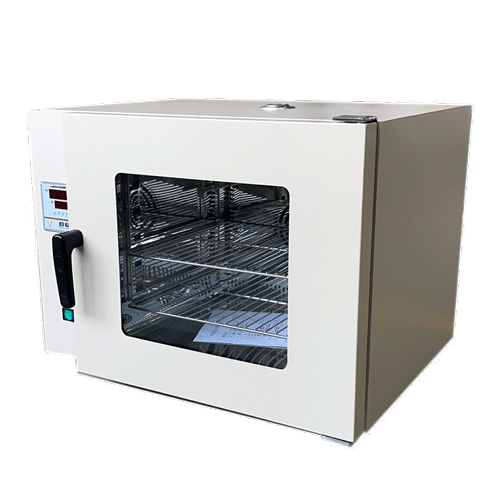
From the core, a desktop air blower dryer is a professional forced convection drying oven designed for laboratory and small-scale production use. It is used to remove moisture or solvents from solid samples, powders, electronic components, and other materials through controlled hot air circulation. Unlike static ovens, it employs a powerful fan to actively circulate heated air, resulting in faster and more uniform drying compared to natural convection or simple radiation methods.
Core Function and Working Principle
The basic function of a desktop air blower dryer is to transform a wet or moisture-containing sample into a dry, stable state. The core working mechanism involves a closed insulated chamber, a heating element (usually electric resistance wire), and a centrifugal or axial fan. The fan draws air from the chamber, passes it over the heating element, and then forces the hot air back into the chamber through specially designed vents. This continuous circulation ensures that every part of the sample is exposed to fresh hot air, accelerating the evaporation of water or organic solvents.
Key process parameters include temperature, airflow rate, and drying time. Temperature is precisely controlled by a digital thermostat or PID controller, typically ranging from ambient +10°C up to 250°C or higher. The airflow rate can be adjusted on some models to accommodate delicate samples. The final product quality depends on the uniform distribution of heat and the ability to maintain a stable setpoint without overshoot. For temperature-sensitive materials, a ramp-and-soak profile can be programmed to avoid thermal degradation.
Core Components and Key Technologies
While the desktop air blower dryer is a single product type, its performance relies on several critical components:
- Heating System: High-quality stainless steel or nickel-chromium alloy heating elements ensure rapid heating and long service life. The power rating (typically 500W to 2000W) determines the maximum heating rate.
- Fan and Air Duct Design: A powerful fan combined with a well-designed air duct (often with adjustable louvers) guarantees uniform temperature distribution across all shelves. The horizontal or vertical airflow pattern is optimized for different sample placements.
- Temperature Control: Microprocessor-based PID controllers with PT100 or thermocouple sensors provide accurate temperature control (±0.5°C to ±1°C). Some models include programmable timers, data logging, and alarm functions for over-temperature protection.
- Chamber Construction: The inner chamber is made of corrosion-resistant stainless steel, while the outer body is powder-coated steel with thick insulation to minimize heat loss and ensure surface temperature safety.
- Safety Features: Over-temperature cut-off, door interlock switch, and current leakage protection are standard to ensure operator safety.
Key Performance Indicators and Selection Criteria
When selecting a desktop air blower dryer, users should pay attention to the following metrics:
- Temperature Range and Stability: Most models offer a range from RT+10°C to 250°C. Higher-end units can reach 300°C. Stability is usually expressed as ±0.5°C to ±1°C at setpoint.
- Chamber Volume: Common sizes are 20L, 40L, 70L, and 100L. Choose based on the maximum batch size of samples.
- Airflow Rate and Uniformity: Look for specifications that indicate air change rate (e.g., 10-20 times per hour) and temperature uniformity (e.g., ±2°C across the chamber).
- Control Precision: Digital PID controllers with programmable ramp and dwell functions are preferred for complex drying profiles.
- Energy Efficiency and Noise: Modern units use efficient motors and insulation to reduce power consumption. Noise level is typically below 55 dB.
- Maintenance and Cleaning: Removable shelves, easy-access fan and heating elements, and smooth internal surfaces simplify cleaning and servicing.
Application Areas and Selection Advice
Desktop air blower dryers are widely used in:
- Material Science and Chemistry: Drying of powders, catalysts, and synthesized materials.
- Electronics and Semiconductor: Baking of PCBs, curing of coatings, and moisture removal from components.
- Pharmaceutical and Biomedical: Drying of herbal extracts, granulation, and sterilization of glassware.
- Ceramics and Metallurgy: Pre-drying of green bodies before sintering.
- Food and Agriculture: Moisture content determination and sample preparation.
For general laboratory use, a standard model with 40-70L volume and 250°C max temperature is a versatile choice. If you require precise temperature programming or work with flammable solvents, consider a model with explosion-proof features or inert gas purge capability. For high-throughput applications, larger units or multiple units may be more efficient.
References
Related Products
Get In Touch
Our professional team will reply to you within one business day. Please feel free to contact us!