

What Is a Corundum Grinding Ball? A Durable Ceramic Media for Fine Grinding
What Is a Corundum Grinding Ball?
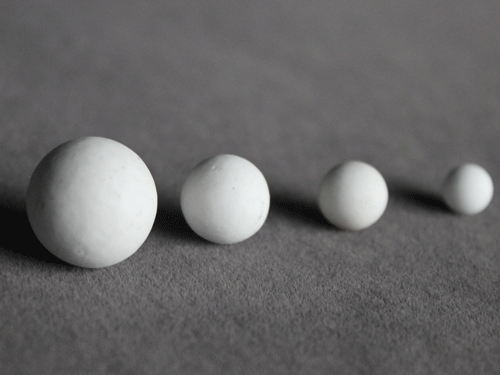
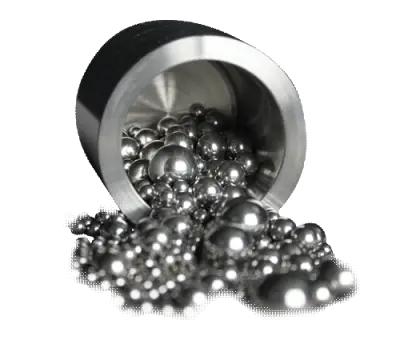
At its core, a corundum grinding ball is a ceramic grinding medium used inside ball mills, jar mills, and similar milling equipment to reduce particle size and disperse solid materials. In powder processing, the balls are the working elements that transfer motion from the mill jar or drum to the material being processed. The product name points to two defining ideas: corundum identifies the ceramic material family, and grinding ball identifies the physical form and function. The linked Corundum grinding ball product page is the best starting point for the exact grade, size, and packaging offered for a specific project.
For buyers, the useful definition is functional rather than decorative: the ball must be hard enough to resist wear, tough enough to survive repeated impacts, chemically stable enough not to contaminate the batch, and consistent enough to make milling results repeatable. Corundum grinding balls are therefore selected when a ceramic medium is preferred over steel or other metallic media, especially where contamination control, abrasion resistance, and fine grinding are important. The rest of this article explains the working principle, core components, selection criteria, applications, and practical operating questions in plain technical language.
How Corundum Grinding Balls Work
The basic job is simple: convert coarse feed into a finer, more uniform product. Inside a rotating or oscillating mill, the grinding balls are set in motion. Depending on the mill type and operating speed, the balls may cascade, tumble, roll, or strike one another. Material trapped between balls, between balls and the jar wall, or in the moving ball charge is subjected to impact, compression, and shear. Those mechanical actions break down particles and mix them into a more homogeneous powder. In a jar mill, the same principle operates at laboratory scale; in a larger ball mill, it operates at production scale. The corundum ball is the energy-transfer medium that makes this possible.
From Feed Material to Fine Particles
At the start, the feed may be a coarse powder, a granulated solid, a slurry, or a mixture of different ingredients. The mill does not change the fundamental chemistry of the material by itself; it applies mechanical energy. Size reduction occurs when the stress imposed by the grinding media exceeds the strength of the particles. Fine particles are created progressively as fractures accumulate. At the same time, mixing and dispersion take place because the ball charge continually rearranges the material. This is why ball milling is often described as a combined comminution and homogenization process, not merely a crushing step.
The transition from feed to product is gradual. Early in the cycle, large particles are broken and the particle-size distribution broadens. With continued milling, the distribution usually becomes narrower, although over-milling can also produce very fine fractions that are difficult to handle. A corundum grinding ball contributes to this process through its density, surface hardness, and shape. Hard, dense media can deliver effective impact energy, while smooth, consistent surfaces help maintain predictable motion inside the jar. The exact balance depends on the mill, the material, and the target fineness.
Key Process Parameters
Several parameters determine whether a corundum ball charge performs well. The first is ball size. Smaller balls provide more contact points and are generally useful for fine grinding, while larger balls carry more individual impact energy and are often better for breaking coarser feed. The second is ball charge volume. Too little media means inefficient grinding; too much media can restrict motion, increase power draw, and reduce the free space needed for material. The third is mill speed. If the mill runs too slowly, the charge may simply slide; if it runs too fast, centrifugal effects can pin the charge against the wall and reduce useful tumbling. The fourth is material fill and slurry viscosity. A batch that is too dry, too wet, or too sticky can coat the balls and jar, slowing size reduction.
Milling time is another critical variable. Longer milling generally produces finer particles, but it also increases wear, energy consumption, and the risk of over-processing. For heat-sensitive materials, the temperature rise caused by mechanical work must be considered. For reactive or high-purity materials, the chemical stability of the grinding medium matters. Corundum grinding balls are chosen because they offer a ceramic option that can be adapted to these variables. The practical lesson is that a ball should not be selected in isolation; it must be matched to the mill, the feed, the target product, and the acceptable level of contamination.
Wet and Dry Milling Conditions
The same ball can behave differently in wet and dry milling. In wet milling, the liquid carries particles, helps dissipate heat, and can improve dispersion, but it also changes viscosity and the way the ball charge moves. A slurry that is too thick may cushion impacts; a slurry that is too thin may allow particles to settle or bypass the most active grinding zone. In dry milling, the powder itself fills the voids between balls. Fine dry powders can coat the media, reduce friction, and make cleaning more difficult. For both modes, the ball charge should be adjusted to the material and the mill, and the process should be verified by a trial rather than by assumption.
Core Components and Key Technology
Because corundum grinding ball is a focused product rather than a large machine with many subassemblies, its core technology is best understood through the ball itself and its relationship with the milling environment. The important components are the ceramic body, the ball surface, the size distribution, and the jar or mill system that contains the charge. Each element influences grinding efficiency and the quality of the final powder.
Material Structure and Surface Condition
In general ceramic-media terms, corundum is associated with aluminum oxide, a hard oxide ceramic. The value of this material family in grinding comes from abrasion resistance and dimensional stability. A well-made ball should have a consistent body, without gross porosity, cracks, or soft spots that could cause premature breakage. Surface condition also matters. A smooth, regular surface reduces excessive friction and helps the ball charge move predictably. A damaged or rough surface can increase contamination and make cleaning more difficult. Users should inspect deliveries for chips, cracks, and obvious color or dimensional inconsistencies, and should confirm the exact material grade and quality controls with the supplier.
Ball Size, Shape, and Charge Design
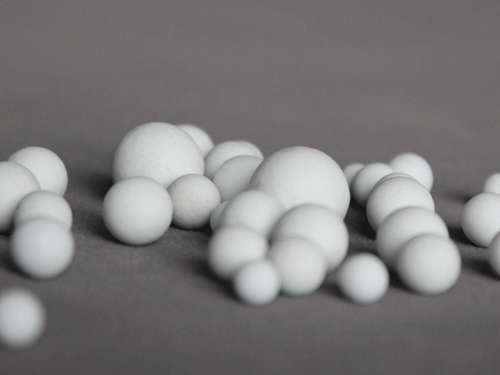
Grinding balls are not interchangeable just because they share a name. Size, sphericity, and size distribution affect the number of contact points, the mass of each ball, and the packing behavior of the charge. A narrow size distribution gives more predictable grinding; a mixed charge can combine coarse-breaking and fine-grinding actions. The right choice depends on the initial particle size, the target fineness, the jar diameter, and the available mill speed. In practice, a jar mill may use a relatively small media charge to avoid excessive wear, while a larger mill may need a broader ball-size strategy. The product page should be consulted for the available options rather than assuming that one size fits every application.
Jar and Mill Compatibility
The ball is only one part of the milling system. The jar material, jar geometry, lid seal, and mill motion all affect performance. A corundum ball charge should be compatible with the jar lining and with the material being processed. Hard media can wear softer jar materials, so the combination should be reviewed together. In planetary ball mills, the centrifugal and rotational motion creates a complex ball path; in roll mills, the jar rotates against rollers; in vibratory mills, high-frequency motion drives many small impacts. The same corundum ball may behave differently in each machine. This is why selection should begin with the mill type and the process goal, not with ball size alone.
What Good Quality Looks Like
Quality is not only a laboratory certificate; it is also consistency in the hand and in the mill. Balls from the same lot should look alike, feel uniform, and show no obvious defects. They should be packed to protect edges during transport and stored in conditions that avoid unnecessary moisture or impact. For process control, keep a record of the supplier, lot, size, and first use date. If a new lot behaves differently, the record helps isolate the cause. This kind of traceability is especially useful in laboratories and production environments where small changes in media can shift particle-size results.
Key Performance Indicators and Selection Criteria
When comparing corundum grinding balls, buyers should look beyond the product name. The most useful evaluation compares the media against the intended duty: what is being ground, how fine it must become, how often the mill runs, and how sensitive the final product is to contamination. The following indicators provide a practical framework.
Grinding Capacity and Particle Size Control
Capacity is not a single number that applies to every material. It depends on the mill volume, ball charge, feed properties, and target fineness. A media that works well for a free-flowing mineral powder may behave differently with a sticky chemical paste or a fibrous material. Particle-size control is equally important. The user should ask whether the ball charge can produce the required fineness within a reasonable time, whether the resulting distribution is narrow enough, and whether the product remains stable after milling. For many applications, the goal is not simply smaller particles but a reproducible particle-size range that meets a specification.
Energy Use and Milling Efficiency
Milling efficiency is the relationship between the useful size reduction achieved and the energy consumed. Dense, hard media can transfer energy effectively, but they also add mass to the mill and can increase power demand. The optimum is the combination that reaches the target fineness in the shortest practical cycle without excessive heating or wear. The operator should monitor cycle time, motor load, temperature, and product quality together. If a change in ball size or charge volume reduces milling time without harming the product, efficiency has improved. If it only increases wear and heat, the change is not necessarily beneficial.
Contamination Control and Wear Life
For high-purity ceramics, electronic materials, pigments, and laboratory samples, contamination is a central concern. Grinding media wear can introduce foreign particles into the batch. Corundum grinding balls are selected in many ceramic milling setups because the media family is compatible with oxide-based products and can offer good abrasion resistance. Even so, no grinding medium is completely immune to wear. Users should ask about wear rate, expected service life, and the chemical composition of the ball. In sensitive work, a small-scale trial followed by analysis of the milled product is more reliable than a generic claim.
Automation, Maintenance, and Cost of Ownership
Grinding balls are consumable working parts, so maintenance and cost of ownership matter. The operator needs a simple way to inspect the charge, remove broken or worn balls, clean the jar, and replace the media when performance drops. In automated or high-throughput laboratories, consistent ball quality helps reduce variability between runs. The purchase price is only one part of the cost; downtime, cleaning, reject batches, and premature jar wear also count. A practical evaluation should compare the ball’s useful life and handling behavior with the value of the product being made.
Documentation and Supplier Support
Good documentation makes selection easier. Useful information includes the product designation, available sizes, packaging, recommended handling, and any stated quality controls. The supplier should be able to answer questions about compatibility with different jar materials and about the best way to trial the media. Because applications vary widely, a supplier who can discuss the process rather than only the catalogue number is often more helpful. Buyers should also confirm that the quoted product matches the intended use, especially when the mill is used for regulated, high-value, or contamination-sensitive work.
Applications and Selection Advice
Corundum grinding balls are used where a ceramic milling medium is needed for particle-size reduction, mixing, or dispersion. Typical settings include laboratory jar mills, planetary ball mills, roll mills, vibratory mills, and other small-to-medium milling systems. They are common in ceramic raw materials, mineral powders, pigments, coatings, chemical powders, and research samples. The exact suitability depends on the material, the mill, and the required cleanliness. In some cases, the ball is used simply to break down agglomerates; in others, it is part of a carefully controlled fine-grinding step.
Typical Application Areas
In ceramic processing, corundum media can be used to mill oxide powders, glaze ingredients, and other ceramic compositions where a hard ceramic ball is appropriate. In pigment and coating work, the ball charge helps disperse colorants and reduce agglomerates in a liquid vehicle. In geological and mineral laboratories, jar mills with ceramic media prepare samples for analysis. In chemical and materials research, small mill jars allow expensive or scarce materials to be processed with low dead volume. Each application has its own priorities: some demand fine particle size, some demand low contamination, and some demand fast turnaround.
How to Choose the Right Corundum Grinding Ball
Start with the mill. Confirm the jar material, jar volume, recommended ball charge, and maximum operating speed. Then define the feed: initial particle size, hardness, moisture, and chemical sensitivity. Next define the target: final particle size, acceptable distribution, batch size, and whether the process is dry or wet. With those inputs, choose a ball size and charge that can deliver enough energy without overloading the mill. If the application is contamination-sensitive, review the ball composition and wear behavior carefully. If the application is a new process, run a small trial and compare results at more than one ball size. The product page for the Corundum grinding ball should be used to confirm the available specifications before ordering.
Practical Operating Checklist
Before each run, check the balls for cracks, chips, and unusual wear. Confirm that the jar is clean and that the lid seal is in good condition. Use the recommended ball charge rather than filling the jar arbitrarily. Record the ball size, charge weight, milling speed, and milling time so that results can be repeated. After milling, inspect the product for contamination and unwanted agglomeration. Clean the media according to the supplier’s guidance and store it dry. If milling time begins to increase for the same product, inspect the charge for worn or broken balls. These simple habits improve repeatability and protect the mill.
Troubleshooting Common Milling Problems
If the product is not becoming fine enough, first check the ball charge and milling time, then review the feed size and mill speed. If the product is contaminated, inspect the jar, lid, and media for wear. If the mill is overheating, reduce the charge, lower the speed, or split the batch. If results vary from run to run, standardize the charge weight, milling time, and loading procedure. If balls break repeatedly, the cause may be an unsuitable size, a damaged jar, or excessive speed. Troubleshooting should be systematic: change one variable at a time and record the result.
Frequently Asked Questions
These questions cover the points buyers ask most often when they first consider a corundum ball charge.
Is a corundum grinding ball the same as an alumina ball?
In broad industrial language, corundum is an aluminum oxide-based ceramic material, and corundum grinding balls are often discussed alongside alumina ceramic media. However, product names and specifications vary by supplier. Buyers should confirm the exact composition, grade, and quality standard rather than relying on the name alone.
Can corundum balls be used in a planetary ball mill?
They can be considered for planetary ball mills when the jar material, ball size, and operating conditions are compatible. Planetary mills generate high-energy motion, so the ball charge should be selected with care. Check the mill and jar instructions, and confirm the recommended media with the supplier.
Do larger balls always grind faster?
No. Larger balls carry more impact energy, which can help break coarse feed, but they provide fewer contact points. For fine grinding, a smaller ball size may be more effective. The best choice depends on the feed size, target fineness, mill diameter, and available speed.
How full should the mill jar be?
The jar should not be packed so tightly that the balls cannot move. A practical charge leaves enough free space for material and ball motion. The exact fill ratio should follow the mill manufacturer’s guidance and be confirmed through trials.
How can I reduce contamination?
Use media and jars that are appropriate for the product, inspect them for damage, and avoid mixing incompatible materials. For sensitive products, run a small trial and analyze the milled powder. Wear is normal, so monitoring and timely replacement are part of contamination control.
When should grinding balls be replaced?
Replace balls that are cracked, chipped, heavily worn, or no longer delivering the expected grinding performance. A sudden increase in milling time, visible damage, or unexplained product contamination can indicate that the charge needs attention.
Where to Learn More
For exact product details, available sizes, and ordering information, refer to the Corundum grinding ball product page. The most reliable selection process is to match the media to the mill, the feed material, and the required final powder specification, then confirm the choice through a small representative trial. A corundum grinding ball is a simple-looking component, but it plays a central role in milling performance, contamination control, and repeatability. Treated as part of the whole milling system rather than as a generic consumable, it can help users achieve consistent fine grinding results.
Related Products
Get In Touch
Our professional team will reply to you within one business day. Please feel free to contact us!