
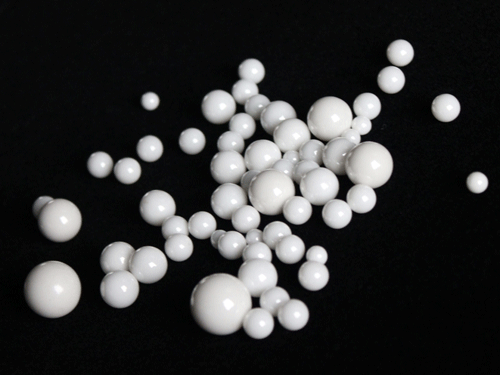
What is a Zirconia Grinding Ball? A High-Performance Grinding Medium for Ultra-Fine Powder Preparation in Ball Mills and Sand Mills

Introduction
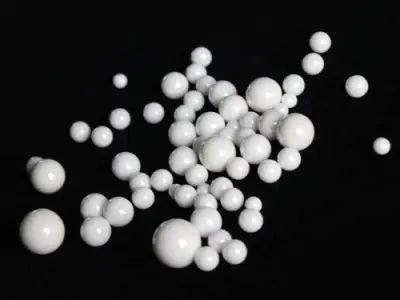
At its core, a zirconia grinding ball is a precision-engineered ceramic ball used as a grinding medium in ball mills, sand mills, and agitated media mills. It transforms coarse or agglomerated powder particles into ultra-fine, dispersed slurries with minimal contamination. Made primarily from yttria-stabilized tetragonal zirconia polycrystal (Y-TZP), these balls combine extreme hardness, high density, and outstanding toughness to deliver efficient comminution in demanding applications such as battery materials, electronic ceramics, paints, and pharmaceuticals.
How Does a Zirconia Grinding Ball Work?
The fundamental function of a zirconia grinding ball is to impart mechanical energy to the feed material through impact and attrition. Inside a rotating or agitated mill chamber, the balls are set into motion. In planetary ball mills, the centrifugal forces cause the balls to tumble and collide with the material trapped between them or against the chamber wall. In high-speed sand mills, the balls are stirred by a rotor, generating intense shear and impact forces that break down particles into the nanometer range.
The key working mechanism relies on the ball's high density (typically 5.95–6.05 g/cm³), which provides greater kinetic energy per ball compared to lower-density media like glass or alumina. This allows for shorter grinding times and finer final particle sizes. The yttria stabilization ensures the zirconia maintains a tough tetragonal crystal structure, preventing catastrophic fracture under repeated high-energy collisions.
Key Process Parameters
Several parameters influence grinding efficiency: ball size (ranging from 0.1 mm to 20 mm), ball-to-powder weight ratio, rotational speed, and grinding time. Smaller balls create more contact points for dispersing soft agglomerates, while larger balls are better for breaking hard primary particles. The chemical inertness of zirconia prevents unwanted reactions with the slurry, preserving material purity—a critical requirement for high-value products.
Types and Classifications of Zirconia Grinding Balls
Zirconia grinding balls are mainly classified by their zirconia content and stabilizer type. The most common grades are:
1. 95% Zirconia Balls (Y-TZP)
These contain about 95% ZrO₂ stabilized with 3–5 mol% yttria. They offer the best combination of hardness (HRA 87–91), fracture toughness (9–11 MPa·m½), and wear resistance. Self-wear levels are extremely low (ppm range), making them ideal for high-purity applications like MLCC paste and pharmaceutical ingredients. The Sanno brand, with ISO 9001 and IATF 16949 certifications, is a notable example, offering reproducible quality with XRD and SEM reports.
2. Ceria-Stabilized Zirconia Balls (Ce-TZP)
These use cerium oxide as the stabilizer. They exhibit slightly lower hardness but higher toughness. They are preferred for grinding highly abrasive materials where impact resistance is critical, such as in mining and mineral processing.
3. 65% Zirconia Balls (Zirconia-Silica Composite)
Containing approximately 65% ZrO₂ and 35% SiO₂, these are more economical and suit lower-intensity grinding tasks like pigments and inks. They have lower density (around 4.0 g/cm³) and higher wear rates compared to 95% balls but cost less.
Selection Criteria Between Types
The choice depends on the material hardness, purity requirement, and budget. For zero-contamination, high-efficiency nanogrinding, 95% yttria-stabilized balls are the clear choice. For less demanding applications or initial cost savings, ceria-stabilized or 65% zirconia balls can be suitable.
Key Performance Indicators and Selection Guide
When selecting zirconia grinding balls, consider these critical metrics:
- Density: Higher density (≥5.95 g/cm³) provides more grinding power. However, excessively high density may accelerate mill liner wear. Optimal balance is around 5.95–6.0 g/cm³.
- Hardness and Toughness: Hardness ensures media retain shape; toughness prevents chipping and breakage. Look for HRA ≥87 and fracture toughness ≥9 MPa·m½.
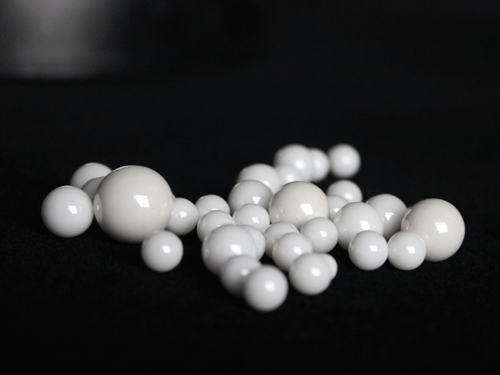
- Sphericity and Surface Finish: High sphericity (>95%) and smooth surface reduce mill wear and prevent impurity migration. Visually, good balls have a pearl-like luster.
- Wear Rate: Premium Y-TZP balls have wear rates below 0.01% per hour in typical planetary mill operation. This directly impacts batch purity.
- Size Distribution: Uniform size ensures consistent grinding action. Suppliers should provide tight tolerances (e.g., ±0.1 mm).
- Chemical Inertness: The ball must not react with acids, alkalis, or organic solvents used in the process. Zirconia's inertness is excellent.
Applications and Recommendations
Zirconia grinding balls are used across many industries: lithium battery materials (cathode/anode active materials), electronic ceramics (MLCC, ferrites), paints & coatings (high-viscosity inks), pharmaceuticals (API particle size reduction), cosmetics (pigment dispersion), and food science (colloidal milling).
For laboratory R&D and small-batch production, a zirconia grinding ball set in sizes 1–10 mm paired with a planetary ball mill is ideal. For industrial mass production, larger balls (10–20 mm) are used in sand mills or stirred mills. Always match ball size to the mill's separator gap to avoid jamming.
If contamination from iron or silica must be avoided (e.g., for high-purity ceramics), choose only high-grade Y-TZP with documented purity analysis. For general purpose grinding, 95% zirconia offers excellent cost-performance balance.
Conclusion
Zirconia grinding balls are indispensable consumables in modern ultra-fine grinding. Their engineered properties—high density, toughness, and chemical inertness—enable reproducible, high-purity particle size reduction. By understanding the types, performance indicators, and proper selection factors, you can optimize your milling process and achieve superior product quality.
References
Related Products
Get In Touch
Our professional team will reply to you within one business day. Please feel free to contact us!