

What is a 3D Mixer? A High-Efficiency Mixing Equipment for Uniform Blending of Powders and Granules
What is a 3D Mixer?
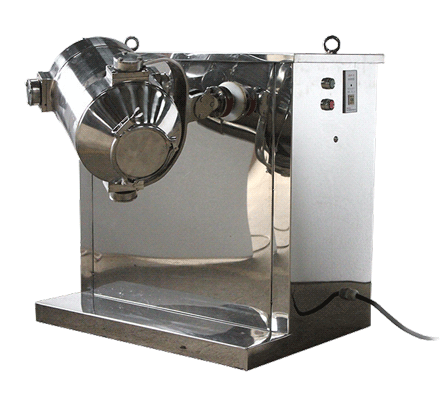
At its core, a 3D mixer (also known as a three-dimensional motion mixer or multi-dimensional mixer) is a specialized mixing equipment designed to achieve highly uniform blending of powders and granules. Industries such as pharmaceuticals, chemicals, food processing, and scientific research use it to overcome the limitations of conventional mixers, particularly the segregation caused by centrifugal forces. Unlike traditional rotary mixers, a 3D mixer moves the mixing container in three spatial directions simultaneously, creating a complex tumbling and swirling motion that ensures every particle has equal opportunity to mix.
Core Function and Working Principle
How It Transforms Raw Materials
The fundamental function of a 3D mixer is to convert a mixture of solid particles from an initial segregated state into a uniformly blended final product. The key mechanism involves a mixing container (usually a cylindrical or polyhedral drum) that is suspended on two universal joints (Y-type universal joints) arranged perpendicularly in space. When the drive shaft rotates, the container undergoes a composite motion of translation, rotation, and tumble in three orthogonal axes (X, Y, Z). This multi-directional movement causes the material inside to flow, diffuse, and collide from all directions, effectively eliminating the centrifugal force that causes density segregation and accumulation in conventional mixers.
Key Process Parameters
The mixing quality is influenced by several adjustable parameters:
- Rotation speed: Affects the intensity of the motion; optimal speed ensures the material is lifted and tumbled without excessive impact.
- Mixing time: Usually short (minutes to tens of minutes) due to high efficiency; uniformity can reach 99.9% or higher.
- Loading volume: A 3D mixer can be loaded up to 90% of its total volume (compared to 50% for conventional mixers), significantly improving throughput.
- Material properties: Works best with free-flowing powders and granules; cohesive materials may require special adjustments.
Core Components and Key Technologies
While the 3D mixer is a single type of equipment, it can be broken down into its essential components:
- Mixing Container: Typically made of stainless steel (304 or 316L) with polished inner and outer surfaces to meet GMP cleanliness standards. The container has smooth, rounded corners to eliminate dead zones and facilitate easy cleaning.
- Drive System: An electric motor and reduction gearbox that provide controlled rotation. Some models include a frequency inverter for variable speed control.
- Universal Joints (Y-type): Two joints mounted at right angles to each other, allowing the container to move freely in three dimensions.
- Control System: Digital timers and speed controllers; advanced models may include touch screens and programmable logic controllers (PLC) for automated operation.
- Frame and Base: A robust steel structure designed to absorb vibrations and ensure stability during operation.
Key Performance Indicators and Selection Guide
What to Look for When Choosing a 3D Mixer
- Mixing Uniformity: The best 3D mixers achieve uniformity exceeding 99.9%. This is critical for pharmaceutical applications where content uniformity must meet strict standards.
- Loading Capacity: High fill ratio (up to 90%) means higher productivity per batch. Compare with conventional mixers that only handle 50%.
- Material Compatibility: Ensure the container material (stainless steel, optional coatings) is compatible with your product. For abrasive or corrosive materials, special linings may be required.
- Cleanability and GMP Compliance: Polished surfaces, no dead corners, and easy disassembly for cleaning are essential for pharmaceutical and food applications.
- Automation Level: From simple manual timer to fully programmable systems with data logging, choose according to your quality management requirements.
- Scale: Laboratory-scale units (1-10 liters) for R&D; pilot-scale (10-100 liters) for process development; production-scale (100-1000+ liters) for manufacturing.
Application Areas and Selection Advice
Where is a 3D Mixer Used?
The 3D mixer is a versatile tool across many industries:
- Pharmaceutical: Blending of active pharmaceutical ingredients (APIs) with excipients, granulation intermediates, and powder formulations for tablets or capsules.
- Chemical: Mixing of pigments, catalysts, plastic additives, and fine chemicals.
- Food: Blending of spices, seasonings, beverage powders, nutritional supplements, and instant food mixes.
- Cosmetics: Homogenization of powder foundations, eye shadows, and other dry cosmetic products.
- Research & Development: Laboratories in universities and institutes for material science, battery materials, ceramics, and more.
Selection Tips for Different Users
- For R&D labs: Choose a compact, benchtop model with variable speed and easy cleaning. Look for transparent containers to observe mixing behavior.
- For small-scale production: Opt for a stainless steel model with GMP design, sealed ports for dust-free operation, and optional vacuum or inert gas capability.
- For large-scale manufacturing: Consider automated systems with PLC control, integrated feeding/discharging, and clean-in-place (CIP) options.
References
For more detailed specifications and to explore the full range of 3D mixers, visit the official product page: 3D Mixer - TENCAN. Related mixing equipment includes the V-type mixer, Double cone mixer, and Oblique mixer.
Related Products
Get In Touch
Our professional team will reply to you within one business day. Please feel free to contact us!