

What is a Three Roll Mill? A High-Shear Grinding Equipment for Viscous Paste Dispersion
What is a Three Roll Mill?
At its core, a three roll mill is a specialized grinding and dispersing machine used to mix, refine, and homogenize high-viscosity paste materials. Industries such as ink, paint, cosmetics, electronics, and pharmaceuticals use it to break down agglomerates and achieve ultra-fine particle dispersion, typically down to 3-18 microns. By applying intense shear force between three horizontally positioned rolls rotating at different speeds, the three roll mill transforms coarse, lumpy pastes into smooth, uniform, and stable finished products.
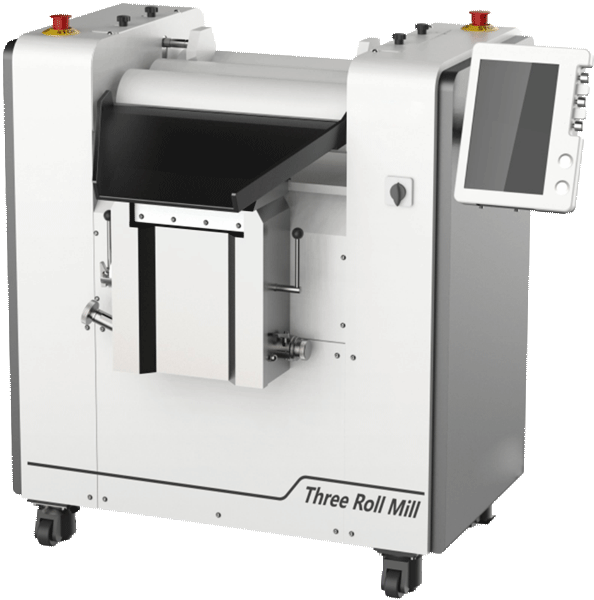
Core Working Principle: How a Three Roll Mill Works
The three roll mill operates on a simple yet highly effective principle: shear force. It consists of three adjacent cylindrical rolls—commonly called the feed roll, center roll, and apron roll—that rotate in opposite directions at progressively higher speeds. Material, usually in the form of a thick paste, is fed between the feed roll and the center roll. As the rolls turn, the narrowing gap between them creates intense shear, forcing the paste through the first nip.
After passing the first nip, most of the material adheres to the center roll and is carried into the second nip between the center roll and the apron roll. Here, the shear force is even greater due to the higher speed of the apron roll and a typically smaller gap. Finally, a knife blade scrapes the processed material off the apron roll, and the refined paste rolls down for collection. This milling cycle can be repeated multiple times to maximize dispersion uniformity and achieve the desired fineness.
Product Types and Key Component Features
Three roll mills come in several types to suit different production scales and application needs:
- Laboratory & Small Batch Models (e.g., S65, S150): Designed for R&D, formulation testing, and small-scale production. They feature compact footprints, manual gap adjustment, and lower throughput, making them ideal for labs and pilot plants.
- Production Models (e.g., S260, S315, S405): Built for continuous, high-volume manufacturing. These robust machines often include hydraulic systems for precise gap control, automatic feeding, and cooling systems to manage heat buildup during high-speed operation.
- Hydraulic and CNC-Controlled Models: Advanced versions integrate hydraulic roll adjustment and PLC-based control systems, allowing for repeatable, precise gap settings and automated operation. These are preferred for high-end applications requiring strict quality consistency.
Key component features include rolls made from chilled alloy cast iron or ceramic, high-precision bearings, and interchangeable scraper blades. The surface hardness of the rolls is typically around HS70° to ensure durability and consistent performance.
Key Performance Indicators and Selection Guidelines
When selecting a three roll mill, consider the following critical parameters:
- Roll Diameter and Working Length: Larger rolls provide higher throughput and better cooling capacity. For example, an SM260 model has a roll diameter of 260 mm and a working length of 620 mm.
- Speed Ratios and Motor Power: Different speed ratios between rolls generate varying shear forces. Typical ratios are around 1:2.5:6 (slow:medium:fast). Motor power ranges from 0.75 kW for lab models up to 15 kW for production units.
- Fineness Capability: Most three roll mills can achieve finished product particle sizes of 3-18 microns, measured with a fineness scraper. The number of passes and gap settings determine the final fineness.
- Cooling System: For heat-sensitive materials like cosmetics or food, a built-in water cooling system inside the rolls is essential to maintain temperature stability and prevent degradation.
- Automation and Control: Hydraulic gap adjustment, PLC touchscreen interfaces, and automatic feeding systems enhance repeatability, reduce operator dependency, and improve overall efficiency.
Applications and Selection Advice
The three roll mill is a versatile machine widely used across many industries. Common applications include:
- Printing Inks and Paints: To disperse pigments and achieve consistent color, gloss, and viscosity.
- Cosmetics and Personal Care: For milling lipstick, cream, and toothpaste to ensure a smooth, luxurious texture.
- Electronics and Ceramics: To process conductive pastes, electrode materials, and ceramic slurries for thick-film circuits and capacitors.
- Pharmaceuticals and Food: For refining ointments, pastes, and chocolate masses.
For labs and small-scale R&D, a bench-top model like the S65 offers flexibility and low capital investment. For full-scale production, choose a heavy-duty model such as the SM315 or SM405 with hydraulic control and automated feeding to maximize throughput and consistency. Always match the roll material (steel or ceramic) and cooling capability to the chemical and thermal properties of your paste.
References
Related Products
Get In Touch
Our professional team will reply to you within one business day. Please feel free to contact us!