

What Is a Hydraulic Dual-Shaft Disperser? A High-Shear Slurry Mixing Machine
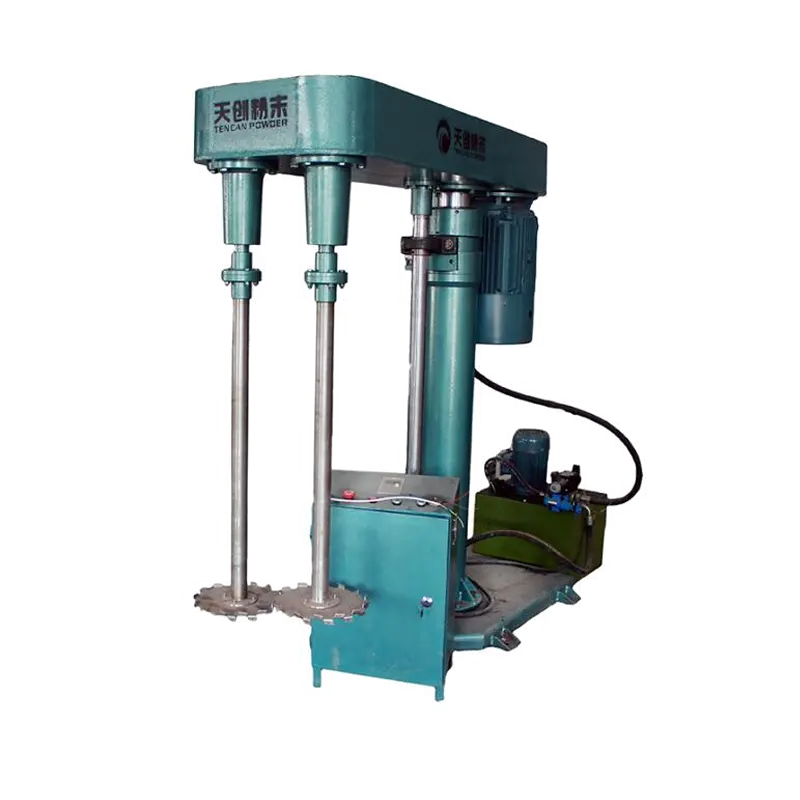
From a core engineering standpoint, a hydraulic dual-shaft disperser is a heavy-duty wet mixing and dispersion machine used to turn a combination of powders, liquids, and additives into a uniform, stable slurry. It belongs to the broader family of high-shear dispersers, but its defining feature is the use of two shafts that perform different duties at the same time. One shaft usually provides high-speed shear for breaking down agglomerates and dispersing solids; the other provides low-speed bulk mixing and wall scraping so that the entire batch moves through the high-shear zone. The hydraulic system generally assists with lifting, lowering, or positioning the mixing head, which makes the machine easier to load, clean, and maintain. The hydraulic dual-shaft disperser from TENCAN is presented as part of a mixed-equipment series, and its exact working volume, motor ratings, and control package should always be confirmed against the official product page before purchase.
Core Functions and Working Principle
From Raw Materials to a Uniform Slurry
Manufacturing a slurry is not simply a matter of stirring powder into liquid. When powder first contacts liquid, each particle must be wetted, air must be displaced from the powder surface, and clusters of fine particles must be broken apart. If these steps are incomplete, the batch may contain lumps, visible specks, sediment, or an unstable viscosity. A dual-shaft disperser addresses these steps by combining bulk turnover with localized high shear. The low-speed shaft keeps the batch moving and pushes material toward the high-speed shaft; the high-speed shaft creates a zone of rapid flow, pressure differences, and shear that pulls agglomerates apart. The result is a slurry in which solids are distributed more evenly and the liquid phase wets the particle surfaces more consistently.
The Role of the Two Shafts
Although designs differ, the two shafts in a hydraulic dual-shaft disperser are normally assigned complementary tasks. The high-speed dispersion shaft often carries a sawtooth or toothed-disc impeller. At the impeller tip, the material is accelerated outward and then sheared as it moves through the surrounding slurry. This action is effective for breaking down soft agglomerates and for distributing powders that tend to form lumps. The low-speed shaft often carries an anchor, paddle, or scraper assembly. Its job is not to generate the finest dispersion; it is to keep the whole batch circulating, reduce dead zones, and prevent material from collecting on the vessel wall or bottom. Working together, the two shafts can process formulations that would be difficult for a single-shaft mixer: highly filled pastes, viscous slurries, and batches in which powder addition causes a rapid rise in viscosity.
Hydraulic Positioning and Operator Control
The word hydraulic in the product name is sometimes misunderstood. In a hydraulic dual-shaft disperser, the hydraulic system most commonly provides lifting or positioning force for the dispersing head, rather than acting as the only source of mixing energy. Hydraulic lifting allows the shaft and impeller assembly to be raised for loading, inspection, and cleaning, and lowered into the vessel for operation. This arrangement can reduce manual effort and make the machine more practical when the mixing head is heavy or when the vessel is large. The mixing energy itself normally comes from one or more electric motors driving the shafts, while the hydraulic circuit controls movement and may also support lid sealing or other mechanical functions. Buyers should confirm which functions are hydraulic on a given model, because configurations can differ between suppliers and machine sizes.
Wetting, Deagglomeration, and Stabilization
Three physical processes are usually happening in parallel. Wetting is the replacement of air on the powder surface by liquid; deagglomeration is the breakup of clusters held together by Van der Waals forces, moisture, or electrostatic attraction; and stabilization is the creation of conditions that keep the particles from re-clumping after dispersion. The first two processes depend strongly on flow and shear, while the third depends on formulation chemistry, particle size, and mixing history. A dual-shaft disperser can help with all three by providing both global circulation and local high-shear zones, but it cannot compensate for a poorly designed formulation. This is why disperser selection should be treated as part of a broader process design that includes binder selection, dispersant choice, solids loading, temperature control, and the order of ingredient addition.
Process Parameters That Change the Result
Several operating parameters influence the quality of the final slurry. Shaft speed affects shear rate and the amount of air entrained; too little shear may leave agglomerates intact, while excessive shear can overheat the batch, damage shear-sensitive ingredients, or create foam. The solids-to-liquid ratio affects viscosity and the ability of the impeller to move the batch. The position of the impeller in the vessel influences the flow pattern and the risk of dead zones. Feed rate and addition sequence matter as well: adding powder too quickly can create a viscous mass that the impeller cannot wet efficiently. Vacuum or temperature control, when available, can remove air and manage heat. These are general process principles, not fixed settings for a particular TENCAN model; the correct values must be established through trials and the manufacturer's operating instructions.
Core Components and Configuration Choices
Because a hydraulic dual-shaft disperser is often configured for a specific process, it is more useful to think in terms of component groups than to assume a single universal design. The right combination depends on batch size, viscosity, solids loading, hygiene requirements, and the way operators will load and clean the machine.
Shaft Arrangement and Impeller Geometry
Common dual-shaft layouts place a high-speed dispersion shaft off-center and a low-speed stirring shaft near the center, or use an anchor/scraper on the vessel wall with a separate high-speed shaft. The geometry must be matched to the vessel so that the high-shear zone is not isolated from the bulk batch. A sawtooth disc is widely used for dispersion because its teeth create high local shear and strong pumping; an anchor or paddle is used for bulk movement. Some machines add a wall scraper to improve heat transfer and prevent buildup. The correct impeller diameter, tooth pattern, and clearance are engineering variables, not interchangeable accessories. A mismatched impeller can cause poor circulation, excessive power draw, or dead zones even when the motor is adequate.
Vessel, Lid, and Sealing
The vessel is part of the mixing system, not a passive container. Its diameter-to-height ratio, bottom shape, baffles, and jacket affect flow and heat transfer. A close-fitting lid can support dust containment, solvent retention, and vacuum operation, but it also changes loading and cleaning procedures. Seals must be selected for the process: dry powders, waterborne slurries, solvent-based products, and abrasive fillers place different demands on shaft seals and bearings. For abrasive or high-purity products, wetted materials and surface finishes may matter as much as motor power. Users should identify all wetted materials, cleaning agents, and temperature conditions before choosing a configuration.
Hydraulic Power Unit and Safety
The hydraulic power unit should be treated as a separate subsystem with its own maintenance needs. Hydraulic oil condition, filtration, hose routing, and cylinder seals all affect reliability. Good machine design keeps hydraulic components away from spill zones and provides service access without dismantling the mixing head. Safety devices may include limit switches, pressure relief, guards, and interlocks that prevent lifting or rotation when the lid is open. Because the exact safety architecture varies, buyers should ask for the relevant documentation and ensure that local requirements are met. A hydraulic system that is well specified for one product may be unsuitable for another if the operating environment is corrosive, dusty, or washdown-heavy.
Controls and Data Logging
Basic machines may use manual pushbuttons for lifting, shaft speed, and auxiliary functions. More advanced configurations can include variable-frequency drives, recipe management, temperature interlocks, and data logging. The value of automation depends on the process. For a laboratory or small pilot line, manual control with clear readouts may be sufficient; for production, repeatable recipes and audit trails can reduce batch-to-batch variation. It is important to separate mixing control from hydraulic control: the operator should be able to see shaft speed, motor load, batch temperature, and hydraulic position without guessing. Control architecture should also allow safe cleaning and maintenance. Any claimed accuracy or communication protocol should be verified against the supplier's specification.
Key Performance Indicators and Selection Points
Selecting a hydraulic dual-shaft disperser is not a matter of choosing the largest motor. The machine must match the rheology of the product, the batch size, the required fineness, and the cleaning regime. The following indicators are useful for comparing quotations and for asking better technical questions.
- Working volume range for normal, minimum, and maximum batches.
- Viscosity and solids-loading range at the thickest process stage.
- Required dispersion fineness and the acceptance test method.
- Motor, shaft-speed, and hydraulic-lift requirements.
- Wetted materials, seal type, and cleaning procedure.
- Temperature, vacuum, electrical, and safety requirements.
Working Capacity and Batch Size
Working capacity should be stated as a usable volume range, not only as a vessel volume. A vessel may be filled to different levels depending on foam, viscosity, and the need for headspace. Oversizing a machine can waste energy and leave the impeller too far from the batch surface; undersizing can cause long cycle times and poor circulation. The best approach is to define a normal batch, a minimum batch, and a maximum batch, then confirm that the proposed shaft lengths and impeller positions work across that range. For multi-product plants, flexibility may be more valuable than a single optimized point.
Viscosity, Solids Loading, and Flow Regime
High-solids slurries and pastes require enough low-speed torque to keep the mass moving, while the high-speed shaft must still be able to create local shear. If the product becomes too viscous, the high-speed impeller may simply carve a channel without dispersing the whole batch. The low-speed scraper then becomes essential for renewing material at the wall. Buyers should describe the product at its thickest and thinnest points, not just its final viscosity. They should also explain whether the viscosity changes during processing, because a machine that works at the end of the batch may fail during powder loading.
Dispersion Quality and Fineness
Fineness of dispersion is usually assessed by grind gauge, particle-size analysis, gloss, haze, conductivity, or another product-specific method. The disperser alone does not determine final fineness; the formulation, raw-material quality, and downstream milling also matter. A dual-shaft disperser is often used to wet out and pre-disperse solids before a bead mill or other fine-grinding step. It can also complete the dispersion for products that do not require very fine particles. Users should define the acceptance test before selecting a machine, and they should avoid assuming that a higher shaft speed will always improve quality. In some systems, over-dispersion can damage fillers, generate foam, or cause flocculation.
Energy, Heat, and Air Entrainment
Mixing energy eventually becomes heat. High-shear dispersion can raise batch temperature quickly, especially in viscous products with high solids loading. If the formulation contains heat-sensitive binders, surfactants, or solvents, the vessel may need a jacket, controlled addition rate, or a lower-shear strategy. Air entrainment is another common issue: a strong vortex can pull air into the slurry, creating foam and reducing density consistency. The interaction between impeller design, shaft speed, and liquid level determines how much air enters the batch. A well-designed dual-shaft system can reduce surface vortices through bulk circulation, but it should be tested with the actual formulation.
Maintenance, Cleaning, and Changeover
Cleaning is a major part of ownership cost. Shafts, impellers, scrapers, lids, and seals must be accessible without unnecessary disassembly. Product contact surfaces should be compatible with the cleaning chemicals and temperature used. If the plant switches between colors, solvents, or regulated materials, the machine should support verified cleaning procedures. Hydraulic hoses and fittings should be routed so that spills do not create slip hazards or contaminate product. A machine that is difficult to clean may perform well in one campaign but become a bottleneck in a multi-product plant. Maintenance intervals for oil, filters, seals, and bearings should be documented in the manual.
Applications and Selection Advice
Hydraulic dual-shaft dispersers are used where a formulation must be mixed, wetted, and dispersed at high solids loading. Typical sectors include coatings and paints, printing inks, adhesives and sealants, battery slurries, ceramic suspensions, chemical intermediates, and some cosmetic or pharmaceutical preparations. The common thread is a need to combine powder and liquid into a uniform suspension without creating excessive dust or long manual mixing times. In a coatings line, the machine may prepare a mill base before fine grinding; in an adhesive plant, it may handle a filled paste; in a battery-material process, it may wet and pre-disperse active materials and conductive additives. These are general application patterns, and the suitability of a specific model must be confirmed with the supplier.
For a laboratory or pilot project, prioritize flexibility, small working volume, easy cleaning, and clear instrumentation. For production, prioritize repeatability, hydraulic lifting convenience, service access, and the ability to handle the thickest stage of the batch. If the product is shear-sensitive, consider lower-shear bulk mixing and controlled high-shear time. If the product is abrasive, focus on wear protection and seal design. If solvents are present, confirm electrical classification, sealing, and solvent-compatible materials. If the process requires vacuum or temperature control, treat those as system requirements rather than add-ons. The best way to compare offers is to provide a detailed process brief: formulation, solids loading, viscosity curve, batch size, required fineness, cleaning method, and utilities. Then ask each supplier to explain how the proposed shaft arrangement and hydraulic system meet those conditions.
Practical FAQ
Is a hydraulic dual-shaft disperser the same as a planetary mixer?
No. Both can handle viscous materials, but a planetary mixer typically moves one or more mixing tools around the vessel on a planetary path, while a dual-shaft disperser uses a high-speed dispersion shaft and a low-speed bulk-mixing shaft. The dual-shaft design is generally chosen for wetting and dispersing powders into liquids, especially when high local shear is needed.
Does the hydraulic system create the dispersion shear?
Usually not. The hydraulic system commonly lifts, lowers, or positions the mixing head. The high shear comes from the rotating dispersion shaft and its impeller. Some machines may use hydraulic power for other functions, so the exact role of the hydraulic circuit should be confirmed in the technical description.
Can one machine handle both low-viscosity and high-viscosity batches?
It may, but the working range must be checked carefully. A low-viscosity batch can splash or form a deep vortex, while a high-viscosity batch may require more low-speed torque and wall scraping. The impeller position, shaft speed, and vessel design all affect the practical range. A trial with the real formulation is more reliable than a general viscosity claim.
What information should be included in a trial request?
Provide the formulation, solids content, viscosity at different stages, batch size, required fineness, maximum temperature, cleaning method, and available utilities. Also state whether the product is abrasive, flammable, shear-sensitive, or prone to foaming. These details allow the supplier to recommend a realistic shaft arrangement and to define the tests that will confirm performance.
Where to Verify Product Details
The official TENCAN product page for the hydraulic dual-shaft disperser is the authoritative place to confirm the current configuration, available options, and technical documents: hydraulic dual-shaft disperser product page. Because a single product family can be built with different vessel sizes, motor ratings, and control packages, this article intentionally avoids quoting fixed numbers that may not apply to every unit. When preparing a purchase specification, request a dimension drawing, utility requirements, wetted-material list, control description, and maintenance schedule. That documentation will be more useful than a generic capacity claim, and it will make comparisons between suppliers more reliable.
Related Products
Get In Touch
Our professional team will reply to you within one business day. Please feel free to contact us!