

What is a Hanging Tank Flotation Machine? A Laboratory Flotation Device for Selective Mineral Separation
What is a Hanging Tank Flotation Machine? A Laboratory Flotation Device for Selective Mineral Separation
At its core, a hanging tank flotation machine is a specialized laboratory-scale flotation device that mineral processing and research laboratories use to separate valuable minerals from gangue (waste rock) through the process of froth flotation. It is designed to handle small batches of ore samples, typically from a few grams up to several kilograms, allowing researchers to test flotation performance, optimize reagent schemes, and evaluate ore amenability before scaling up to industrial operations. The machine is also widely employed in educational institutions for teaching the principles of mineral separation.
Core Function and Working Principle
The basic function of a hanging tank flotation machine is to transform a mixed ore pulp into two distinct products: a concentrate enriched in target minerals and a tailings consisting mostly of gangue. The working principle relies on the difference in surface wettability between minerals. After adding appropriate flotation reagents (collectors, frothers, modifiers), the pulp is agitated by a rotating impeller, which simultaneously disperses air into fine bubbles. Hydrophobic (valuable) mineral particles attach to the rising bubbles and accumulate as froth on the surface, while hydrophilic (gangue) particles remain in the pulp and are eventually discharged as tailings.
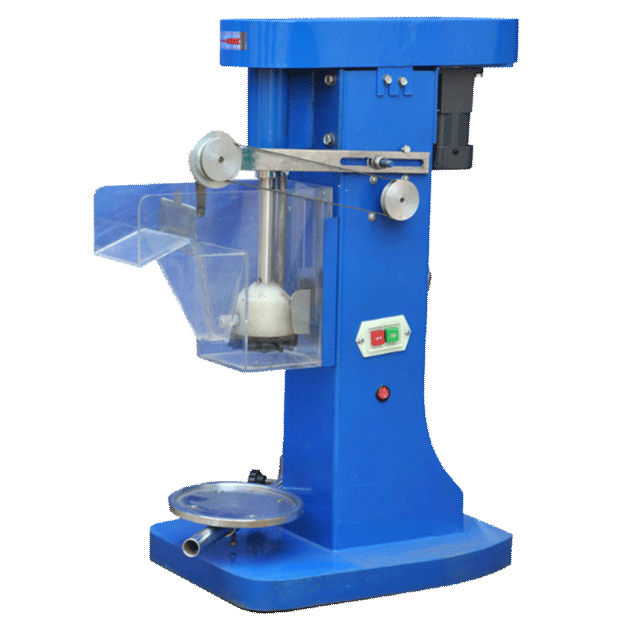
The machine's design features a hanging tank that is easily interchangeable, allowing quick switching between different sample sizes or tests without cross-contamination. The impeller speed and aeration rate are precisely controllable, enabling researchers to mimic different flotation kinetics. The froth layer is scraped manually or automatically to collect the concentrate, and the desired separation efficiency is achieved by adjusting parameters such as impeller speed, aeration rate, pulp density, reagent dosage, and flotation time.
Core Components and Technical Features
While the machine type is relatively straightforward, the hanging tank flotation machine incorporates several key components that ensure reliable and reproducible results:
- Hanging Tank (Cell): Made of transparent or wear-resistant material, the tank is suspended from a bracket and is interchangeable. Common capacities range from 20 mL to 4000 mL, accommodating samples from 5 g to 1000 g.
- Impeller Assembly: The impeller is connected to a variable-speed motor via a vertical shaft. Impeller diameters vary according to tank volume (e.g., Φ20 mm for small cells to Φ80 mm for 1000 g cells). Speed is typically adjustable between 900 and 2000 rpm to suit different flotation conditions.
- Air Intake System: Often a hollow shaft or separate air tube introduces air into the impeller zone, where it is sheared into fine bubbles. Some models include a flow meter for precise air control.
- Froth Scraper: A motorized or manual scraper rotates above the cell to skim off the froth layer into the collection launder.
- Control Panel: Modern units feature digital displays for speed, timer, and sometimes aeration rate, allowing easy setup and repeatability.
Key Performance Indicators and Selection Criteria
When selecting a hanging tank flotation machine, users should consider the following metrics:
- Sample Capacity Range: Units typically cover 5–1000 g per test. Choose a model that matches your typical sample weight. For example, an XFG5-35 handles 5–35 g, while an XFG1000 handles 1000 g.
- Impeller Speed Range and Control: A wider speed range (e.g., 900–1850 rpm) provides flexibility for different mineral types and particle sizes. Digital speed control ensures reproducibility.
- Aeration Control: The ability to adjust and measure air flow rate is critical for mimicking industrial conditions. Some machines have built-in air pumps or external connections.
- Material of Construction: The tank and impeller should be chemically inert and abrasion-resistant. Transparent acrylic or polycarbonate tanks are common for observing bubble-particle interactions.
- Ease of Maintenance: Quick-change cell design, simple sealing, and easy cleaning prevent cross-contamination between tests.
Applications and Selection Advice
The hanging tank flotation machine is primarily used in:
- Mineral processing research laboratories for bench-scale flotation tests on ores of copper, lead, zinc, molybdenum, gold, and other metals.
- Geological survey departments for ore deposit evaluation and process development.
- Universities and technical colleges for teaching flotation principles and conducting student projects.
- Chemical and environmental laboratories for testing flotation of industrial minerals or waste treatment.
If you work with very small samples (e.g., <50 g), choose a model with micro-tanks (such as XFG5-35). For larger batch testing (e.g., 500–1000 g), opt for a bigger capacity unit like XFG1000. For multi-parameter flotation optimization, a machine with continuous speed and aeration adjustment is recommended. Visit the Hanging tank flotation machine product page for detailed specifications and models.
References
Produtos relacionados
Entre em contato
Nossa equipe profissional responderá em até um dia útil. Fique à vontade para entrar em contato conosco!