

What is a Small Ball Mill with a Ceramic Jar? A Compact Drum Ball Mill for Laboratory Sample Grinding
What is a Small Ball Mill with a Ceramic Jar? A Compact Drum Ball Mill for Laboratory Sample Grinding
At its core, a small ball mill with a ceramic jar is a specialized drum-type grinding mill designed for laboratory and pilot-scale applications. It uses a rotating cylindrical jar made of high-quality ceramic to grind, mix, and homogenize solid materials into fine powders. This equipment is favored in research and small-batch production settings because the ceramic jar effectively prevents metallic contamination, ensuring high purity of the final product.
Core Function and Working Principle
The primary function of this mill is to reduce particle size through mechanical impact and attrition. The ceramic jar is partially filled with grinding media (typically ceramic balls of the same material) and the material to be ground. As the jar rotates around its horizontal axis, the grinding media are lifted by friction and centrifugal force to a certain height, then cascade or cataract down, crushing the material through impact, shearing, and abrasion.
The rotational speed is a critical parameter: at low speeds, the media roll and cause attrition; at optimal speed (around 60-75% of critical speed), the media fall in a cataracting motion, providing efficient impact grinding. If the speed exceeds the critical limit, the media are centrifuged and no grinding occurs. The grinding fineness can be controlled by adjusting the rotation speed, the size and type of grinding balls, the material-to-ball ratio, and the milling duration.
Core Components and Key Technologies
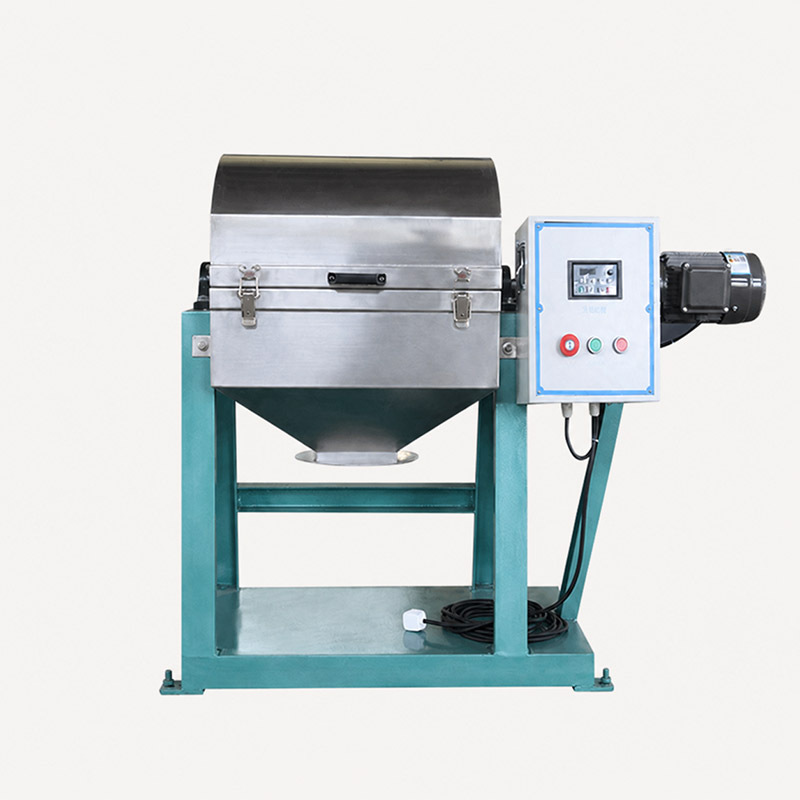
Although the design is relatively simple, the performance of a small ball mill with a ceramic jar depends on several key components:
- Ceramic Jar: The jar is typically made of alumina, zirconia, or other high-density ceramics. These materials offer excellent wear resistance, chemical inertness, and non-metallic properties, making them ideal for grinding samples that must avoid iron or other metal contamination. The jar's volume ranges from hundreds of milliliters to several liters, suitable for small batch processing.
- Drive System: A reliable motor and speed control unit (often variable frequency drive) regulate the rotation speed precisely. Digital displays allow users to set and monitor the speed, ensuring reproducibility across experiments.
- Roller or Direct Drive Mechanism: In roller-type designs, the jar rests on powered rollers that rotate it. This allows easy swapping of jars of different sizes. Some models use direct coupling for more stable rotation, especially with heavier jars.
- Safety Features: Many units include a safety cover or interlock to prevent operation when the lid is open, protecting users from flying debris or accidental injury.
Key Performance Indicators and Selection Guide
When evaluating a small ball mill with a ceramic jar, consider the following parameters:
- Capacity and Jar Volume: Choose a jar size that matches your batch volume. Typical capacities range from 0.5 L to 5 L per jar. Larger jars can process more material but require more powerful drives.
- Grinding Fineness: The achievable particle size depends on the material, milling conditions, and time. Most models can produce particles down to a few micrometers or even sub-micron levels with extended milling.
- Speed Range and Control: A wide speed range (e.g., 50-600 RPM) allows adaptation to different materials. Precise digital speed control ensures consistent results.
- Material of Jar and Media: For contamination-sensitive applications, select high-purity alumina or zirconia jars and matching grinding balls. Avoid using steel balls with ceramic jars unless the jar is lined with wear-resistant material.
- Ease of Maintenance: Ceramic jars are easy to clean and resistant to chemicals. Removable lids and smooth inner surfaces simplify cleaning between batches.
- Noise and Safety: Look for models with sound-dampening enclosures and safety interlocks to ensure comfortable and safe operation in a laboratory environment.
Application Fields and Selection Recommendations
This type of ball mill is widely used in:
- Materials Research: For grinding ceramics, minerals, catalysts, and composite materials.
- Pharmaceutical and Chemical Industry: For preparing fine powders of active ingredients, pigments, and additives.
- Geology and Mining: For pulverizing rock and ore samples before analysis.
- Electronics and Battery Materials: For preparing electrode materials and electrolytes without metal contamination.
For users who need to process multiple samples simultaneously, consider multi-station models like the two working station jar mill or four station jar mill. If larger batch sizes are required, a large roll ball mill may be more appropriate. For light-duty laboratory tasks, the light-duty roll ball mill offers a compact and economical solution.
Summary
A small ball mill with a ceramic jar is an essential tool for any laboratory that demands contamination-free, reproducible fine grinding. Its simple operation, minimal maintenance, and versatility make it a top choice for researchers and small-scale producers. By understanding the working principles and key specifications, you can select the right model to meet your specific grinding needs.
References
関連製品
お問い合わせ
当社の専門チームが1営業日以内に返信します。お気軽にお問い合わせください。