

What is a Laboratory Planetary Grinder? A Desktop High-Energy Ball Mill for Fine Grinding and Mixing of Small Samples
What is a Laboratory Planetary Grinder?
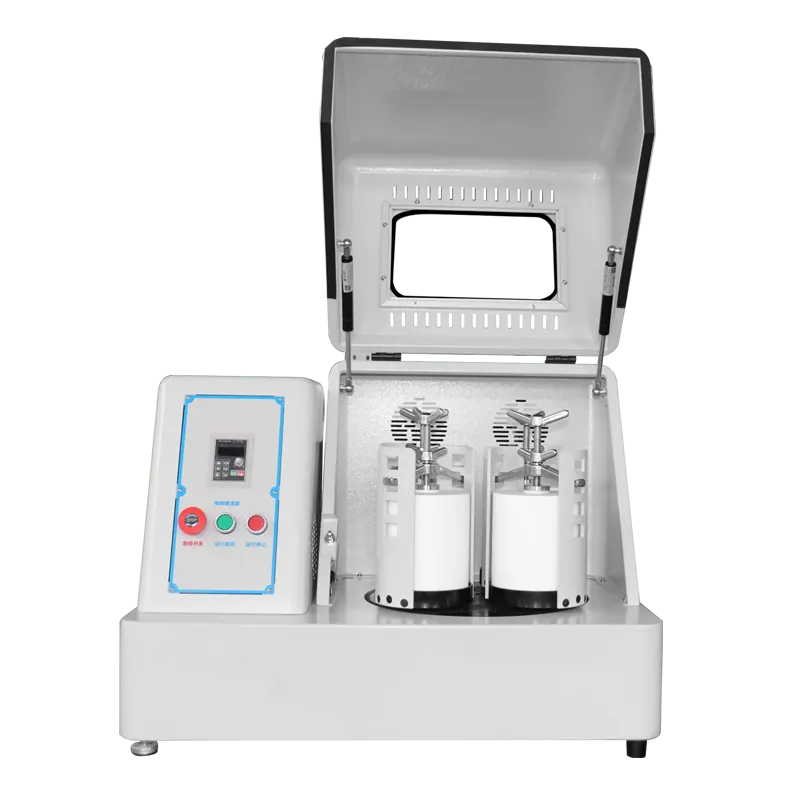
At its core, a laboratory planetary grinder is a specialized desktop device used to mill, mix, and homogenize small quantities of materials—typically from a few grams to a few hundred grams—into fine powders or suspensions. Researchers and engineers in materials science, pharmaceuticals, chemistry, and geology rely on it to achieve ultrafine grinding, uniform blending, and efficient dispersion of solids, often down to the nanometer scale. Unlike conventional ball mills, the laboratory planetary grinder employs a unique planetary motion that generates extremely high impact energy within a compact footprint, making it an indispensable tool for sample preparation and small-scale production.
Core Function and Working Principle
The primary function of a laboratory planetary grinder is to transform coarse particles into ultrafine powders through mechanical energy. The machine consists of a main sun wheel (also called the rotary table) that holds one or more grinding jars. During operation, the sun wheel rotates around its central axis while each jar simultaneously rotates around its own axis in the opposite direction—much like planets orbiting the sun. This dual-rotation creates powerful centrifugal and Coriolis forces that drive the grinding balls inside the jars into intense motion.
The grinding process involves three simultaneous actions: impact (high-speed collisions break large particles), shear (friction between balls and material creates fine abrasion), and compression (pressure forces particles to fracture). By adjusting the rotation speed (typically 300–600 rpm), grinding time, ball size, and ball-to-material ratio, operators can precisely control the final particle size distribution. Many modern laboratory planetary grinders, such as those offered by TENCAN, also feature programmable touchscreens that allow users to store up to ten grinding programs, ensuring repeatability and ease of use.
Key Components and Critical Technologies
Although the laboratory planetary grinder is a single product type, its performance heavily depends on several core components:
Grinding Jars and Media
The jars are available in a wide range of materials—including stainless steel, zirconia, agate, nylon, polyurethane, PTFE, and tungsten carbide—to suit different sample hardness, abrasiveness, and contamination requirements. For instance, agate jars are ideal for grinding silica-containing materials without iron contamination, while zirconia jars offer high wear resistance for ceramic powders. Similarly, grinding balls (media) are chosen in matching materials and sizes (typically 0.5–20 mm diameter) to optimize impact and shear forces.
Drive and Transmission System
A robust motor and gear system deliver consistent planetary motion. Quality grinders employ precision bearings and balanced rotors to minimize vibration and noise, even at maximum speeds. Some advanced models integrate full-directional rotation (360° swinging) to prevent material sedimentation in the jar, ensuring more homogeneous mixing.
Control and Safety Features
Modern units come with microprocessor-based control, touch-screen interfaces, and programmable timing. Safety interlocks prevent operation when the lid is open, and some versions include automatic reverse rotation to reduce heat buildup. For specialized applications, cryogenic models using liquid nitrogen or low-temperature planetary grinders are available to process heat-sensitive or volatile materials.
Key Performance Indicators and Selection Guide
When choosing a laboratory planetary grinder, consider the following criteria:
- Capacity and Throughput: Typical jar volumes range from 50 mL to 500 mL per jar, with total sample loads of a few grams up to about 200 grams. Select a model that matches your typical batch size.
- Particle Size Control: Most laboratory planetary grinders can achieve final fineness below 1 μm (micron), with some reaching 0.1 μm (100 nm). Check the specified minimum particle size and the ability to adjust speed and time.
- Speed Range and Energy Input: Higher speed (e.g., up to 600 rpm) generates more impact but may cause excessive heating. For heat-sensitive materials, a low-temperature version is advisable.
- Automation Features: Programmable memory, adjustable acceleration/deceleration, and multi-step protocols improve reproducibility and convenience.
- Maintenance and Durability: Look for easy-to-clean jar clamping systems (e.g., quick-release clamps) and durable seals. The use of high-quality bearings and gears extends service life.
Application Areas and Selection Advice
Laboratory planetary grinders are widely used in: materials research (ceramics, metals, polymers, composites), pharmaceutical formulation (drug powders, excipients), geology and mining (ore, rock, soil analysis), chemistry (catalysts, nanomaterials), and energy storage (battery materials). For routine sample preparation with moderate throughput, a standard two- or four-station model like the Laboratory Planetary Grinder from TENCAN delivers excellent value. If your work involves ultra-trace quantities (less than 10 grams), consider a micro planetary ball mill designed for glove-box integration. For large-volume pilot-scale studies, a vertical production planetary ball mill may be more appropriate.
References
- Laboratory Planetary Grinder — https://www.planetaryballmills.com/ja/products/grinding-series/planetary-ball-mill/laboratory-planetary-grinder.html
関連製品
お問い合わせ
当社の専門チームが1営業日以内に返信します。お気軽にお問い合わせください。