

What is Double Cone Mixer? A Versatile Mixing Equipment for Blending Powders and Granules
What is Double Cone Mixer? A Versatile Mixing Equipment for Blending Powders and Granules
At its core, a double cone mixer is a professional batch mixing device that industries such as pharmaceuticals, chemicals, food processing, feed, and building materials use to uniformly blend dry powders, granules, and even small amounts of liquid into a homogeneous mixture. This equipment relies on the rotation of a double-cone-shaped vessel to tumble materials, using gravity and centrifugal force to repeatedly combine and separate particles without any cutting or crushing action.
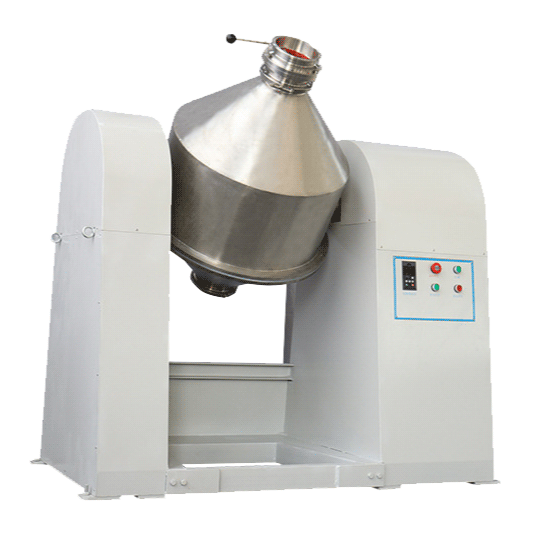
Core Function and Working Principle
The basic function of a double cone mixer is to transform a mixture of different solid particles from an initial segregated state into a final uniformly blended state. The heart of the machine is a horizontally or slightly inclined rotating vessel shaped like two cones joined at their bases (hence the name double cone). The vessel is driven by a motor and gear system, which rotates it at a controlled speed.
Inside, as the vessel turns, materials are lifted by the internal walls and, upon reaching a certain height, tumble downward under gravity along the cone surfaces. This repeated lifting, cascading, and rolling motion promotes intensive particle-to-particle movement, leading to rapid mixing by diffusion, convection, and shear—though the process is gentle and does not grind or damage the particles. Key parameters affecting mixing quality include rotation speed (typically adjustable), fill volume (usually 30-60% of the total vessel capacity), and mixing time. The cone angle is often designed to match the material's angle of repose (commonly 90° or 75°) to ensure efficient discharge.
Core Components and Key Technologies
A double cone mixer consists of four main subsystems:
- Vessel (Tank): Made of stainless steel (304 or 316L), with polished internal and external surfaces for easy cleaning and corrosion resistance. The cone angle is optimized for material flow and discharge.
- Drive System: Includes a motor, reducer, and gear transmission. Many models feature variable-speed drives to adjust rotation speed for different materials and batch sizes.
- Slip Ring Box: Provides electrical power and signals to rotating components, enabling automated control and monitoring.
- Support Frame: A robust metal structure that holds the vessel and drive system, ensuring stable operation.
Optional additions include heating/cooling jackets for temperature-sensitive materials, liquid spray nozzles for adding binders or coatings, and vacuum or inert gas connections for specialized processes.
Key Performance Indicators and Selection Criteria
When selecting a double cone mixer, buyers should consider the following factors:
- Batch Volume / Capacity: Common capacities range from laboratory-scale (a few liters) to industrial (up to several cubic meters). Choose a model that fits your typical batch size without overfilling (recommended 30-60% fill).
- Mixing Uniformity: High-quality double cone mixers achieve coefficient of variation (CV) below 5% for most free-flowing powders. GMP-compliant designs ensure no dead zones and easy cleanability.
- Speed Control: Adjustable rotation speed allows optimization for different materials (e.g., fragile granules require slower speeds).
- Material Contact Parts: Stainless steel is standard; for corrosive materials, titanium or special coatings may be used (e.g., titanium alloy for chemical processes).
- Automation: Features like timer, PLC control, and automatic discharge valves improve repeatability and reduce operator intervention.
- Cleaning and Maintenance: Smooth internal surfaces, rounded corners, and CIP (Clean-in-Place) options simplify cleaning between batches, crucial for pharmaceutical and food applications.
Applications and Selection Advice
Double cone mixers are widely used across many industries:
- Pharmaceutical: Blending active pharmaceutical ingredients (APIs) with excipients, granulation mixtures before tableting or capsule filling.
- Chemical: Mixing powdered catalysts, pigments, fertilizers, and plastic additives.
- Food & Feed: Blending seasonings, protein powders, animal feed premixes, and nutritional supplements.
- Battery Materials: Pre-mixing electrode powders before further processing in V-type mixers or 3D mixers.
For users with free-flowing, non-friable powders requiring gentle blending, a double cone mixer is an excellent choice. If materials tend to segregate by density or particle size, consider a multi-dimensional mixer or a horizontal screw belt mixer for more aggressive action. For lab-scale R&D, compact tabletop double cone mixers are available, while production-scale units can process hundreds of liters per batch.
References
المنتجات ذات الصلة
تواصل معنا
سيرد فريقنا المتخصص عليك خلال يوم عمل واحد. لا تتردد في الاتصال بنا!