

What is a Colloid Mill? A High-Shear Wet Grinding Equipment for Emulsifying, Dispersing, and Homogenizing
What is a Colloid Mill? A High-Shear Wet Grinding Equipment for Emulsifying, Dispersing, and Homogenizing
At its core, a colloid mill is a specialized wet grinding machine that industries such as food processing, pharmaceuticals, chemicals, cosmetics, and coatings use to process fluid and semi-fluid materials into ultra-fine emulsions, dispersions, and suspensions. By applying intense mechanical forces, the colloid mill reduces particle sizes down to the micron or even submicron range, creating stable colloidal systems that are essential for product quality and consistency. Unlike dry grinding equipment like ball mills or jet mills, the colloid mill excels in wet comminution where the material is already in liquid or paste form.
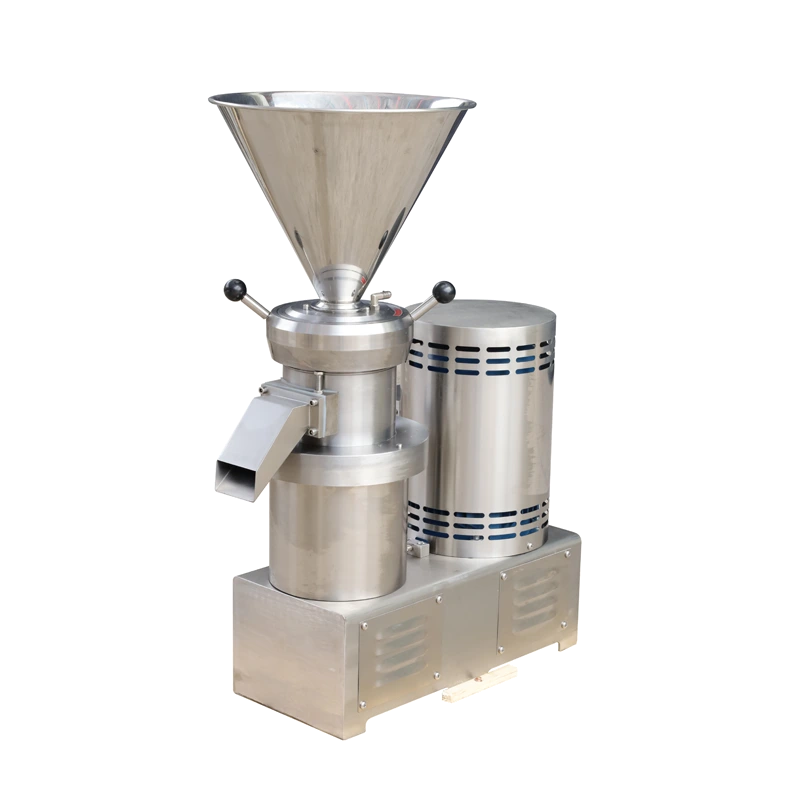
Core Function and Working Principle
The basic function of a colloid mill is to transform a coarse, inhomogeneous mixture into a finely dispersed, stable product. It achieves this by passing the material through a narrow, adjustable gap between a high-speed rotating rotor (also called a rotating tooth) and a stationary stator (fixed tooth). The rotor, driven by an electric motor through a belt drive, spins at speeds typically ranging from 2,000 to 10,000 RPM depending on the model.
The material enters the mill either by gravity or by external pressure (e.g., from a pump) and is forced downward in a spiral path through the rotor-stator gap. In this gap, the material experiences a combination of forces: high shear (due to the velocity gradient between rotor and stator), friction (rubbing against the tooth surfaces), high-frequency vibration, and turbulence. These actions effectively cut, crush, and deform the particles, breaking them down into smaller sizes. The gap width can be precisely adjusted (usually from 0.01 mm to 2 mm) to control the final fineness. The result is a product with particles typically between 2 and 50 micrometers, suitable for stable emulsions and homogeneous pastes.
Key process parameters that influence the final quality include rotor speed, gap width, material viscosity, and feed rate. For example, a smaller gap and higher speed produce finer particles but increase energy consumption and heat generation. Some colloid mills are equipped with cooling jackets to dissipate heat, especially when processing heat-sensitive materials like pharmaceuticals or food ingredients.
Main Types and Classifications
Colloid mills come in several physical configurations, each suited for specific production environments and material characteristics. The most common types are:
Vertical (or Upright) Colloid Mill
In a vertical colloid mill, the motor is mounted directly above the grinding chamber or coupled via a pulley. This compact design is widely used in laboratories and small-scale production. It is easy to clean and maintain, making it ideal for batch processing of food, beverages, and pharmaceutical formulations.
Horizontal Colloid Mill
Horizontal colloid mills feature the grinding chamber and motor aligned horizontally. This configuration is preferred for continuous, large-scale production lines because it can handle higher flow rates (up to 80,000 L/h) and offers better stability under heavy loads. It is common in industries such as paint, ink, and chemical manufacturing.
Split-Type (or Separate) Colloid Mill
Also known as a “stand-alone” colloid mill, this type places the motor separately from the grinding head, connected by a belt or coupling. It allows for more flexible installation and is easier to service. It is often chosen when the motor needs to be isolated from the product (e.g., for hygienic or explosion-proof requirements).
Fully Enclosed Colloid Mill
Fully enclosed (or sealed) colloid mills are designed to operate in a closed system, preventing the release of volatile solvents or dust. They are essential for handling flammable, toxic, or aromatically sensitive materials such as essential oils, perfumes, and alcohol-based formulations. The enclosed design also supports vacuum operation and inert atmosphere processing.
Additionally, there are specialized models like inline (pipeline) colloid mills that can be integrated directly into a pipe for continuous processing, and dual-cooling colloid mills that use both water and air cooling to manage heat in high-intensity operations.
Key Performance Indicators and Selection Criteria
When selecting a colloid mill for your application, consider the following critical metrics:
- Flow Capacity and Production Rate: Models range from laboratory units handling a few liters per hour to industrial machines with flow rates of 700 to 80,000 L/h. Choose a capacity that matches your batch size or continuous throughput requirement.
- Fineness and Particle Size Distribution: The achievable fineness is typically 2–50 µm. For submicron emulsification, you may need multiple passes or a mill with finer gap adjustment. Check the manufacturer’s specification for the minimum particle size under your product conditions.
- Power and Speed: Motor power usually varies from 2.2 kW to 110 kW. Higher power is needed for high-viscosity materials or larger flow rates. Optimize the rotor speed to balance shear intensity and energy efficiency.
- Rotor-Stator Material: The grinding elements are often made of stainless steel, coated with hard alloys, or even ceramic (e.g., zirconia) for wear resistance and corrosion resistance. For food or pharmaceutical applications, 316L stainless steel is common. Abrasive materials like titanium dioxide may require tungsten carbide or polyurethane-lined parts.
- Seal and Temperature Control: Mechanical seals prevent leakage of liquids; for harsh chemicals, double mechanical seals with a barrier fluid are recommended. A cooling jacket (water or oil) is necessary for heat-sensitive processes to prevent product degradation.
- Automation and Control: Modern colloid mills offer variable frequency drives (VFD) for speed control, digital gap adjustment, and integration with PLC systems for repeatable quality.
- Maintenance and Cleanability: Look for designs that allow quick disassembly without tools, especially in food/pharma applications where CIP (clean-in-place) is needed. Replaceable stator/rotor sets reduce downtime.
Application Fields and Selection Advice
Colloid mills are indispensable in numerous industries:
- Food & Beverage: Production of mayonnaise, ketchup, peanut butter, fruit juices, and dairy products like yogurt and cheese sauces.
- Pharmaceuticals & Cosmetics: Creams, ointments, lotions, syrups, and injectable emulsions where uniform particle size is critical for stability and bioavailability.
- Chemicals & Coatings: Paints, pigments, adhesives, sealants, and printing inks. Titanium dioxide dispersion often requires a robust colloid mill with hard grinding surfaces.
- Petrochemicals: Asphalt emulsions, lubricants, and fuel additives.
- Biotechnology & Fine Chemicals: Cell disruption, enzyme extraction, and nano-emulsion preparation.
For laboratory R&D, choose a small vertical or enclosed model with easy adjustment and cleaning. For pilot or small batch production, consider a split-type or vertical mill with a flow rate of 100–500 L/h. For full-scale production, a horizontal or inline colloid mill with automation features will provide consistent, high-volume output. Always test a sample with the actual material to verify the achievable fineness and process efficiency.
References
Sản phẩm liên quan
Liên hệ
Đội ngũ chuyên nghiệp của chúng tôi sẽ phản hồi trong vòng một ngày làm việc. Vui lòng liên hệ với chúng tôi bất cứ lúc nào!