

What is a Three Roll Mill? A Precision Dispersion and Grinding Equipment for High-Viscosity Pastes
Introduction
At its core, a three roll mill (also called a three roller mill) is a specialized dispersion and grinding equipment that industries such as ink, paint, cosmetics, and electronics use to break down agglomerates and achieve a homogeneous, fine-particle paste. It employs three horizontally positioned rollers rotating at different speeds to mechanically shear and squeeze materials, transforming coarse, lumpy mixtures into smooth, consistent pastes with particle sizes down to the micron or even submicron range.
Core Function and Working Principle
The primary function of a three roll mill is to convert a pre-mixed paste (often containing powders in a liquid vehicle) from a state of coarse agglomeration into a finely dispersed, uniform suspension. The device consists of three parallel rollers mounted on a sturdy frame, typically made of hardened steel or ceramic. The rollers rotate in opposite directions at different speeds: the feed roller turns slowly, the center roller at a medium speed, and the apron roller at the highest speed. Material is fed into the gap between the feed and center rollers. As it passes through this first nip, intense shear forces generated by the differential roller speeds and the narrow gap break down particle agglomerates. The material then adheres to the center roller and moves to the second nip between the center and apron rollers, where further shear and compression refine the dispersion. A doctor blade scrapes the finished product off the apron roller.
Key process parameters include the roller gap (adjustable down to microns), roller speed ratio (typically 1:2:4 or similar), and temperature control (many models have cooling or heating to manage viscosity). The final dispersion quality is directly influenced by the number of passes, gap setting, and material temperature.
Main Types and Classifications
Three roll mills can be categorized by automation level and construction material:
Laboratory Three Roll Mill
These are compact, bench-top units designed for R&D, small-batch testing, and color matching. They often feature manual gap adjustment and simple controls. Ideal for universities, labs, and pilot plants developing new formulations.
Production Three Roll Mill
Heavy-duty floor models with larger rollers (e.g., 200 mm diameter and above) and automated gap control. They offer higher throughput (up to several hundred kilograms per hour) and are used for full-scale manufacturing.
Hydraulic Three Roll Mill
Uses hydraulic systems for precise gap adjustment and constant pressure, ensuring consistent product quality even with changing material volumes. Suitable for high-precision applications like electronic pastes.
Additionally, roller material choice (e.g., chilled cast iron, ceramic-coated, or stainless steel) depends on the material being processed to avoid contamination and wear. The selection between types is based on batch size, required throughput, and dispersion fineness.
Key Performance Indicators and Selection Criteria
When choosing a three roll mill, users should evaluate these core metrics:
- Throughput/Capacity: Typically expressed in liters per hour or kilograms per hour. Lab mills handle 0.5–5 L/h, while production models can exceed 100 L/h.
- Fineness Control: The ability to achieve particle sizes down to 1–5 microns after multiple passes. The minimum achievable fineness depends on roller precision and gap adjustment.
- Shear Intensity: Determined by roller speed ratio and gap size. Higher ratios (e.g., 1:3:9) provide more shear for tough agglomerates.
- Energy Consumption: Directly linked to motor power (ranging from 0.75 kW to 30 kW). Higher power is needed for larger rollers and higher viscosity materials.
- Automation: Options include manual, semi-automatic (electric gap adjustment), or fully automatic (PLC-controlled with recipe storage). Automation reduces operator skill dependency and improves repeatability.
- Maintenance: Easy access to rollers, doctor blade replacement, and cleaning features (e.g., quick-disassembly) are critical for production uptime.
Application Areas and Selection Advice
Three roll mills are indispensable in industries requiring ultra-fine dispersion of high-viscosity pastes. Typical applications include:
- Printing Inks: Offset, gravure, and screen inks (pigment dispersion).
- Paints & Coatings: Industrial, automotive, and decorative coatings.
- Cosmetics: Lipstick, foundation, and mascara (pigment and additive mixing).
- Electronics: Conductive pastes, solder pastes, and dielectric materials.
- Chemicals: Carbon fiber composites, adhesives, and sealants.
For small-scale R&D, choose a laboratory three roll mill with manual gap control and ceramic rollers to avoid metal contamination. For production, opt for a hydraulic or fully automated model to ensure consistency and throughput. Always test your material with a sample to confirm the required fineness and capacity.
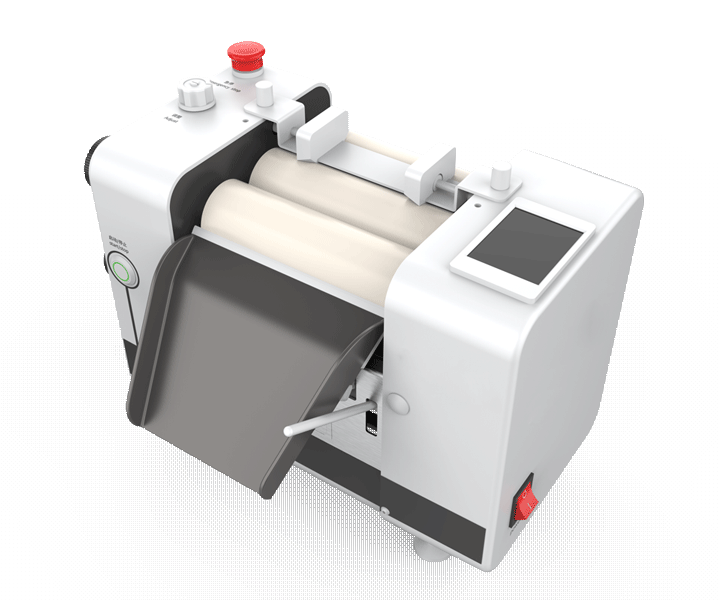
For more details, visit the product page: Three Roll Mill.
References
Похожие продукты
Свяжитесь с нами
Наша профессиональная команда ответит вам в течение одного рабочего дня. Пожалуйста, обращайтесь к нам в любое время!